
 By
By Bad week at the ER. I can't say more than that — partly because of patient privacy, partly because Dr. Reeves and I have agreed that I won't write about specific cases in the blog, not even obliquely. The blog is my cooking space, not my trauma space. Those are different rooms and the door between them stays closed, most of the time. This was a week when the door rattled.
I came home Wednesday after a twelve-hour shift and stood in my kitchen for ten minutes without moving. Not the floor — I didn't go to the floor. I stood. The standing is the difference. The standing is the ten months of therapy and the medication and the boundaries I've built between the ER and everything else. I stood, and then my hands moved the way hands move when the brain is too tired to direct them, and they reached for garlic.
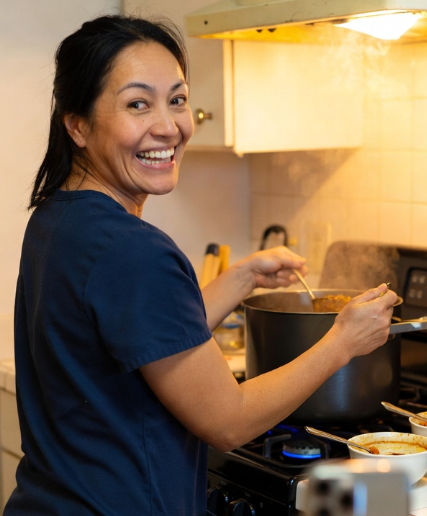
I made adobo. Not because I was hungry. Because the recipe is automatic. Because vinegar and soy sauce and garlic are the ingredients my hands know in the dark. I browned the chicken. I poured the vinegar. I watched it simmer. The act of cooking — the physical, repetitive, sensory act — brought me back from wherever I'd gone, some grey space between the ER and the apartment where the cases live and whisper and I'm learning to make them be quiet.
Angela came over Thursday. She didn't ask what happened — she saw my face and brought ice cream and we sat on the couch and watched a cooking show where beautiful people made beautiful food in beautiful kitchens and nothing was on fire and nobody was dying and the worst thing that happened was a souffle that fell. We watched three episodes. Angela ate most of the ice cream. I ate adobo, reheated, still good.
Friday, therapy. Dr. Reeves adjusted nothing — no medication changes, no new techniques. She just listened. She said, "You stood." I said, "I stood." She said, "That's the work." I said, "The work is exhausting." She said, "Yes." There's a comfort in a therapist who says yes instead of reframing. Sometimes the work is exhausting and the only honest response is agreement. Sometimes you stand in a kitchen and make adobo because your hands refuse to let you fall. Sometimes that's all the poetry there is: you stood. You cooked. You're here. Keep standing.
The adobo I made Wednesday was mine alone—my grandmother’s proportions, my muscle memory—but I wanted to share something in the same spirit: a recipe that asks your hands to stay busy, that rewards you with something sharp and savory and real, that fills the kitchen with enough garlic and heat to crowd out the grey. Kung Pao Chicken isn’t adobo, but it lives in the same emotional zip code—bold, deeply umami, built on soy sauce and aromatics and the satisfying physics of a hot pan. It’s the recipe I make when I need my kitchen to feel like a kitchen again.
Kung Pao Chicken
Prep Time: 15 min | Cook Time: 15 min | Total Time: 30 min | Servings: 4
Ingredients
- For the chicken & marinade:
- 1 1/2 lbs boneless, skinless chicken breasts or thighs, cut into 3/4-inch pieces
- 1 tablespoon soy sauce
- 1 tablespoon Shaoxing wine or dry sherry
- 1 teaspoon cornstarch
- 1/2 teaspoon sesame oil
- For the sauce:
- 3 tablespoons soy sauce
- 2 tablespoons rice vinegar
- 1 tablespoon hoisin sauce
- 1 tablespoon sugar
- 1 teaspoon cornstarch
- 1/2 teaspoon sesame oil
- For the stir-fry:
- 2 tablespoons vegetable oil, divided
- 6–8 dried red chilies (such as Tien Tsin or arbol), stems removed
- 1 teaspoon Sichuan peppercorns (optional, for numbing heat)
- 4 cloves garlic, minced
- 1 teaspoon fresh ginger, minced
- 4 green onions, white and green parts separated, sliced
- 2/3 cup dry roasted peanuts
Instructions
- Marinate the chicken. In a medium bowl, combine the chicken pieces with soy sauce, Shaoxing wine, cornstarch, and sesame oil. Toss to coat evenly and let sit for at least 10 minutes while you prepare the remaining ingredients.
- Make the sauce. In a small bowl, whisk together the soy sauce, rice vinegar, hoisin sauce, sugar, cornstarch, and sesame oil until smooth. Set aside.
- Sear the chicken. Heat 1 tablespoon of vegetable oil in a large wok or heavy skillet over high heat until shimmering. Add the chicken in a single layer and cook without stirring for 2 minutes, until golden on the bottom. Toss and continue cooking 2–3 minutes until cooked through. Transfer to a plate.
- Toast the chilies and peppercorns. Reduce heat slightly and add the remaining 1 tablespoon of oil to the pan. Add the dried chilies and Sichuan peppercorns (if using) and stir-fry for 30–45 seconds until fragrant and the chilies begin to darken. Do not let them burn.
- Build the aromatics. Add the garlic, ginger, and white parts of the green onions to the pan. Stir-fry for 30 seconds until fragrant.
- Bring it together. Return the chicken to the pan and pour the sauce over everything. Toss quickly over high heat for 1–2 minutes until the sauce thickens and coats the chicken evenly.
- Finish and serve. Remove from heat and stir in the peanuts and green parts of the green onions. Serve immediately over steamed white rice.
Nutrition (per serving)
Calories: 390 | Protein: 38g | Fat: 20g | Carbs: 14g | Fiber: 2g | Sodium: 980mg