
 By
By Lourdes is in lockdown. Angela and I enforced it — strict isolation, no visitors, no community events, no church, no Filipino cultural nights, no cooking for crowds. Lourdes hates it with every fiber of her being. She is not a woman built for staying home. She is a woman built for community, for church, for the kitchen at St. Patrick's where she makes lumpia for three hundred and feeds everyone who walks through the door. Taking that away from Lourdes is like taking the water from a fish and explaining that the air is safer.
She calls me six times a day. Not an exaggeration — six. Morning (did I eat breakfast), mid-morning (am I wearing my mask), noon (did I eat lunch), afternoon (am I home from the ER), evening (am I cooking dinner), night (am I going to bed). The calls are a surveillance system disguised as love, and the love is real even if the surveillance is exhausting. I answer every call. Every single one. Because Lourdes is seventy years old and alone in the Mountain View house and the aloneness is harder for her than the virus would be, and the least I can do is answer the phone.
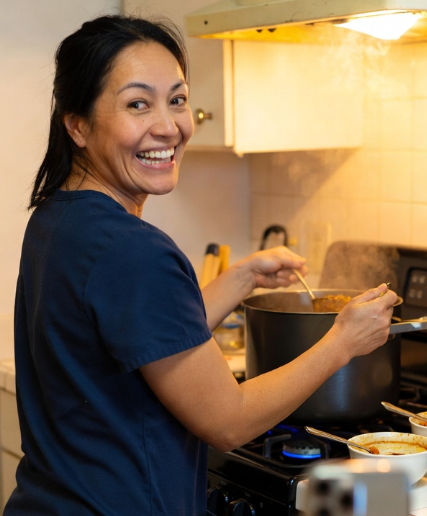
She cooks alone now. She wraps lumpia she can't deliver to anyone. She makes adobo for one. The image of Lourdes cooking for one — Lourdes, who has never cooked for fewer than ten people in her life — is the saddest thing I've imagined in a month that has been full of sad things. I drop groceries on her porch and we talk through the window — her inside, me outside, the glass between us, the glass that is both protection and prison.
I made dinuguan — pork blood stew, the dark, rich, intensely flavored dish that Lourdes makes for special occasions and that I make when I need to cook something that requires my full attention because the full attention keeps me from thinking about the six phone calls and the window conversations and the fact that my mother is on the other side of the glass and the glass is keeping her alive and the alive is worth the glass but the glass is killing me.
The dinuguan was dark and rich and slightly bitter, the way blood stew is — not for the faint, not for the casual, only for those who understand that the best food is sometimes the most difficult food, the food that demands something of you, the food that doesn't apologize for what it is.
I couldn’t share the dinuguan with Lourdes — I couldn’t share anything with her except phone calls and window glass — but I kept cooking anyway, because the stove was the only place that made sense. This kielbasa spinach soup isn’t dinuguan, but it has the same soul: smoky, rich pork, a deep savory broth, the kind of warmth that asks something of you and gives something back. If you’ve ever cooked not to eat, but to feel less helpless, this is that kind of recipe.
Kielbasa Spinach Soup
Prep Time: 15 minutes | Cook Time: 35 minutes | Total Time: 50 minutes | Servings: 6
Ingredients
- 1 lb kielbasa sausage, sliced into 1/4-inch rounds
- 1 tablespoon olive oil
- 1 medium yellow onion, diced
- 4 cloves garlic, minced
- 3 medium carrots, peeled and sliced
- 3 stalks celery, sliced
- 1 can (15 oz) diced tomatoes, with juices
- 1 can (15 oz) white cannellini beans, drained and rinsed
- 6 cups low-sodium chicken broth
- 1 teaspoon smoked paprika
- 1/2 teaspoon dried thyme
- 1/2 teaspoon black pepper
- 1/2 teaspoon salt, or to taste
- 5 oz fresh baby spinach
- 1 tablespoon red wine vinegar
Instructions
- Brown the kielbasa. Heat olive oil in a large heavy-bottomed pot or Dutch oven over medium-high heat. Add the kielbasa slices in a single layer and cook, undisturbed, for 2–3 minutes until browned on one side. Flip and brown the other side, then transfer to a plate and set aside.
- Build the base. Reduce heat to medium. In the same pot, add the diced onion and cook, stirring occasionally, for 4–5 minutes until softened and translucent. Add the garlic and cook 1 minute more until fragrant.
- Add the vegetables. Stir in the carrots and celery. Cook for 3–4 minutes, scraping up any browned bits from the bottom of the pot.
- Add liquids and seasoning. Pour in the chicken broth and diced tomatoes with their juices. Stir in the smoked paprika, thyme, black pepper, and salt. Bring to a boil over high heat.
- Simmer. Return the browned kielbasa to the pot along with the drained cannellini beans. Reduce heat to medium-low, cover partially, and simmer for 20 minutes until carrots are tender and the broth has deepened in flavor.
- Finish with spinach. Remove from heat and stir in the baby spinach in two or three handfuls, letting each addition wilt before adding the next. Stir in the red wine vinegar. Taste and adjust salt and pepper as needed.
- Serve. Ladle into bowls and serve hot, with crusty bread alongside if desired.
Nutrition (per serving)
Calories: 320 | Protein: 16g | Fat: 18g | Carbs: 22g | Fiber: 5g | Sodium: 890mg