
 By
By The pandemic is here. Not approaching, not threatening, not on the news from somewhere else. Here. In Phoenix. In my station. In my house. In the space between my family and everything I cannot control.
The fire department has shifted to pandemic operations. We are not just fighting fires anymore — we are responding to a public health crisis that does not have edges, that does not have a perimeter you can set up around, that does not have a knockdown point where someone says "fire is out." This fire is everywhere and it is invisible and it does not care about my PPE or my training or my fourteen years on the job.
The calls: respiratory distress. Difficulty breathing. Coughing, fever, fear. We are rolling on calls that used to be routine medical — shortness of breath, chest tightness — and now every one of them might be COVID. The N95 is on before we exit the truck. The gown is on before we enter the house. The decontamination is thorough, obsessive, a ritual that replaces the casual "wipe down the equipment" with a systematic scrubbing that takes twenty minutes and feels like penance.
I cannot hug my kids when I come home from shift. Jessica set up a decontamination station in the garage: strip off the uniform, bag it, shower immediately, do not touch the children until you are clean. Sofia stood at the garage door on Wednesday and watched me strip down and she said, "Daddy, why can you not hug me?" I said, "Because I have to be careful, mija. I am keeping you safe." She said, "I do not feel safe." And my heart broke into a number of pieces that I have not finished counting.
Diego does not understand. He runs to me when I come home and I have to redirect him to Jessica while I decontaminate, and he screams "DADDY" and reaches for me and I walk past him into the garage and the sound of his voice calling me while I cannot hold him is the worst sound in the world. Worse than the fire alarm. Worse than anything.
I am cooking. Of course I am cooking. It is the only thing I can do that makes sense. The freezer meals are rotating out — one per night, replaced by new batches on my days off. I made a massive pot of green chile stew on Tuesday and portioned it into fourteen containers: four for us, four for my parents (dropped on the porch, no contact), two for the firehouse, and four for elderly parishioners from church who cannot go out. Jessica calls it "drive-by feeding." I call it the only useful thing I can do with my hands besides fight a fire I cannot see.
The Sunday cookout did not happen. The first Sunday in thirty-two years with no smoke rising from Roberto's grill. I called him at noon — the hour we would normally be standing side by side, flipping meat, watching the smoke. He answered and said, "The grill is cold, mijo." I said, "It will not be cold forever." He said, "I know." But his voice said something else. His voice said: I am sixty-two years old and I am afraid.
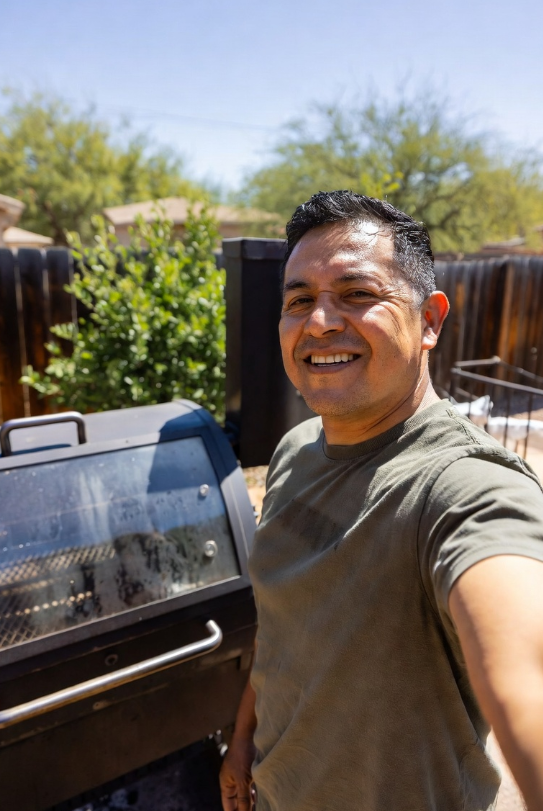
I stood in my backyard at sunset and lit the charcoal. Not to cook — there was nothing to cook, the stew was already done, the family was already fed. I lit the charcoal because the fire needed to be lit. Because somewhere in Maryvale, the cinder block grill was cold, and somewhere in my backyard, the fire could still burn, and the smoke could still rise, and the signal could still go up: we are here. We are still here. The coals are not out.
This is the chili I make when my hands need something real to do. During those early pandemic shifts — the decontamination rituals, Diego screaming “DADDY” from the doorway, Sofia telling me she didn’t feel safe — I needed to cook something that scaled, something I could ladle into fourteen containers and drive across the city and leave on porches without knocking, and know that people were fed even if I couldn’t sit at the table with them. A deep, slow chili like this one does that work. It keeps, it travels, it reheats on a Tuesday night when someone’s too tired or too afraid to cook for themselves. Jessica started calling it drive-by feeding; I just call it the one thing I could still do right.
Kentucky Chili
Prep Time: 20 minutes | Cook Time: 1 hour 30 minutes | Total Time: 1 hour 50 minutes | Servings: 14
Ingredients
- 2 lbs ground beef (80/20)
- 1 lb ground pork
- 2 medium yellow onions, diced
- 1 green bell pepper, diced
- 4 cloves garlic, minced
- 2 cans (15 oz each) kidney beans, drained and rinsed
- 2 cans (15 oz each) diced tomatoes, with juices
- 1 can (15 oz) tomato sauce
- 1 cup beef broth
- 3 tablespoons chili powder
- 1 tablespoon ground cumin
- 1 teaspoon smoked paprika
- 1 teaspoon dried oregano
- 1/2 teaspoon cayenne pepper (adjust to taste)
- 1 teaspoon salt, plus more to taste
- 1/2 teaspoon black pepper
- 2 tablespoons olive oil
- 1 tablespoon Worcestershire sauce
- 1 tablespoon apple cider vinegar
Instructions
- Brown the meat. Heat olive oil in a large stockpot or Dutch oven over medium-high heat. Add ground beef and pork. Cook, breaking up with a wooden spoon, until browned and no pink remains, about 10 minutes. Drain off excess fat, leaving about 1 tablespoon in the pot.
- Soften the aromatics. Reduce heat to medium. Add onions and bell pepper to the pot. Cook, stirring occasionally, until softened and translucent, about 7 minutes. Add garlic and cook 1 minute more until fragrant.
- Bloom the spices. Add chili powder, cumin, smoked paprika, oregano, cayenne, salt, and black pepper directly to the meat and vegetable mixture. Stir well and cook for 2 minutes, letting the spices toast slightly in the fat.
- Build the base. Pour in diced tomatoes (with their juices), tomato sauce, beef broth, and Worcestershire sauce. Stir to combine, scraping up any browned bits from the bottom of the pot.
- Add the beans. Stir in the drained kidney beans. Bring the pot to a boil over medium-high heat, then reduce to a low simmer.
- Simmer low and slow. Cook uncovered, stirring occasionally, for at least 1 hour. The chili should reduce and thicken. For a deeper flavor, simmer up to 90 minutes. Add a splash of beef broth if it becomes too thick.
- Finish and adjust. Stir in apple cider vinegar. Taste and adjust salt, cayenne, and chili powder as needed. The vinegar brightens the whole pot — don’t skip it.
- Portion for storage or serving. Ladle into bowls to serve immediately, or divide into quart-size containers (roughly 1 to 1 1/4 cups per container) for freezer storage or delivery. Keeps in the refrigerator up to 5 days, frozen up to 3 months. Reheat on the stovetop over medium-low or in the microwave in 2-minute intervals.
Nutrition (per serving)
Calories: 310 | Protein: 24g | Fat: 14g | Carbs: 22g | Fiber: 6g | Sodium: 620mg