
 By
By Halloween approaches and Alaska does Halloween differently. The kids trick-or-treat in parkas over their costumes, the carved pumpkins freeze solid on the porches, and the darkness — already deep, sunset at 6:30 PM now — makes the whole holiday feel less like a celebration and more like the season finally dropping its pretense. You want scary? Try driving to work at 8 AM in full darkness on ice-covered roads. The ghosts are redundant.
Angela invited me over to help with costumes for her neighbor's kids — Angela doesn't have her own children yet, but she mothers everything in radius, which is how she ended up decorating three-year-old Tyler's Spiderman costume with reflective tape so he'd be visible to traffic. Practical. Angela is always practical. It's her superpower and occasionally her limitation, but tonight it was just love expressed in safety tape.
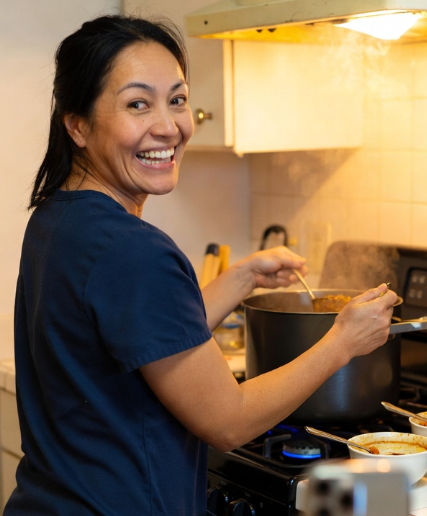
I made kalamay for the gathering — Filipino rice cake, sticky and sweet, made from glutinous rice flour, coconut milk, and brown sugar. You cook it in a pan, stirring constantly — and I mean constantly, the way you monitor a critical patient, no breaks, no distraction — until the mixture thickens into a glossy, caramel-colored mass that pulls away from the sides of the pan. Then you pour it into a dish, let it cool, and cut it into squares that are chewy and sweet and taste like coconut and burned sugar and patience.
Kalamay is a test of your attention. You cannot walk away. You cannot check your phone. You stand and stir and the mixture transforms beneath your spatula from liquid to solid, from pale to dark, and if you stop stirring it burns and if you stir too fast it spatters. It requires the kind of focused, sustained attention that the ER requires but without the consequences — no one dies if your kalamay burns. They just don't get dessert.
I brought the kalamay to Angela's and the neighborhood kids ate it with the enthusiasm of children who don't know what they're eating and don't care, because sugar is sugar and kids are the most honest food critics alive. Tyler the Spiderman ate three pieces. His mother asked for the recipe. I said, "It's my mom's." She said, "Your mom is a genius." I said, "I know. Don't tell her. She's already impossible."
I drove home in the dark — five PM dark, the kind that Alaska serves without apology — and the road was slick and the mountains were invisible and my car smelled like coconut and brown sugar. The darkness is here. I'm in it. But I have kalamay and therapy and a sister who puts reflective tape on tiny Spiderman costumes, and that's not nothing. That's actually quite a lot.
My mom’s kalamay is the recipe I reach for when I need to remember that some things are simple and good and just require your full attention — no more, no less. After a week of five PM darkness and the specific exhaustion of caring for people in crisis, I needed something that would ask something of me without asking everything. Here’s how she makes it, which is now how I make it.
Kalamay (Filipino Coconut Sticky Rice Cake)
Prep Time: 10 minutes | Cook Time: 45 minutes | Total Time: 55 minutes | Servings: 16 squares
Ingredients
- 2 cups glutinous rice flour (malagkit)
- 1 can (13.5 oz) full-fat coconut milk
- 1 can (13.5 oz) coconut cream
- 1 1/2 cups dark brown sugar, packed
- 1/4 teaspoon fine salt
- 1 tablespoon neutral oil or softened butter, for greasing the pan
- Toasted sesame seeds or latik (coconut curds), for topping — optional
Instructions
- Prepare your pan. Lightly grease an 8x8-inch baking dish or a round 9-inch cake pan with oil or butter. Set aside.
- Make the base mixture. In a heavy-bottomed saucepan or wide nonstick skillet, whisk together the glutinous rice flour, coconut milk, coconut cream, brown sugar, and salt until completely smooth with no lumps remaining.
- Cook low and slow. Place the pan over medium-low heat. Begin stirring continuously with a wooden spoon or heatproof silicone spatula, scraping the bottom and sides of the pan. Do not stop stirring — this is non-negotiable. Kalamay burns quickly if left unattended.
- Watch the transformation. After about 20 minutes, the mixture will begin to thicken noticeably. Continue stirring. After 35–45 minutes total, the mixture should be very thick, glossy, and deep caramel in color. It will pull away cleanly from the sides of the pan and hold its shape briefly when you drag the spatula through it.
- Transfer and cool. Immediately pour and scrape the hot kalamay into your prepared pan, smoothing the top with a wet spatula. If using sesame seeds or latik, scatter them over the surface now. Let the kalamay cool completely at room temperature, at least 1 hour, before cutting.
- Cut and serve. Once fully cooled and set, run a lightly oiled knife around the edges and cut into squares. Kalamay is served at room temperature. Pieces can be wrapped individually in wax paper or banana leaf for traditional presentation.
Nutrition (per serving)
Calories: 210 | Protein: 2g | Fat: 9g | Carbs: 32g | Fiber: 0g | Sodium: 45mg