
 By
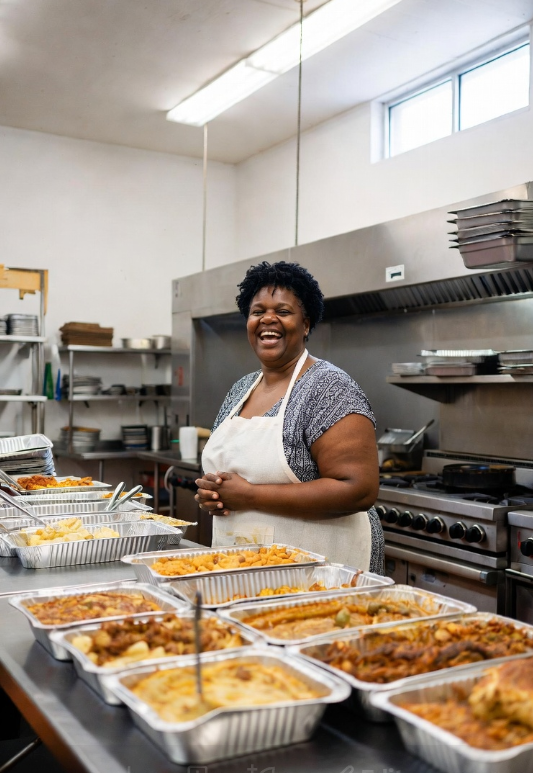
By The heat broke for exactly two days this week — Tuesday and Wednesday the temperature dropped to the low eighties and a breeze came through like an apology from the weather — and I used those two days to cook like the world was ending. When the heat breaks in Alabama, you do not waste it. You cook everything you have been putting off, everything that requires the oven, everything that turns the kitchen into a furnace. I roasted a whole chicken on Tuesday with root vegetables and made enough for three meals. Wednesday I baked: two sweet potato pies, a pound cake, and three pans of cornbread that I wrapped and froze for the church kitchen.
Thursday the heat came back like it had only stepped out for a cigarette, and I was back to cold salads and iced tea and standing in front of the open refrigerator for longer than is necessary, which is my summer coping mechanism and I am not ashamed.
Visited Daddy at the nursing home on Saturday. He was having a quiet day — the kind where he sits in his wheelchair by the window and watches the parking lot like it is showing him something nobody else can see. I brought sweet potato pie, fresh from this week's baking. He ate a slice. His hands trembled on the fork but the fork found his mouth every time, because muscle memory is the last thing to leave and eating is the most practiced muscle of all. He did not say anything. He did not recognize me. But he ate the pie, and somewhere in the eating I have to believe he tasted Mama, tasted home, tasted the kitchen in Bessemer where everything made sense.
Destiny went back to UAB for summer session on Monday. The house is quieter without her, the way a room is quieter when you turn off music you did not realize was playing. I miss her already. I sent her back with four containers of food and a pound cake wrapped in foil and instructions to call me when she gets there, which she did, because Simms children call their mother. It is not optional.
Marcus is still working at the hardware store. He has saved two hundred dollars toward college, which he announced at dinner with the pride of a man who has earned his first honest money. I made oxtails to celebrate — braised low and slow in a gravy so rich it could apply for a bank loan. He ate three servings. That boy and food have an understanding that I recognize because it is my understanding too: food is love made visible, and Marcus has always been hungry for both.
That night, watching Marcus eat his third bowl of oxtails with the kind of satisfaction that has nothing to do with hunger and everything to do with being seen, I knew I wanted to stay in that feeling a little longer—slow-cooked, rich, unhurried. Italian pot roast has that same spirit: it asks you to be patient, to let the heat do its work, to trust that something good is happening even when you can’t see it. Here’s how I made it.
Italian Pot Roast
Prep Time: 20 minutes | Cook Time: 4 hours | Total Time: 4 hours 20 minutes | Servings: 6
Ingredients
- 3 to 4 pounds beef chuck roast
- 2 teaspoons kosher salt, plus more to taste
- 1 teaspoon black pepper
- 1 teaspoon garlic powder
- 1 teaspoon dried Italian seasoning
- 3 tablespoons olive oil
- 1 medium yellow onion, roughly chopped
- 4 garlic cloves, smashed
- 2 stalks celery, chopped
- 2 medium carrots, chopped
- 1/3 cup sun-dried tomatoes in oil, drained and roughly chopped
- 2 tablespoons tomato paste
- 1/2 cup dry red wine (or beef broth)
- 1 can (14.5 oz) crushed tomatoes
- 1 1/2 cups beef broth
- 2 sprigs fresh rosemary (or 1/2 teaspoon dried)
- 2 bay leaves
- 1 tablespoon balsamic vinegar
Instructions
- Season the roast. Pat the chuck roast completely dry with paper towels. Combine the salt, pepper, garlic powder, and Italian seasoning and rub the mixture all over the meat. Let it sit at room temperature for 15 to 20 minutes while you prep the vegetables.
- Sear on all sides. Heat the olive oil in a large Dutch oven over medium-high heat until shimmering. Add the roast and sear without moving it for 4 to 5 minutes per side, including the edges, until a deep brown crust forms all over. Remove the roast and set aside.
- Build the base. Reduce heat to medium. Add the onion, celery, and carrots to the same pot and cook, stirring occasionally, for about 5 minutes until softened. Add the garlic and sun-dried tomatoes and cook another 2 minutes. Stir in the tomato paste and let it cook against the bottom of the pot for 1 to 2 minutes until it darkens slightly.
- Deglaze and add liquid. Pour in the red wine and scrape up every bit of the browned fond from the bottom of the pot — that is where the flavor lives. Add the crushed tomatoes, beef broth, rosemary, and bay leaves. Stir to combine.
- Braise low and slow. Nestle the roast back into the pot. The liquid should come about halfway up the sides of the meat. Bring to a gentle simmer, then cover tightly and transfer to a 300°F oven. Braise for 3 1/2 to 4 hours, turning the roast once halfway through, until the meat is completely fork-tender and beginning to fall apart.
- Finish the gravy. Remove the roast to a cutting board and tent loosely with foil. Discard the bay leaves and rosemary sprigs. If the braising liquid is thin, simmer it uncovered on the stovetop over medium heat for 8 to 10 minutes until it reduces into a rich, glossy gravy. Stir in the balsamic vinegar and taste for salt.
- Serve. Slice or pull the roast apart into large chunks and return it to the pot, spooning the gravy generously over the top. Serve over mashed potatoes, egg noodles, or white rice with plenty of gravy and cornbread on the side.
Nutrition (per serving)
Calories: 480 | Protein: 45g | Fat: 26g | Carbs: 12g | Fiber: 2g | Sodium: 680mg