
 By
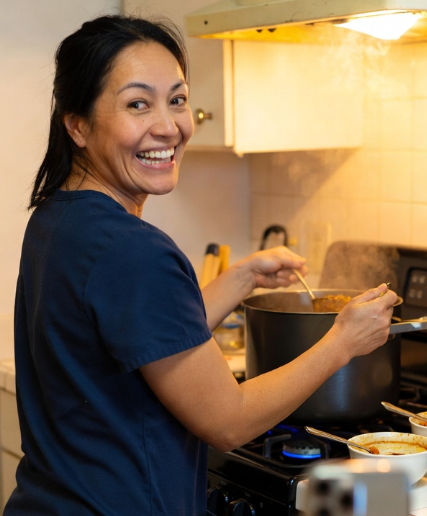
By It is four in the morning and I am standing at my stove in a too-big University of Alaska sweatshirt and socks that don’t match, watching garlic turn gold in a pan of hot oil. The kitchen window is black. Outside, it’s maybe fifty-five degrees, which is July in Anchorage—not cold, not warm, just a particular Alaskan gray that never fully resolves. The mountains are out there somewhere in the dark. I know because they’re always there. That’s the thing about Alaska: the landscape is permanent even when you can’t see it. Same as memory. Same as the smell of adobo, which is already starting to rise from the pan and fill this small kitchen in a way that makes it feel like a completely different room.
My name is Grace Santos. I’m twenty-seven years old. I’m an emergency room nurse at Providence Alaska Medical Center, and I have been on leave for the past several weeks for reasons that I will get to, because that’s why we’re here. I’m not going to make you work for it. The short version: I fell apart. The longer version: I’ve been putting myself back together, one pot of adobo at a time, and I wanted to write that down somewhere before I forgot what it felt like to need it this badly.
I grew up in Mountain View, which is one of Anchorage’s oldest neighborhoods and one of the most diverse places in America—not that any magazine ever ran that feature, because it was also one of the poorer neighborhoods, and America tends to celebrate diversity when it’s decorative and ignore it when it’s just people trying to survive. My parents were Filipino immigrants. My dad, Reynaldo, came over first in 1982, following a chain of Lourdes’s relatives who’d come to Alaska for the fishing industry, the military, the hospitals. He was a radiology technician at the Alaska Native Medical Center. My mom, Lourdes, was a home health aide who drove to her patients through ice and darkness in temperatures that made the Philippines seem like another planet, which it was. They built a life in a ranch house on a street where you could hear Tagalog and Samoan and Hmong and Spanish all in the span of a single walk to the corner store.
My mother cooked the way Filipino mothers cook: constantly, generously, and in quantities that assumed at least twice as many people would show up as were actually invited. The kitchen was the center of the house. It was never quiet and it was never cold. Adobo was always in rotation—on the stove, in the fridge as leftovers that somehow tasted better the next day, made in batches that could feed a block. Adobo is the national dish of the Philippines. It is also the recipe every Filipino family will defend to the death, because every family makes it slightly differently and every family is correct. My mother’s version was simple: chicken, soy sauce, vinegar, garlic, bay leaves. Five things. One pot. An hour, if you weren’t rushing. Twenty minutes if you were, which she often was, because there were four of us kids and a husband who worked long shifts and a house that required constant maintenance to keep from sliding into chaos.
I am the eldest. Mark came after me, then Angela, then Joseph, who we called the baby until he turned six feet tall and started working on a fishing boat in Kodiak, which my mother considers a personal attack. The eldest daughter in a Filipino family is part older sister, part second mother, part family diplomat. I changed diapers. I helped with homework. I cooked dinner when Lourdes worked late—first under her supervision, then alone, and eventually with enough confidence to riff on the recipes, to add a little more vinegar here, more garlic there, to understand that adobo is less a fixed recipe than a philosophy. Acid. Salt. Fat. Heat. Time. Everything else is commentary.
My dad died in 2008. He had Type 2 diabetes, which is common in Filipinos—something about the interaction of genetics and the Western diet that nobody warned his generation about. The diabetes led to kidney disease. Kidney disease led to dialysis, three times a week, four hours a session. I was fifteen when he was diagnosed and nineteen when he died, and the years between were a long, slow lesson in how a body can fail while the person inside it keeps trying to be present for everyone around him. My dad came to my high school graduation on dialysis days. He sat in that chair, connected to a machine that was doing the work his kidneys couldn’t do, and he still asked about my grades and teased me about boys and made sure everyone in the family ate enough. That’s a particular kind of strength. I think about it every time I’m in the ER, holding someone’s hand while their body fails them. I think: my dad did this. He did it without complaint. I can at least not flinch.
I became a nurse because of him, and because of the nurses who cared for him. I went to nursing school at the University of Alaska Anchorage and graduated in 2010 and went straight to the ER, which is where the hardest cases end up and, I discovered, where I was built to work. I’m calm under pressure. I’m fast. I can hold a patient’s hand while doing four other things with the rest of my body and my brain. I’m good at the job. I want to be very clear about that, because what happened to me this spring doesn’t change whether I’m good at the job. It just means I’m human, which the ER has a way of making you forget.
The trauma accumulates. That’s what my therapist told me, and it’s the truest thing anyone has said to me in years. It doesn’t hit you all at once. It comes in shifts, in individual moments that seem manageable and then, at some point, stop being manageable. A car accident victim who doesn’t make it. A child who came in and shouldn’t have had to. The overdoses, the gunshot wounds, the domestic violence cases where you patch someone up knowing they’re going back. Six years of that. I thought I was handling it. I was not handling it. I was performing handling it, which is different, and which costs more than you realize until the invoice comes due.
The invoice came due in April. I finished a twelve-hour shift, drove home, sat down on my kitchen floor, and could not get up. Not because I was hurt. Not because I was tired in the normal way. I just—couldn’t. I sat there for three hours. I called in sick the next day. And the next. My sister Angela came over on the fourth day and found me still on the floor, not eating, not sleeping, just existing in a way that wasn’t really existing. She drove me to a therapist. The therapist diagnosed me with PTSD. I am twenty-seven years old and I have the psychological profile of a combat veteran, which makes sense when you think about what an ER is, and which I had never once thought about until someone put a name to it.
I took a leave of absence. I started therapy. I started medication. And then, before any of it had fully taken hold, I started cooking.
I don’t know why the cooking came first. Maybe because the body knows things before the brain catches up. Maybe because I’d watched my mother cook through every hard thing in her life—through my dad’s illness, through his death, through the grief that followed—and somewhere in my cells, cooking had become synonymous with survival. The first thing I made was adobo. My mother’s recipe, which is the same as her mother’s recipe and probably her mother’s before that, reaching back across generations to a kitchen in Iloilo that I have never seen but that somehow lives in my hands. I browned the chicken. I added the vinegar and the soy sauce and the garlic and the bay leaves. I let it braise. The smell that filled my kitchen was so specific, so exactly right, so completely the smell of my childhood, that I started crying and then couldn’t stop. I cried through the whole hour of cooking. I ate the adobo at my kitchen table, alone, at eleven o’clock at night, and I felt, for the first time since the floor, like a person again.
I’ve made it probably forty times since then. Each time is different. Sometimes I cry. Sometimes I don’t. Sometimes I think about my dad and sometimes I just think about the garlic. But it always works. The rhythm of the cooking—the chopping, the browning, the braising, the waiting—does something to my nervous system that I cannot clinically explain but that feels like what meditation is supposed to feel like and never does for me. It quiets the noise. It puts me in my body in a way that the ER, paradoxically, does not. In the ER, I am a machine executing tasks. In my kitchen, I am a daughter making her mother’s recipe, and that is a much easier thing to be.
I’m going back to the ER next month. I’m not entirely ready and I’m going anyway, because I have learned, in twenty-seven years, that readiness is mostly a story we tell ourselves to justify delay. You show up. You do the work. You go home and make adobo and let the vinegar and garlic remind you that you are still here, still connected to something that predates the hospital and the shifts and the accumulated weight of other people’s emergencies.
I’m writing this because the cooking saved me and I want to write that down somewhere it can be found. Not to be dramatic. Because I think there are other people on kitchen floors, metaphorically or literally, who need to know that five ingredients and an hour can constitute a form of medicine. Because my mother cooked through every hard thing and her mother cooked through every hard thing and I am the eldest daughter and this is what we do.
Start with garlic. The rest will follow.
This is the recipe I made the night I decided to go back—the one that sat in the oven turning golden while I sat at the table and let myself feel something other than tired. I didn’t plan it; I just had chicken and a box of pastina and a need to put my hands on something warm. It bakes like a casserole your lola would approve of—bread crumbs on top, mozzarella pulling in long strings when you break through the crust—and it asked almost nothing of me, which was exactly what I had to give. Here’s how I make it.
Italian Baked Chicken and Pastina
Prep Time: 20 min | Cook Time: 30 min | Total Time: 50 min | Servings: 4
Ingredients
- 1 cup pastina pasta (or any small pasta — I used cellantani)
- 2 tablespoons olive oil
- 1/2 cup cubed chicken breast (1-inch cubes)
- 1/2 cup diced onion (about 1/2 a small onion)
- 1 clove garlic, minced
- 1 (14.5-ounce) can diced tomatoes with juice
- 1 cup shredded mozzarella
- 1/4 cup chopped fresh flat-leaf parsley
- 1/4 teaspoon kosher salt
- 1/4 teaspoon freshly ground black pepper
- 1/4 cup bread crumbs
- 1/4 cup grated Parmesan
- 1 tablespoon butter, plus more for buttering the baking dish
Instructions
- Preheat. Preheat the oven to 400 degrees F.
- Cook the pasta. Bring a medium pot of salted water to a boil over high heat. Add the pasta and cook until just tender, stirring occasionally, about 5 minutes. Drain pasta into a large mixing bowl.
- Sear the chicken. Meanwhile, put the olive oil in a medium saute pan over medium heat. Add the chicken and cook for 3 minutes.
- Add onions and garlic. Add the onions and garlic, stirring to combine, and cook until the onions are soft and the chicken is cooked through, about 5 minutes more. Put the chicken mixture into the bowl with the cooked pasta.
- Assemble the bake. Add the canned tomatoes, mozzarella cheese, parsley, salt, and pepper. Stir to combine. Place the mixture in a buttered 8 by 8 by 2-inch baking dish. In a small bowl mix together the bread crumbs and the Parmesan cheese. Sprinkle over the top of the pasta mixture.
- Bake until golden. Dot the top with small bits of butter. Bake until the top is golden brown, about 30 minutes.
Nutrition (per serving)
Calories: 380 kcal | Protein: 17g | Fat: 21g | Saturated Fat: 8g | Carbs: 32g | Fiber: 3g | Sugar: 5g | Cholesterol: 46mg | Sodium: 647mg