Mamma called Tuesday morning at 10 AM, as she always does, as she has done since she had a phone of her own in 1953. She wanted to know what I was making for dinner. The question matters to her in a way that I now understand at sixty-eight in a way I did not understand at thirty. The asking is the love. The answering is the love. The conversation is the bridge across the days. We talked for nineteen minutes. Mamma is ninety. The phone calls are precious and finite. I do not waste them.
Anna sent photos from Minneapolis — the kids in their school uniforms, David's new bookshelf, the dog (their dog, not mine; their dog is named Cooper, and Cooper is a Bernese mountain dog who weighs more than Anna and who is, by all accounts, the most relaxed dog in the upper Midwest). I printed three of the photos and put them on the fridge. The fridge holds the family that is not currently in the kitchen.
Elsa called from Voyageurs. She had a sighting of a wolf — a single gray adult crossing a frozen bay at dawn, fifty yards from her cabin. She had a sighting of a moose two days later. She is happy in the woods. I am glad someone in this family is happy in the woods. I have always loved Lake Superior, but the deeper woods are not for me. Elsa is for the deeper woods. The match is right.
I cooked Wild rice soup (always) this week. The Thursday constant. The soup does not respect the calendar.
Damiano Center, Thursday. New volunteer this week — a young woman named Sara, just out of college, looking lost and brave. I showed her how to ladle. She caught on quickly. She asked me how long I had been doing this. I said: "Long enough that I do not count." She laughed. She will be back. The good ones come back.
Paul's chair is at the head of the table. His glasses are on the shelf. The arrangement is permanent. The arrangement is the love. The arrangement has been remarked on, gently, by various people over the years — Anna, mostly, and well-meaning friends. The arrangement persists. I do not require justification for it. The chair is the chair.
It is enough. It has to be. And on a morning like this, with the lake doing what the lake does and the dog at my feet and the bread on the counter and the kitchen warm enough to live in, it is.
I have started, in the last few years, to think about what I will leave behind. Not in a morbid way. In a practical way. The recipes are written down. The notebook is on the counter. The kitchen is in good order. The house is in Anna's name (we did the legal work in 2032; the kids agreed; it was the practical thing). The grandchildren and great-grandchildren each have a few small specific things — a wooden spoon, a bread pan, a particular cast iron skillet — that I have already labeled with their names on small pieces of masking tape. Nobody knows about the masking tape labels. They will find them when they find them.
Paul used to say that the difference between a place and a home was that a home was a place where you knew, from any room, what was happening in any other room. I knew, from the kitchen, when he was reading in the living room. I knew, from the bedroom, when he was getting coffee in the kitchen. The Kenwood house is still that kind of home. From the kitchen I know that Sven is asleep on his bed in the dining room (the small specific snore). From the kitchen I know what time the radio in the living room is set to come on. The home is the body of knowledge of itself. I still live inside that body of knowledge, even though Paul is not the one creating most of the data anymore.
It is enough.
The bread I mentioned — the one on the counter — was Irish soda bread, as it has been most Thursdays for longer than I can properly account for. It is not the soup (the soup is its own thing, and the soup does not need explaining), but it is the bread that sits beside it, and beside the coffee in the morning, and beside whatever the day requires. Irish soda bread because it comes together without planning, without yeast, without waiting — and some weeks, waiting is the one thing I cannot afford. Paul liked it toasted, with butter, at seven in the morning. Sven likes it plain, on the floor beside his bed, which is not a thing I allow but which has happened. The loaf is on the counter. That is the fact of it.
Irish Soda Bread
Prep Time: 10 minutes | Cook Time: 45 minutes | Total Time: 55 minutes | Servings: 8
Ingredients
- 4 cups all-purpose flour, plus more for dusting
- 1 teaspoon baking soda
- 1 teaspoon salt
- 1 3/4 cups cold buttermilk
- 1 tablespoon unsalted butter, melted (optional, for brushing)
Instructions
- Heat the oven. Preheat your oven to 425°F. Lightly flour a baking sheet or line it with parchment paper.
- Mix the dry ingredients. In a large bowl, whisk together the flour, baking soda, and salt until evenly combined.
- Add the buttermilk. Make a well in the center of the flour mixture and pour in the cold buttermilk. Stir with a wooden spoon or your hands just until the dough comes together — it will be shaggy and slightly sticky. Do not overwork it.
- Shape the loaf. Turn the dough out onto a lightly floured surface and gently shape it into a round, roughly 8 inches across. Place it on the prepared baking sheet. Using a sharp knife, cut a deep X across the top of the loaf, about 1 inch deep. This allows the center to bake through.
- Bake. Bake at 425°F for 15 minutes, then reduce the heat to 400°F and continue baking for 25 to 30 minutes more, until the loaf is deep golden brown and sounds hollow when tapped on the bottom.
- Cool before cutting. Transfer to a wire rack and let the loaf cool for at least 15 minutes before slicing. Brush the top with melted butter while still warm, if desired.
Nutrition (per serving)
Calories: 245 | Protein: 8g | Fat: 2g | Carbs: 49g | Fiber: 2g | Sodium: 480mg
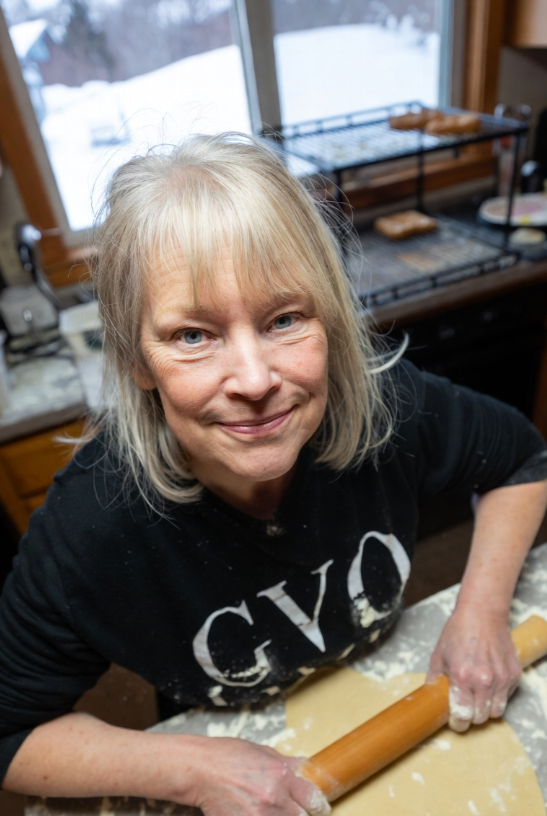
About the cook who shared this
Linda Johansson
Week 434 of Linda’s 30-year story
· Duluth, Minnesota
Linda is a sixty-three-year-old retired nurse from Duluth, Minnesota, living alone in the house where she raised her children and said goodbye to her husband. She lost Paul to ALS in 2020 after two years of watching the kindest man she'd ever known lose everything but his dignity. She cooks Scandinavian comfort food and Minnesota hotdish and the pot roast Paul loved, and she sets two places at the table out of habit because it makes her feel less alone. Every recipe she writes is a person she's loved.
