August. Two children. The specific chaos of a three-year-old and a six-week-old coexisting in the same house — one who talks constantly and one who cries constantly, creating a stereo experience that is neither restful nor quiet.
Anaya has become Rohan's narrator. She follows him around ("follows" — he's in a bouncer, he's not going anywhere) and provides commentary: "Baby is awake. Baby is looking at the light. Baby is making a face. Baby smells bad. AMMA, BABY SMELLS BAD."
The baby does, frequently, smell bad. This is his primary superpower.
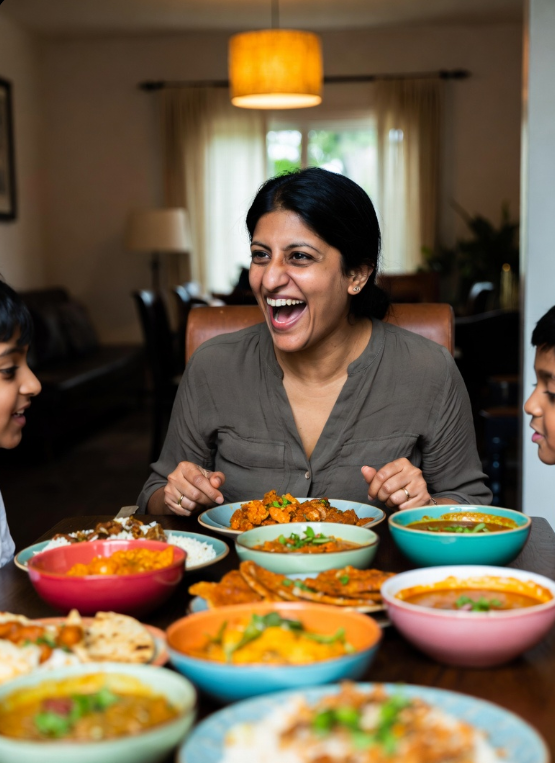
I'm cooking again — not the survival cooking of the first weeks but real cooking, with intention and spices and the five-burner range doing what it was designed for. The maternity leave cooking has become my practice: every afternoon, while Amma watches both kids, I cook. One recipe per day. One dish from the leather journal or the blog archives or the book manuscript.
I'm testing every recipe in the book. Every measurement, every technique, every "generous pinch" — I'm cooking them all, verifying them, making sure they work when someone who isn't Amma follows them. The book needs to be replicable. The recipes need to travel from my kitchen to a stranger's kitchen and produce something recognizable.
I made Amma's vathal kuzhambu on Tuesday. The sun-dried vegetable curry. I followed the recipe in the journal exactly — my notes, my measurements (translated from Amma's handfuls into actual quantities). It worked. The kuzhambu tasted right. A stranger could make this.
This is the test: can the recipe survive without the cook? Can Amma's sambar exist in a book, made by hands that aren't hers, in kitchens she'll never see? Can a generous pinch be captured in words?
I believe it can. That's why I'm writing the book. That's why every recipe is tested, tasted, verified.
The food doesn't need Amma's hands to be Amma's food. It needs Amma's intention. And intention can be written down.
I think.
The vathal kuzhambu passed its test on Tuesday, but it wasn’t the only recipe I ran through that week — every afternoon I was back at the stove, verifying that the journal’s measurements held. These Indian Ginger Potatoes were one of those tests: simple enough to be unforgiving, spiced enough to matter, the kind of dish where a careless hand with the turmeric announces itself immediately. They worked. The ginger cuts through in exactly the right place, the way a well-written recipe should — present, purposeful, unmistakable even in a kitchen Amma has never set foot in.
Indian Ginger Potatoes
Prep Time: 10 minutes | Cook Time: 25 minutes | Total Time: 35 minutes | Servings: 4
Ingredients
- 1 1/2 lbs baby potatoes or Yukon Gold potatoes, cut into 1-inch pieces
- 2 tablespoons neutral oil (such as avocado or sunflower)
- 1 teaspoon cumin seeds
- 1 tablespoon fresh ginger, finely grated
- 3 cloves garlic, minced
- 1/2 teaspoon turmeric powder
- 1 teaspoon ground coriander
- 1/2 teaspoon red chili powder (or to taste)
- 3/4 teaspoon salt, plus more to taste
- 1 tablespoon fresh lemon juice
- 2 tablespoons fresh cilantro, chopped
Instructions
- Boil the potatoes. Place the potato pieces in a medium saucepan, cover with cold salted water, and bring to a boil over high heat. Cook for 10–12 minutes until just tender when pierced with a fork — they should hold their shape. Drain and set aside.
- Bloom the cumin. Heat the oil in a large skillet over medium-high heat. Add the cumin seeds and let them sizzle for 30–45 seconds until fragrant and a shade darker. Do not walk away — they go from toasted to burnt quickly.
- Build the base. Add the grated ginger and minced garlic to the skillet. Stir constantly for 1 minute until the raw smell softens and the mixture begins to turn golden at the edges.
- Add the dry spices. Reduce heat to medium. Add the turmeric, coriander, and chili powder, stirring for 30 seconds to coat the aromatics and toast the spices in the oil. If the pan looks dry, add a splash of water to prevent scorching.
- Add the potatoes. Add the drained potatoes to the skillet and toss to coat evenly in the spice mixture. Press the potatoes gently against the pan and let them sit undisturbed for 2 minutes to develop a lightly crisped crust, then toss and repeat on the other side.
- Season and finish. Add the salt and lemon juice, toss to combine, and taste for seasoning. Remove from heat and stir in the fresh cilantro.
- Serve. Transfer to a serving dish and serve warm as a side alongside dal, rice, or flatbread.
Nutrition (per serving)
Calories: 210 | Protein: 4g | Fat: 7g | Carbs: 33g | Fiber: 3g | Sodium: 460mg
About the cook who shared this
Priya Krishnamurthy
Week 279 of Priya’s 30-year story
· Edison, New Jersey
Priya is a pharmacist, wife, and mom of two in Edison, New Jersey — the town she grew up in, surrounded by the sights and smells of her mother's South Indian kitchen. These days, she splits her time between the hospital pharmacy, school pickups, and her own kitchen, where she cooks nearly every night. Her style is a blend of the Tamil recipes her mother taught her and the American comfort food her kids actually want to eat. She writes about the beautiful mess of balancing two cultures on one plate — and she wants you to know that ordering pizza is also an act of love.
