
 By
By Lourdes is losing weight. Not dramatically — a few pounds, enough that her face looks thinner through the window where we talk. She's not eating enough. She's cooking — she's always cooking — but she's cooking for one, and cooking for one is not Lourdes's natural state. Lourdes's natural state is cooking for thirty. Cooking for one is a reduction that she hasn't adapted to, a shrinking that she resists with every fiber of her seventy-year-old body but that the isolation enforces regardless.
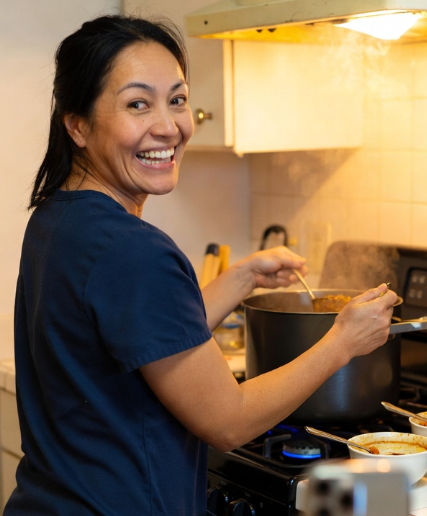
I increased the food drops. Three containers instead of two. I'm making the recipes she likes but won't make for herself in small quantities — lechon kawali (which requires a gallon of oil and isn't worth it for one person, Lourdes says, though she's wrong — lechon kawali is always worth it), lumpia (which requires wrapping hundreds and isn't worth it for one person, though she's wrong again), and the caldereta that takes three hours and serves ten and is completely impractical for a woman eating alone. I make it in my kitchen and bring it to her porch and she eats it from my containers and the containers are the bridge across the glass, the love transmitted through Tupperware.
Angela is worried too. We coordinate — Angela does Monday drop-offs, I do Thursday and Saturday. The Santos sisters managing their mother's isolation the way they manage everything: with logistics, with food, with the systematic application of love to the problem of loneliness. It's not enough. It's never enough. But it's what we have.
I wrote a blog post about cooking for elderly parents during the pandemic — the logistics of feeding someone you can't touch, the emotional toll of porch drop-offs and window conversations, the specific grief of watching your mother thin through glass. The post was personal. The post was too personal, probably — I mentioned the window, the weight loss, the isolation. The readers responded with their own stories. Thousands of them. A thousand windows, a thousand porches, a thousand adult children feeding their parents through glass. The shared grief was a strange comfort. We are alone together. The together is the point.
The caldereta is the one I make most often for Mama — but when I needed something I could transport easily, something that held its depth after a car ride and a porch handoff and a reheating in her kitchen, I turned to this stew. Szekely Gulyas is not Filipino, but it is hers in the way that anything slow and pork-based and built for a crowd can belong to a woman who has spent fifty years feeding thirty people at a time. I made a full pot. I always make a full pot. The leftovers went into Monday’s drop-off, Angela’s container, and the back of my own refrigerator where I ate it standing up and thought about my mother eating it alone at her kitchen table, and how the stew was the same stew in both places, and how that had to count for something.
Hungarian Treasure (Szekely Gulyas)
Prep Time: 20 minutes | Cook Time: 1 hour 30 minutes | Total Time: 1 hour 50 minutes | Servings: 8
Ingredients
- 2 lbs boneless pork shoulder, cut into 1-inch cubes
- 1 tablespoon vegetable oil
- 1 large onion, diced
- 3 cloves garlic, minced
- 2 tablespoons sweet Hungarian paprika
- 1 teaspoon caraway seeds
- 1/2 teaspoon black pepper
- 1 teaspoon salt, plus more to taste
- 1 can (14.5 oz) diced tomatoes, undrained
- 1 cup chicken broth
- 2 lbs sauerkraut, drained and rinsed
- 1 cup sour cream
- 1 tablespoon all-purpose flour
- Fresh dill or parsley, for garnish (optional)
Instructions
- Brown the pork. Heat oil in a large heavy-bottomed pot or Dutch oven over medium-high heat. Working in batches, brown the pork cubes on all sides, about 3–4 minutes per batch. Transfer browned pork to a plate and set aside.
- Soften the aromatics. Reduce heat to medium. Add the diced onion to the same pot and cook, stirring occasionally, until softened and translucent, about 5 minutes. Add the garlic and cook 1 minute more.
- Bloom the spices. Stir in the paprika, caraway seeds, salt, and pepper. Cook for 30 seconds, stirring constantly, until fragrant. Be careful not to let the paprika burn.
- Build the braise. Return the browned pork to the pot. Add the diced tomatoes with their juices and the chicken broth. Stir to combine, scraping up any browned bits from the bottom of the pot.
- Add the sauerkraut. Stir in the drained sauerkraut. Bring the mixture to a boil, then reduce heat to low. Cover and simmer for 1 hour to 1 hour 15 minutes, until the pork is very tender.
- Finish with sour cream. In a small bowl, whisk together the sour cream and flour until smooth. Remove the pot from heat and stir the sour cream mixture in slowly to prevent curdling. Return to very low heat and warm gently for 5 minutes — do not boil. Taste and adjust salt as needed.
- Serve. Ladle into bowls and garnish with fresh dill or parsley if desired. Serve with crusty bread, egg noodles, or boiled potatoes. Stores well refrigerated for up to 4 days and reheats beautifully.
Nutrition (per serving)
Calories: 340 | Protein: 28g | Fat: 19g | Carbs: 12g | Fiber: 3g | Sodium: 780mg