
 By
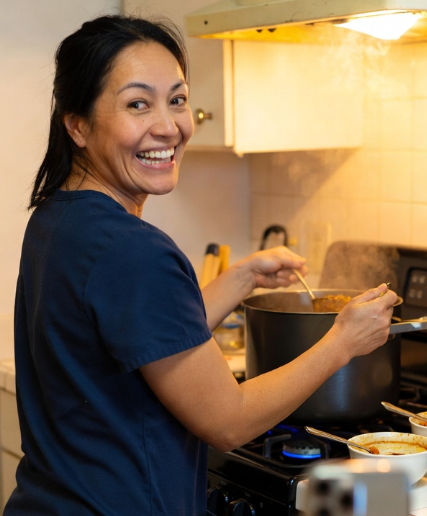
By Daylight Saving ended. The slap at four-thirty PM. A pediatric burn case Tuesday. I came home and made adobo and did not write a blog post.
Lourdes is 75. She is slower. She still cooks. She still tells me to find a husband even though I have one.
I made caldereta Sunday. The celebration stew. The beef and tomato and olives. The dish you make when something good has happened.
The blog post on caldereta got picked up by a Filipino-American newsletter. Traffic doubled for two days. The traffic was the surprise.
The week was ordinary. The ordinary is the point now. The ordinary is the keeping.
The grocery store had no calamansi. I substituted lime. The substitution was acceptable. The acceptable is the working version of perfect.
I cleaned the kitchen Sunday afternoon. I wiped the stove. I scrubbed the sink. I reorganized the spice cabinet. The cleaning was the small reset. The reset was the marker. The marker said: the week is over, the next week begins, the kitchen is ready.
The Filipino Community newsletter announced a fundraiser for typhoon relief in Samar. I committed to making three hundred lumpia. The number is the number. The number has always been the number. Three hundred is what I make. The math has stopped surprising me.
A blog reader sent me a photograph of her grandmother's wooden mortar and pestle, used since 1962. The photograph was holy. I wrote her back. The writing back is the work.
The neighbors invited us over for a small dinner Thursday. They are an Iñupiaq family — Aana and her grandson Joe. We ate caribou stew and rice. I brought lumpia. The kitchens of Anchorage have always been the small UN. The food is the proof.
I drove the Glenn Highway out to Eklutna on Saturday. The mountains were the mountains. The lake was the lake. The body needed the open road. The open road did its work.
I drove home Tuesday evening and the sun set at three forty-five and the highway was already iced at the bridges and the radio was on a station I did not recognize and I did not change it.
Angela texted me a photo of the kids. I texted back a heart. The exchange took thirty seconds. The thirty seconds was the keeping.
I made coffee at six AM. The coffee was the start. The start was always the same.
I taught a Saturday morning Kain Na class on basic adobo proportions for new cooks. Eleven people in the kitchen. Half of them had never cooked Filipino food before. By eleven AM the kitchen smelled the way it should smell. By noon they were all eating. The eating was the lesson landing.
The break room had cake Tuesday. Someone's birthday. We ate the cake. We did not ask whose birthday. The cake was the cake.
The light was good Saturday morning. I sat on the porch with a cup of coffee and watched the inlet for forty minutes. The watching was the small therapy. The therapy was free.
I read three chapters of the novel Saturday night before sleep. The novel was about a Filipina nurse in California. The nurse was being undone by her work. I knew the unraveling. I had lived the unraveling. I read on. The reading was the witnessing.
I took inventory of the freezer Sunday. The freezer had: twelve quarts of broth, eight pounds of adobo in vacuum bags, six pounds of sinigang base, fourteen lumpia trays at fifty rolls each, three pounds of marinated beef for caldereta, and a small bag of pandan leaves Tita Nening had sent me. The inventory was the proof of preparation. The preparation was the proof of love.
I thought about caldereta all week — the beef and tomato and olives, the dish I made because something good had happened, because the newsletter picked up the post, because the ordinary week had earned it. But when I sat down to write the recipe, I kept thinking instead about the three hundred lumpia, about the eleven people in the Saturday kitchen, about Aana and Joe and the caribou stew, about the grandmother’s mortar and pestle used since 1962 — all the food that takes more than one pair of hands. Tamales are that food. They are the tamale-making, not just the tamale. They are the communal work, the standing at the counter, the filling and folding, the proof of preparation. If caldereta is the celebration stew, tamales are the celebration itself.
How To Make Tamales
Prep Time: 2 hours | Cook Time: 1 hour 30 minutes | Total Time: 3 hours 30 minutes | Servings: 24 tamales
Ingredients
- 30 dried corn husks
- 3 cups masa harina
- 2 1/4 cups warm chicken broth, divided
- 3/4 cup lard or vegetable shortening, softened
- 1 teaspoon baking powder
- 1 teaspoon kosher salt
- 2 pounds pork shoulder, trimmed and cut into 2-inch chunks
- 4 dried guajillo chiles, stemmed and seeded
- 2 dried ancho chiles, stemmed and seeded
- 3 cloves garlic
- 1/2 teaspoon cumin
- 1/2 teaspoon dried oregano
- Salt and black pepper to taste
Instructions
- Soak the husks. Place dried corn husks in a large bowl or pot. Cover completely with hot water. Weigh them down with a plate or bowl to keep them submerged. Soak at least 45 minutes until pliable and soft. Drain, pat dry, and keep covered with a damp towel.
- Cook the pork. Season pork chunks with salt and pepper. Place in a medium pot, cover with water, and bring to a boil. Reduce heat and simmer 1 hour until tender. Remove pork and reserve 1 cup of the cooking liquid. When cool enough to handle, shred pork with two forks and set aside.
- Make the chile sauce. Toast guajillo and ancho chiles in a dry skillet over medium heat 1–2 minutes per side until fragrant. Soak in hot water 20 minutes until softened. Transfer chiles to a blender with garlic, cumin, oregano, 1/2 cup reserved pork liquid, and a pinch of salt. Blend until completely smooth. Strain through a fine mesh sieve.
- Combine filling. Heat a skillet over medium heat. Add chile sauce and shredded pork. Stir to coat. Cook 5–8 minutes until sauce thickens and clings to the meat. Taste and adjust salt. Remove from heat and let cool slightly.
- Make the masa. Beat lard or shortening in a stand mixer or with a hand mixer on medium-high until light and fluffy, about 2 minutes. In a separate bowl, mix masa harina, baking powder, and salt. Alternately add masa mixture and warm chicken broth to the beaten lard in three additions, mixing well after each. The dough should be soft, smooth, and slightly tacky — like thick peanut butter. If it feels dry, add more broth one tablespoon at a time. Test by dropping a small ball into a glass of water; it should float.
- Assemble the tamales. Lay a softened corn husk flat with the wide end facing you. Spread about 2 tablespoons of masa in a thin layer across the center of the husk, leaving a 1-inch border on the sides and a 2-inch border at the narrow top end. Spoon 1 tablespoon of pork filling down the center of the masa. Fold one long side of the husk over the filling, then fold the other side over. Fold the narrow end up and under. Place seam-side down. Repeat with remaining husks, masa, and filling.
- Steam the tamales. Stand tamales upright, open end up, in a large steamer basket set over a pot with 2 inches of simmering water. If needed, crumple extra husks around the tamales to keep them upright. Cover tightly and steam over medium heat 1 hour to 1 hour 15 minutes, adding hot water to the pot as needed. Tamales are done when the masa pulls cleanly away from the husk.
- Rest before serving. Remove tamales from the steamer and let rest 10 minutes before opening. The masa will firm up as they rest. Serve with extra chile sauce, crema, or salsa.
Nutrition (per serving)
Calories: 210 | Protein: 9g | Fat: 11g | Carbs: 20g | Fiber: 2g | Sodium: 310mg