
 By
By October in Portland. The rain has returned with the commitment of a lover who went away for summer and is back now, fully, emphatically, with no plans to leave until June. I love the rain. I have always loved the rain. The rain is a curtain between me and the world, and behind the curtain I am safe, and safe is the thing I have wanted most since I was fourteen years old, sitting in a school cafeteria, unable to breathe.
I made oden this week — the simmered one-pot dish of fish cakes, daikon, boiled eggs, and konnyaku in a light dashi broth. Oden is a fall and winter dish, the kind you make in a big pot and eat from over several days, adding broth as the level drops. Fumiko made oden on the first cold day of the year, always, a declaration that summer was over and the long season of simmering had begun. I made it on the first cold day of October and the apartment smelled like dashi and warmth and I thought: the seasons are a clock and the clock is reliable and the reliability is a form of comfort that human relationships fail to provide.
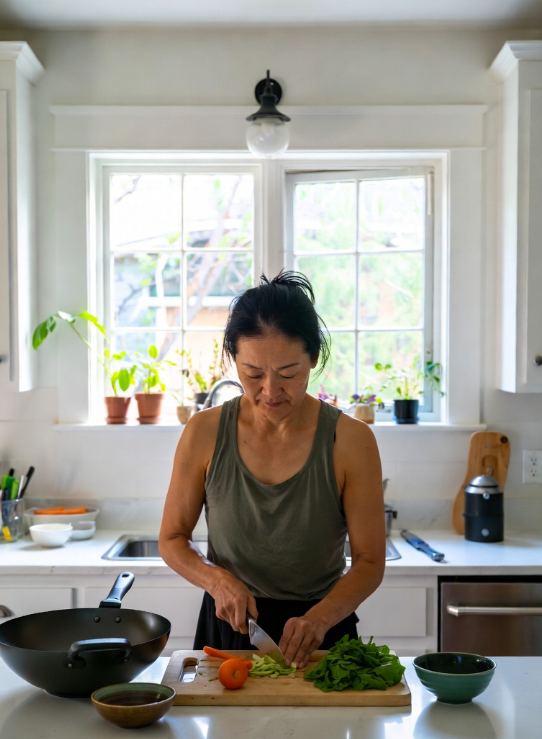
The writing class is week three. I submitted my revised miso soup essay — the grandmother section expanded, the grief made specific, the kitchen rendered with the precision Dana asked for: "Not 'the kitchen' — YOUR grandmother's kitchen. The light through THAT window. The sound of THAT pot." She is teaching me to write the way Fumiko taught me to cook: with specificity, with precision, with the understanding that the universal lives inside the particular. A miso soup is just a miso soup. Fumiko's miso soup, in Fumiko's apartment, on Fumiko's stove, in a bowl she carried from a country she never returned to — that is a universe.
Miya has been bringing home paintings from preschool — abstract, colorful, indecipherable to anyone but her. She explains each one with the seriousness of a gallery docent: "This is a fish. This is the ocean. This is mama's soup." The fish is a red circle. The ocean is a blue smear. The soup is a brown splotch. They are perfect. I tape them to the kitchen wall, next to the stove, next to where Fumiko's recipe cards used to hang before I framed them and moved them to the living room. The kitchen wall is becoming a gallery: Fumiko's handwriting above, Miya's art below. Two generations of women, bookending me.
My anxiety has been manageable this month — a low hum, background noise, the refrigerator that runs but doesn't keep me awake. The medication, the yoga, the writing, the cooking — the four pillars hold. They hold today. They will hold tomorrow. I do not ask them to hold further than that. One day at a time is not a cliche. It is a survival strategy. One bowl at a time. One essay at a time. One rain at a time.
The oden recipe itself I carry in my body now—I don’t need to write it down. But every time I make it, the boiled eggs are where I slow down and pay attention, because they are the part that cannot be rushed or approximated. Dana’s voice was in my head all week: not “an egg”—THIS egg, in THIS pot, at THIS minute. So here is the thing I can actually give you: not a full oden (that is a season, not a recipe), but the boiled egg—done with the specificity that makes the difference between something fine and something that belongs in a bowl of dashi on a cold October night in a warm apartment that smells like home.
How Long To Boil Eggs
Prep Time: 2 minutes | Cook Time: 6–13 minutes | Total Time: 15 minutes | Servings: 6 eggs
Ingredients
- 6 large eggs, straight from the refrigerator
- Water, enough to cover eggs by 1 inch
- 1 teaspoon salt (optional, helps with peeling)
- Ice, for an ice bath
Instructions
- Bring water to a full boil. Fill a medium saucepan with enough cold water to cover the eggs by at least 1 inch. Add salt if using. Bring to a rolling boil over high heat.
- Lower the eggs gently. Using a slotted spoon or spider, lower the cold eggs one at a time into the boiling water. Reduce heat to a gentle boil (medium to medium-high) to prevent cracking.
- Time precisely for your intended use. For soft-boiled eggs with a jammy, custardy yolk (ideal for oden or ramen): cook 6 to 7 minutes. For a yolk that is just set but still tender in the center: cook 9 to 10 minutes. For fully hard-boiled eggs perfect for egg salad or deviling: cook 12 to 13 minutes. Use a timer—do not guess.
- Transfer immediately to an ice bath. As soon as the timer goes off, use a slotted spoon to move the eggs directly into a bowl filled with ice and cold water. Let them sit for at least 5 minutes. This stops the cooking instantly and prevents the grey-green ring from forming around the yolk.
- Peel under cool running water. Gently tap each egg on a hard surface to crack the shell all over, then peel starting from the wider end where the air pocket sits. Running a thin stream of cool water between the shell and the white helps the shell slip away cleanly.
- Use immediately or store. Peeled eggs can be stored in a container of cold water in the refrigerator for up to 5 days. Unpeeled hard-boiled eggs keep in the refrigerator for up to 1 week. For oden, add peeled soft-boiled eggs to the simmering dashi broth during the last 20 minutes so they absorb flavor without overcooking.
Nutrition (per serving)
Calories: 72 | Protein: 6g | Fat: 5g | Carbs: 0g | Fiber: 0g | Sodium: 71mg