
 By
By Mother's Day. The holiday has always been complicated in our family — a thing I celebrate as a mother and observe as a daughter, the two roles layered like the strata in a geological survey, each one revealing something about what lies beneath. James made me breakfast in bed, which consisted of toast, orange juice, and a card he designed on the computer that read, "To the best librarian who also happens to be my mom." It is, to date, the finest piece of literary criticism I have received. Carrie gave me a journal — leather-bound, cream-colored pages — and inside the front cover she had written, "For the stories you haven't told yet." I held it for a long time before I could speak.
Robert gave me a first edition of Eudora Welty's "The Optimist's Daughter," which is a novel about a woman returning to the South after her father's death, about memory and loss and the houses we carry inside us long after we've left the physical ones behind. It was a perfect choice, which is the kind of thing Robert has become since the affair — a man who pays attention to what matters, who selects gifts the way I select books for patrons: with care, with knowledge, with the desire to give someone exactly what they need even if they haven't articulated the need themselves.
I called Mama in Beaufort. She sounded good — clear, present, happy to hear my voice. She told me she'd made shrimp and grits for herself and Joy, and that Joy had tried to help and knocked the grits off the stove, and they'd both laughed until Mama had to sit down. "Your sister," Mama said, "is the funniest person I know." And she meant it. Joy's humor is physical, instinctive, unfiltered — a comedy of pure impulse that catches you off guard because you've forgotten that funny doesn't require sophistication. It just requires surprise.
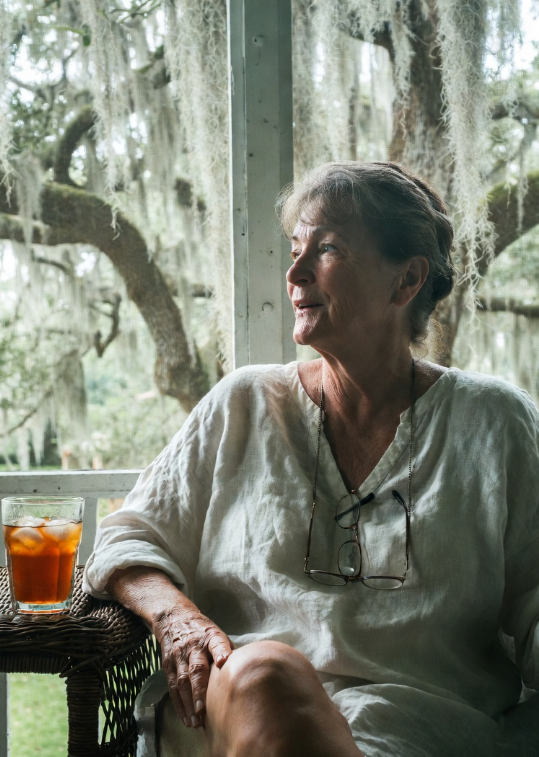
I spent the afternoon on the piazza reading Welty and thinking about the mothers I have known. Mama, who held a family together through Joy's accident and Daddy's rigidity and decades of sacrifice without complaint. Robert's mother, Margaret, who was elegant and distant and died in 2008, leaving behind antiques and expectations but very few recipes. The mothers at the library who bring their children every Saturday morning and sit in the reading corner with a patience I recognize because I had it once, in the Beaufort County Library, waiting for the stacks to reveal whatever I needed that week.
For dinner I made Frogmore stew — the one-pot Lowcountry boil of shrimp, sausage, corn, and potatoes that Mama used to make for church picnics. It's not elegant food. It's newspaper-on-the-table, hands-in-the-food, pass-the-butter food. James and Carrie ate it standing at the counter because I told them to sit down and they inherited their father's selective hearing. Robert opened a beer and ate slowly, and we were a family doing the least complicated version of being a family, which is eating together, which is everything.
After a Mother’s Day spent between Welty and memories of Mama’s kitchen in Beaufort, I wanted to end the evening with something that tasted like the South I carry inside me — not the elegance of a proper dinner party, but the kind of food that asks nothing of you except to sit down and eat. Hoppin’ John felt right: it’s a Lowcountry staple as rooted in that landscape as the marsh grass, as unpretentious as the newspaper we used to spread across the picnic table, and like so many things that matter, it becomes something greater than its parts when you share it with the people you love.
Hoppin’ John with Kale
Prep Time: 15 minutes | Cook Time: 45 minutes | Total Time: 1 hour | Servings: 6
Ingredients
- 1 tablespoon olive oil
- 1 medium yellow onion, diced
- 3 cloves garlic, minced
- 4 oz smoked andouille or kielbasa sausage, sliced into rounds
- 2 cans (15 oz each) black-eyed peas, drained and rinsed
- 2 1/2 cups low-sodium chicken broth
- 1 cup long-grain white rice
- 1 bunch curly kale, stems removed, leaves roughly chopped
- 1 teaspoon smoked paprika
- 1/2 teaspoon crushed red pepper flakes
- 1/2 teaspoon dried thyme
- Salt and black pepper to taste
- Hot sauce, for serving
- Sliced scallions, for garnish
Instructions
- Saute the aromatics. Heat olive oil in a large, heavy-bottomed pot or Dutch oven over medium heat. Add the diced onion and cook, stirring occasionally, until softened and translucent, about 5 minutes. Add the garlic and cook 1 minute more until fragrant.
- Brown the sausage. Add the sliced sausage to the pot and cook 2—3 minutes, stirring, until lightly browned on the edges. This builds the base flavor of the dish.
- Build the broth. Stir in the drained black-eyed peas, chicken broth, smoked paprika, red pepper flakes, and thyme. Bring to a boil over medium-high heat, then taste and adjust seasoning with salt and black pepper.
- Cook the rice. Stir in the rice, reduce heat to low, cover tightly, and simmer for 20 minutes until the rice is tender and has absorbed the liquid. Do not lift the lid during this time.
- Wilt the kale. Remove the lid and stir in the chopped kale. Replace the lid and cook over low heat for an additional 5—7 minutes, until the kale is wilted and tender but still a deep, vivid green.
- Serve. Fluff the rice and peas gently with a fork, taste once more for seasoning, and ladle into bowls. Top with sliced scallions and pass the hot sauce at the table.
Nutrition (per serving)
Calories: 320 | Protein: 15g | Fat: 8g | Carbs: 46g | Fiber: 7g | Sodium: 530mg