
 By
By I talked to Dr. Reeves about the ER. Not about leaving — not yet — but about the cost. The accumulated cost of eleven years of emergency nursing, of trauma, of the pandemic year that accelerated the wear by a factor of three. She listened the way she always listens — with the patience of a woman who has been listening to me for five and a half years and knows that the words I say first are not the words I mean, and the words I mean are hiding behind the first words, and the hiding is the process and the process requires patience.
I said, "I'm tired." She said, "Of the ER?" I said, "Of the version of me that the ER requires." The version: the one who can hold a dying stranger's hand at 2 AM and then go home and eat sinigang at the table and then sleep and then do it again. The version who absorbs trauma and processes it through therapy and cooking and the blog and the careful, daily management of a PTSD that is controlled but not cured. The version who is good at her job. The version who is being consumed by her job. The distinction between being good at something and being consumed by it is the distinction Dr. Reeves has been trying to show me for years. I'm starting to see it.
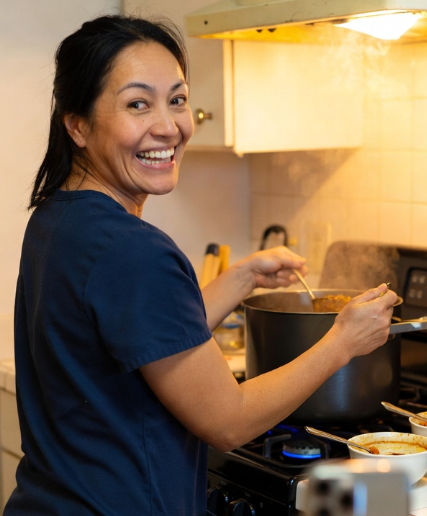
I made tinola — the gentle soup. The ginger chicken soup that asks nothing. The soup I make when the conversation with Dr. Reeves was hard and the hard requires gentleness and the gentleness is ginger and broth and the particular Santos woman remedy of feeding yourself when the world has taken something from you. The tinola was gentle. The conversation was hard. The two coexist. They always coexist. The hard and the gentle. The ER and the kitchen. The consuming and the cooking.
The tinola is what I made that night, but this honey mustard chicken pasta is what I make the night after — when the hard is still sitting with me but has softened enough to let something a little brighter in. It doesn’t ask much: you season the chicken, you build the sauce, you boil the pasta, you eat. That’s the kind of cooking I reach for when I’m still processing — simple enough that the body can do it without the mind having to fully show up. Dr. Reeves would probably say that’s the point.
Honey Mustard Chicken Pasta
Prep Time: 10 minutes | Cook Time: 25 minutes | Total Time: 35 minutes | Servings: 4
Ingredients
- 1 lb boneless, skinless chicken breasts, cut into bite-sized pieces
- 8 oz penne or rotini pasta
- 2 tablespoons olive oil
- 3 cloves garlic, minced
- 1/3 cup Dijon mustard
- 1/4 cup honey
- 1/2 cup heavy cream
- 1/2 cup low-sodium chicken broth
- 1/2 teaspoon salt, plus more for pasta water
- 1/4 teaspoon black pepper
- Fresh parsley, chopped, for garnish
Instructions
- Cook the pasta. Bring a large pot of salted water to a boil. Cook pasta according to package directions until al dente. Reserve 1/4 cup pasta water, then drain and set aside.
- Season and cook the chicken. Pat chicken pieces dry and season with salt and pepper. Heat olive oil in a large skillet over medium-high heat. Add chicken in a single layer and cook 5–7 minutes, turning once, until golden and cooked through. Transfer to a plate.
- Build the sauce. Reduce heat to medium. In the same skillet, add garlic and cook 1 minute until fragrant. Whisk in Dijon mustard, honey, heavy cream, and chicken broth. Simmer 3–4 minutes, stirring occasionally, until the sauce thickens slightly.
- Combine. Return the chicken to the skillet. Add the drained pasta and toss everything together until well coated. If the sauce is too thick, stir in reserved pasta water a tablespoon at a time.
- Serve. Divide among bowls and top with fresh parsley. Eat while it’s warm and the evening is still quiet.
Nutrition (per serving)
Calories: 525 | Protein: 36g | Fat: 17g | Carbs: 57g | Fiber: 2g | Sodium: 490mg