Writing the first RecipeSpinoff piece. I've been at the kitchen table every night after my brewery shifts, laptop open, trying to find the words.
The piece is called "Recipe Cards and a Rubber Band: How My Grandmother Taught Me to Cook After She Died." It's about Babcia — the recipe cards, the pierogi journey, the grief that turned into cooking, the cooking that turned into a life. It's about the short rib and horseradish pierogi — the innovation, the "not traditional but not wrong" — and how food evolves while honoring its roots.
Writing for RecipeSpinoff is different from the Milwaukee Eats column. Bigger audience. Higher stakes. More eyes on every word. I'm writing and rewriting and deleting and starting over and thinking: who am I to write about this? I'm a brewer. I'm twenty-three. I didn't go to culinary school or journalism school. I'm a kid from Bay View with flour on his hands and a dead grandmother's recipes.
But that's exactly who should write about this. Not a professional. A real person. Someone who learned to cook not in a classroom but in a kitchen, not from a textbook but from handwritten cards with grease stains and Polish annotations. That's the whole point of RecipeSpinoff — real people, real food, real stories.
I finished the draft at 1 AM on Friday. Five thousand words. I read it out loud to the empty apartment — an old trick Mrs. Wojcik taught me for checking flow — and it sounded right. It sounded like me. Casual, self-deprecating, a lot of profanity that I edited out, and underneath all of it, a love for food and family that I couldn't hide if I tried.
Sent it to the editor Saturday morning. She replied in two hours: "This is beautiful. Minor edits. Running it mid-June."
Made the short rib and horseradish pierogi for the piece — photographed them for the first time with my new phone, natural light from the kitchen window, on the wooden cutting board that Babcia used. They looked professional. They looked like they belonged on a food website. They also looked like pierogi that a twenty-three-year-old made in a tiny kitchen, which they are, and that's the beauty of it.
The protests continue. Milwaukee is hurting and healing. The world is hurting and healing. I'm writing about pierogi because that's what I know how to do, and sometimes the most radical thing you can do in a broken world is make something beautiful with your hands.
The short rib and horseradish pierogi in the piece took months of iteration to get right — but before I could get there, I had to go back further, to the very beginning of what it means to work dough with your hands. These homemade noodles are that beginning for me: two servings, one bowl, no equipment, nothing between you and the flour except your palms and a little patience. Babcia made something like these on nights when the filling wasn’t ready yet and I was too hungry to wait. I photographed the pierogi for the RecipeSpinoff piece on that same wooden cutting board, under that same kitchen window light — but it’s these noodles, the stripped-down version, that remind me why I cook at all. Some nights you don’t need the innovation. You just need the dough.
Homemade Noodles For Two
Prep Time: 20 min | Cook Time: 10 min | Total Time: 30 min | Servings: 2
Ingredients
- 1 cup all-purpose flour, plus more for dusting
- 1 large egg
- 3 tablespoons cold water
- 1/4 teaspoon salt
- 1 tablespoon unsalted butter
- Pinch of black pepper, to finish
Instructions
- Build the dough. Mound the flour on a clean work surface or in a large bowl and make a well in the center. Add the egg, salt, and 2 tablespoons of cold water into the well. Using a fork, gradually draw the flour inward and mix until a shaggy dough forms. Add the remaining tablespoon of water only if the dough feels dry and isn’t coming together.
- Knead until smooth. Turn the dough onto a lightly floured surface and knead firmly for 6—8 minutes, pushing the heel of your hand into the dough and folding it back on itself, until the dough is smooth, elastic, and springs back when poked. It will feel stiff at first — keep going.
- Rest the dough. Shape the dough into a ball, cover it with an inverted bowl or wrap it in plastic, and let it rest at room temperature for 10 minutes. This relaxes the gluten and makes rolling significantly easier.
- Roll thin. On a well-floured surface, use a rolling pin to roll the dough out to roughly 1/8-inch thickness — thin enough that you can almost see your hand through it. Flour both sides as needed to prevent sticking.
- Cut the noodles. Loosely roll the dough sheet into a cylinder and slice crosswise into strips roughly 1/4-inch wide. Shake the cut noodles loose and drape them over the edge of a bowl or cutting board so they don’t stick together.
- Boil. Bring a medium pot of well-salted water to a rolling boil. Drop in the noodles and cook for 3—4 minutes, until tender but still with a slight chew. Fresh noodles cook fast — taste one at 3 minutes.
- Finish and serve. Drain the noodles, return them to the pot off the heat, and toss immediately with the butter. Season with black pepper. Serve as a simple side or topped with whatever sauce, broth, or braising liquid you have going.
Nutrition (per serving)
Calories: 275 | Protein: 9g | Fat: 8g | Carbs: 41g | Fiber: 1g | Sodium: 310mg
About the cook who shared this
Jake Kowalski
Week 219 of Jake’s 30-year story
· Milwaukee, Wisconsin
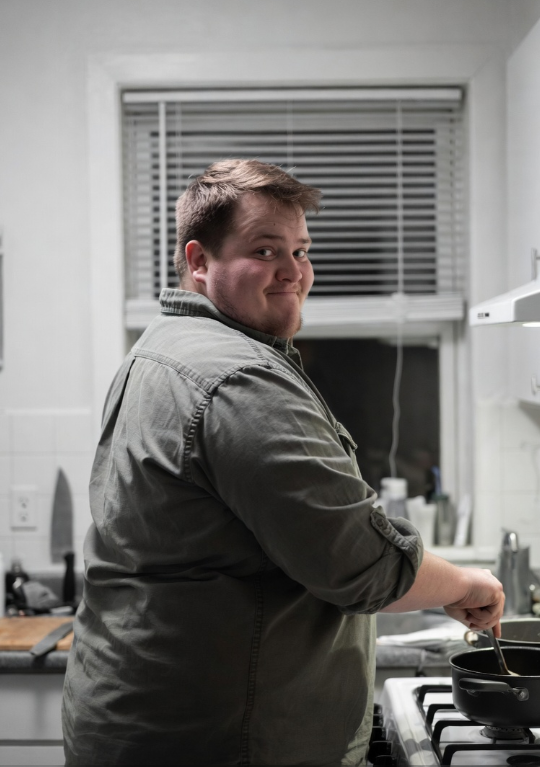
Jake is a twenty-nine-year-old brewery worker, newlywed, and proud Polish-American from Milwaukee's Bay View neighborhood. He didn't start cooking until his grandmother Babcia Helen passed away and left behind a stack of grease-stained recipe cards. Now he makes pierogi from scratch, smokes meats on a balcony smoker his landlord pretends not to notice, and writes for guys who want to cook good food but don't know a roux from a rub.
