Mamma called Tuesday morning at 10 AM, as she always does, as she has done since she had a phone of her own in 1953. She wanted to know what I was making for dinner. The question matters to her in a way that I now understand at sixty-eight in a way I did not understand at thirty. The asking is the love. The answering is the love. The conversation is the bridge across the days. We talked for nineteen minutes. Mamma is ninety. The phone calls are precious and finite. I do not waste them.
Anna sent photos from Minneapolis — the kids in their school uniforms, David's new bookshelf, the dog (their dog, not mine; their dog is named Cooper, and Cooper is a Bernese mountain dog who weighs more than Anna and who is, by all accounts, the most relaxed dog in the upper Midwest). I printed three of the photos and put them on the fridge. The fridge holds the family that is not currently in the kitchen.
Elsa called from Voyageurs. She had a sighting of a wolf — a single gray adult crossing a frozen bay at dawn, fifty yards from her cabin. She had a sighting of a moose two days later. She is happy in the woods. I am glad someone in this family is happy in the woods. I have always loved Lake Superior, but the deeper woods are not for me. Elsa is for the deeper woods. The match is right.
I cooked Wild rice soup this week. Wild rice from the Fond du Lac band. Forty-minute simmer in stock. Carrots, celery, onion, mushrooms. Cream at the end. The pot makes eight quarts. The Thursday batch. The home batch. The freezer batch.
The Damiano Center on Thursday. I have served soup at this center for twenty-some years. I know the regulars by name. I know the seasons of the crowd. I know that the first cold snap brings new faces. I know that the days after holidays bring the lonely ones. I know that the worst weeks of the year are not the ones that feel the worst — they are the ones in February when the cold has worn everyone down and the city has run out of tenderness.
Paul would have liked this dinner. Paul would have liked this week. Paul would have liked this life. I tell him about it anyway. The telling is the keeping. I have been told, by a grief counselor, by friends, by my own children at certain anxious moments, that perhaps the constant tell-Paul thing is not healthy. I do not agree. I think it is exactly healthy. I think it is, in fact, the structural beam of my emotional architecture. The beam is solid. The house stands.
It is enough. It has to be. And on a morning like this, with the lake doing what the lake does and the dog at my feet and the bread on the counter and the kitchen warm enough to live in, it is.
The lake from the kitchen window has been doing what the lake does for as long as there has been a lake. The lake has carried fish and ships and the bodies of drowned sailors and the names of Ojibwe villages and the granite-cold of melted glaciers. The lake does not notice the lives along its shore. The lives notice the lake. That is the deal. That has always been the deal.
It is enough.
I mentioned the bread on the counter almost as an aside, but it wasn’t an aside — it never is. The wild rice soup was the Thursday work, the Damiano work, the eight-quart-pot work. The bread on the counter was the quiet other thing, the thing that just exists in a warm kitchen the way warmth itself exists. Fry bread has been part of this region’s food story for as long as I have been paying attention to it — the Fond du Lac band, the Ojibwe communities whose name the lake still carries — and making it at home feels like a small, honest way of honoring that. Paul always broke off a piece before I had a chance to plate it properly. I still make more than I need.
Homemade Fry Bread
Prep Time: 15 min | Cook Time: 20 min | Total Time: 35 min | Servings: 8
Ingredients
- 2 cups all-purpose flour
- 1 tablespoon baking powder
- 1/2 teaspoon salt
- 3/4 cup warm water (or warm milk for a richer dough)
- Vegetable oil or lard, for frying (about 2 inches deep in pan)
Instructions
- Mix the dough. In a large bowl, whisk together the flour, baking powder, and salt. Add the warm water (or milk) a little at a time, stirring until a soft, slightly sticky dough forms. Do not overwork it — mix just until combined.
- Rest the dough. Cover the bowl with a clean kitchen towel and let the dough rest for 10 minutes. This relaxes the gluten and makes the dough easier to shape.
- Heat the oil. Pour oil into a heavy skillet or Dutch oven to a depth of about 2 inches. Heat over medium-high until the oil reaches 375°F. A small pinch of dough dropped in should sizzle immediately.
- Shape the rounds. Divide the dough into 8 equal pieces. On a lightly floured surface, pat or gently stretch each piece into a round about 1/4 inch thick, roughly 5–6 inches across. Poke a small hole in the center of each round with your finger to help it fry evenly.
- Fry in batches. Carefully lower one or two rounds into the hot oil. Fry for 2 to 3 minutes per side, until puffed and deep golden brown. Use tongs or a slotted spoon to flip and remove. Do not crowd the pan.
- Drain and serve. Transfer finished rounds to a plate lined with paper towels. Serve warm. Fry bread is good plain, with honey or jam, alongside soup, or topped savory-style with beans, shredded meat, or cheese.
Nutrition (per serving)
Calories: 185 | Protein: 4g | Fat: 7g | Carbs: 27g | Fiber: 1g | Sodium: 210mg
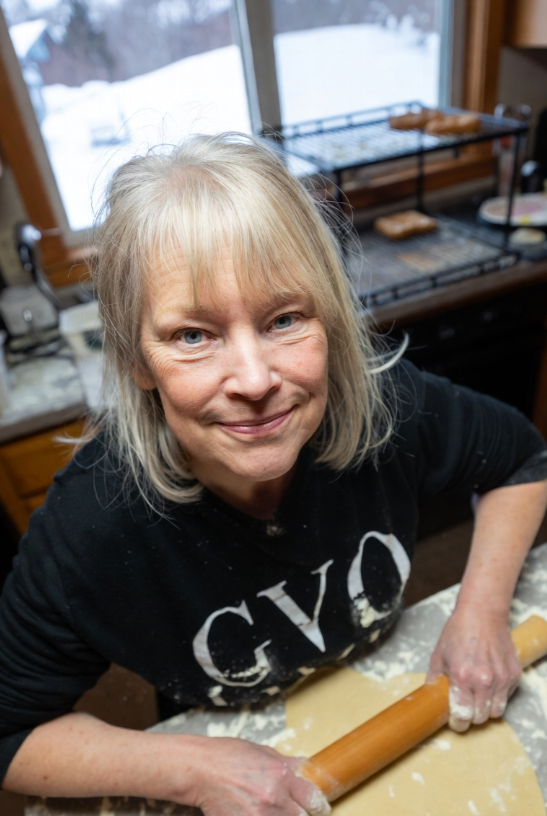
About the cook who shared this
Linda Johansson
Week 364 of Linda’s 30-year story
· Duluth, Minnesota
Linda is a sixty-three-year-old retired nurse from Duluth, Minnesota, living alone in the house where she raised her children and said goodbye to her husband. She lost Paul to ALS in 2020 after two years of watching the kindest man she'd ever known lose everything but his dignity. She cooks Scandinavian comfort food and Minnesota hotdish and the pot roast Paul loved, and she sets two places at the table out of habit because it makes her feel less alone. Every recipe she writes is a person she's loved.
