We drove to Minneapolis on Wednesday. Four hours on I-35, Paul driving, me in the passenger seat watching his hands on the steering wheel. Left hand at nine o'clock. Right hand at three. Both hands steady. The road straight. The drive normal.
We didn't talk much. Paul listened to MPR. I looked out the window. The trees along the highway were starting to turn — a few yellows, a few oranges, the first hints of the change. Two months ago we were picking blueberries. Now we're driving to a neurologist. The speed of things. The way your life can shift between one season and the next, between one hand dropping a coffee mug and a specialist in Minneapolis.
The neurologist was Dr. Andersen at the University of Minnesota. She was young — forty, maybe — and thorough. She examined Paul's hand for thirty minutes. She tested his reflexes. She tested his grip strength. She had him walk across the room. She asked questions about the timeline: when did the clumsiness start? Was it gradual? Any weakness in other limbs? Any difficulty swallowing? Any changes in speech?
Paul answered everything calmly. Factually. Historically. He's a teacher — he presents information in an organized, chronological fashion. "June. Gradual. No. No. No." I sat in the corner chair and listened and held my purse in my lap and my hands were steady because I am a nurse and my hands are always steady, even when the rest of me is not.
Dr. Andersen said she wanted to repeat the EMG — a more comprehensive version, testing more muscle groups. She said she wanted to observe him over time. She said she wasn't ready to make a diagnosis. She said these words: "I want to see you again in three months."
Three months. December.
On the drive home, Paul was quiet for thirty miles. Then he said, "She didn't say what it was." I said, "She wants more information." He said, "What do you think it is, Linda?" And I looked at his profile — his glasses, his jaw, the familiar landscape of his face — and I said, "I think we wait and see." Because I couldn't say what I think it is. Not in the car. Not on the highway. Not to this man who I've loved for thirty years. I couldn't say the word.
He nodded. He drove. We came home. Sven was waiting at the door, tail wagging, oblivious to everything except the fact that his people were back. Paul sat on the floor with Sven and rubbed his ears and Sven put his head in Paul's lap and they stayed like that for a long time.
I went to the kitchen. I made soup — cream of mushroom, homemade, not from a can. Mushrooms, butter, shallots, thyme, cream. You cook the mushrooms until they release their liquid, then until the liquid evaporates, then until they're dark and fragrant. You add the cream and the thyme and you blend it smooth and it's the color of a forest floor and it tastes like autumn and earth and the deep, quiet places where things grow in the dark.
Paul ate two bowls. He said, "Good soup, Linda." I said, "Thank you, Paul."
Three months. We'll go back in December. Until then, we live. We cook. We eat. We hold on.
We hold on.
I’ve made this soup before — on ordinary Wednesdays, on cold nights when nothing was wrong — but that evening it meant something different. I needed to do something with my hands that I knew how to do, something with a clear beginning and a clear end, something that would come out right. The mushrooms go in, the liquid releases, the liquid evaporates, and what’s left is dark and fragrant and certain. That’s what I needed. Certainty in a pot. Paul ate two bowls, and for a little while, that was enough.
Homemade Cream of Mushroom Soup
Prep Time: 15 min | Cook Time: 30 min | Total Time: 45 min | Servings: 4
Ingredients
- 2 tablespoons unsalted butter
- 1 tablespoon olive oil
- 2 medium shallots, finely minced
- 3 cloves garlic, minced
- 1 lb cremini mushrooms, cleaned and roughly chopped
- 4 oz shiitake mushrooms, stems removed, roughly chopped
- 1/2 teaspoon kosher salt, plus more to taste
- 1/4 teaspoon freshly ground black pepper
- 1 tablespoon fresh thyme leaves (or 1/2 teaspoon dried)
- 2 tablespoons dry sherry or dry white wine
- 3 cups low-sodium chicken or vegetable broth
- 3/4 cup heavy cream
- 1 teaspoon fresh lemon juice
- Fresh thyme or a swirl of cream, to finish
Instructions
- Sweat the shallots. In a heavy-bottomed pot or Dutch oven over medium heat, melt the butter with the olive oil. Add the shallots and cook, stirring occasionally, until soft and translucent, about 4 to 5 minutes. Add the garlic and cook 1 minute more.
- Cook down the mushrooms. Add all the mushrooms and the salt. Raise the heat to medium-high. Cook, stirring every few minutes, until the mushrooms release their liquid — about 5 minutes — and then continue cooking until that liquid fully evaporates and the mushrooms turn dark and fragrant, another 7 to 9 minutes. Don’t rush this step. The color and depth of the soup depends on it.
- Deglaze and season. Add the sherry or wine and scrape up any browned bits from the bottom of the pot. Let the alcohol cook off for 1 minute. Stir in the thyme and black pepper.
- Simmer with broth. Pour in the broth. Bring to a gentle boil, then reduce heat and simmer uncovered for 10 minutes to let the flavors deepen.
- Blend smooth. Remove the pot from heat. Using an immersion blender, blend the soup until completely smooth. Alternatively, transfer in batches to a stand blender, venting the lid carefully. Return to pot over low heat.
- Add cream and finish. Stir in the heavy cream and lemon juice. Warm gently over low heat — do not boil. Taste and adjust salt as needed.
- Serve. Ladle into bowls and finish with a few fresh thyme leaves or a thin swirl of cream. Serve immediately with good bread.
Nutrition (per serving)
Calories: 285 | Protein: 6g | Fat: 23g | Carbs: 13g | Fiber: 2g | Sodium: 390mg
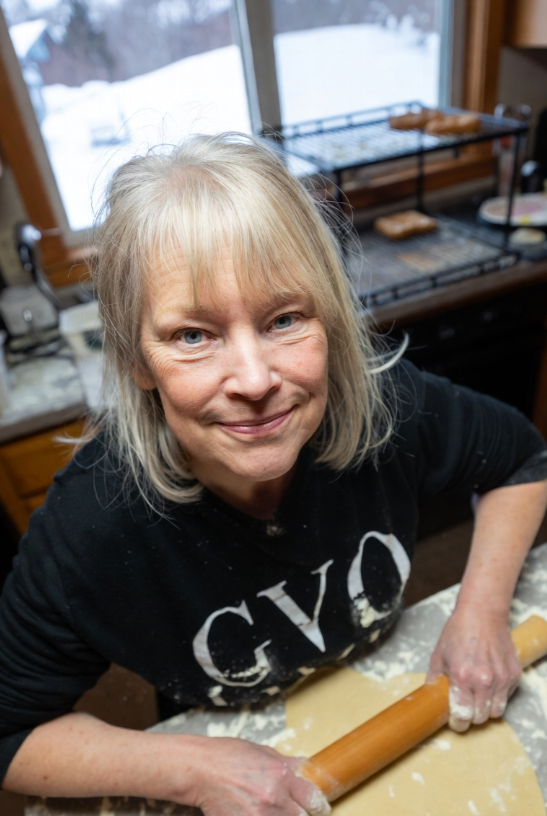
About the cook who shared this
Linda Johansson
Week 78 of Linda’s 30-year story
· Duluth, Minnesota
Linda is a sixty-three-year-old retired nurse from Duluth, Minnesota, living alone in the house where she raised her children and said goodbye to her husband. She lost Paul to ALS in 2020 after two years of watching the kindest man she'd ever known lose everything but his dignity. She cooks Scandinavian comfort food and Minnesota hotdish and the pot roast Paul loved, and she sets two places at the table out of habit because it makes her feel less alone. Every recipe she writes is a person she's loved.
