
 By
By Second week of January and Memphis got cold — real cold, not the damp-cool of December but the hard, dry cold of true winter, the kind that turns your breath into clouds and makes the metal on the mailboxes sting your fingers through your gloves. Twenty-eight degrees on Thursday morning when I started my route, and the wind off the river was the kind of wind that finds every gap in your clothing and moves in like it owns the place.
I don't mind the cold the way I mind the heat. Big men carry cold better than heat — all that mass is insulation, a natural coat that my six-four, two-sixty frame provides free of charge. The problem is the knee. Cold makes the knee worse. The joint stiffens, the pain sharpens, and every step is a negotiation between my will and my cartilage, and my cartilage — which, as Dr. Barker reminded me, is largely absent — is losing the argument but making its case loudly.
Rosetta bought me a knee brace at Walgreens. Not the medical-grade kind, just the slip-on compression kind that promises support and delivers approximately the same amount of support as a motivational poster. But I wore it, because Rosetta bought it and wearing it is cheaper than the argument that comes from not wearing it, and because it did, actually, help a little — enough to get through the route without stopping, which is all I asked of it.
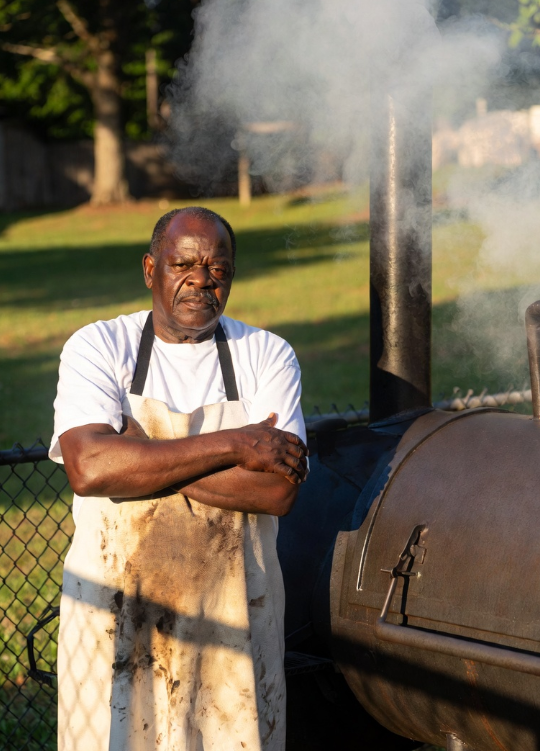
This week I cooked for warmth. Smoked pork belly — a cut that most BBQ people know as the raw material for bacon but which, when smoked whole, becomes something entirely different: thick slabs of meat and fat, smoke-infused, with a bark that crackles when you bite into it and an interior so rich and unctuous that it melts on the tongue like the most indulgent thing you've ever put in your mouth. I rubbed it with salt, pepper, brown sugar, and paprika — simple, because pork belly doesn't need complexity, it needs confidence — and smoked it at 250 for five hours over hickory, wrapping it in foil for the last hour to tenderize without drying the exterior.
Sliced it thick — half-inch slabs — and served it with a tangy vinegar slaw and pickled red onion, because pork belly needs acid the way a bass line needs a treble: to cut through the richness and keep the palate from surrendering entirely to fat and smoke. Rosetta looked at the pork belly and looked at me and said, "Your arteries are writing a formal complaint." I said, "My arteries have been complaining since 1980. They should unionize." She did not laugh. I laughed enough for both of us. This is our system.
Sunday after church I drove to Whitehaven to see Mama. The cold had kept her inside all week — the facility doesn't let residents out when it's below freezing — and she was restless, the way a woman who ran a household for fifty years gets restless when she can't move freely. She was pacing the common room with her walker, and when she saw me she said, "Earl, get me out of here." I said, "Mama, it's twenty-nine degrees." She said, "I've been cold before. I survived Korea." I said, "Mama, Daddy survived Korea. You survived Memphis." She said, "Same thing."
I stayed for two hours. We watched a game show on the television and she yelled answers at the screen with a competitiveness that age has not diminished. She got seven right. I got four. She looked at me with the pity of a mother whose son is less intelligent than she hoped, and I accepted the look because she earned it, and because making Mama feel smart is one of the only gifts I can still give her. She is smart. She has always been the smartest person I know, and the fact that her memory is fading doesn't change the intelligence underneath — just the access to it, like a library that's still full but keeps locking the doors.
The line I kept coming back to while I was plating that pork belly — the one about acid cutting through fat the way a treble line cuts through a bass — that’s not poetry, that’s just honest cooking. Plain white vinegar does the job, but if you’ve got a homemade cranberry vinegar sitting in the pantry, you’ve got something that does the job and says something while it does it: bright, fruity, with enough tang to stand up to five hours of hickory smoke without flinching. Cold January weeks call for pork belly, and pork belly calls for this.
Homemade Cranberry Vinegar
Prep Time: 10 minutes | Cook Time: 10 minutes + 2 weeks steeping | Total Time: 2 weeks 20 minutes | Servings: 16 (makes about 2 cups)
Ingredients
- 2 cups fresh or frozen cranberries
- 2 cups apple cider vinegar
- 1/4 cup granulated sugar
- 1 teaspoon whole black peppercorns
- 1 small sprig fresh rosemary (optional)
- 1/2 teaspoon kosher salt
Instructions
- Simmer the cranberries. Combine cranberries and apple cider vinegar in a small saucepan over medium heat. Bring to a gentle simmer and cook for 8—10 minutes, stirring occasionally, until the cranberries burst and the liquid turns a deep ruby red.
- Sweeten and season. Stir in the sugar and salt until fully dissolved. Remove from heat and allow to cool to room temperature, about 30 minutes.
- Add aromatics and steep. Transfer the mixture to a clean glass jar. Add the peppercorns and rosemary sprig if using. Seal tightly and store in a cool, dark place for at least 2 weeks, shaking the jar gently every 2—3 days.
- Strain and bottle. After steeping, pour the vinegar through a fine-mesh strainer or cheesecloth into a clean glass bottle, pressing the solids to extract all the liquid. Discard the solids. Seal the bottle and store at room temperature for up to 6 months.
- Use in slaw. Whisk 3 tablespoons cranberry vinegar with 1 tablespoon olive oil, 1 teaspoon sugar, and a pinch of celery salt for a tangy slaw dressing that cuts straight through smoked pork belly or any rich BBQ cut.
Nutrition (per serving)
Calories: 18 | Protein: 0g | Fat: 0g | Carbs: 4g | Fiber: 0g | Sodium: 37mg