
 By
By Fall. Bye week, Doug visit.
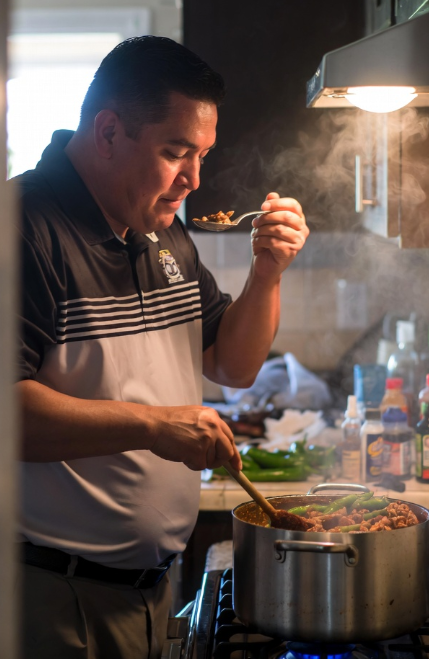
I made beef stew for the family this week. The kitchen filled with the smell that beef stew makes. Lisa and the kids ate around the table. The conversation was about the week, the kids' activities, the small ordinary news of a household in motion. Diego called from CSU and said hello. The twins ate too much. Sofia ate the right amount. Lisa ate slowly. I ate the rest.
The dog tags were under the polo. The chain was around my neck. Hector's ring is not on a chain yet. Papá is still alive. Mamá is still in Las Cruces. The road keeps bending. The road bends. Feed your people. The game is won at the table.
The small Denver-area high-school football-coaching-position at the small 5A school continues to be the small career-passion. The small head-coach role since 2019. The small assistant-coach years before. The small full-time PE-teacher day-job that the small coaching-position is built on. The small twenty-five-year-football-life is the small identity.
The four kids are: Diego (born 2007, plays football), Sofia (born 2009, runs cross-country), twins Marco and Elena (born 2013, in everything). The small Lisa (the small wife, Anglo from Colorado Springs) is the small ER-nurse at the small Denver Health. The small two-income six-person household has the small careful-budget shape.
The small New-Mexican-heritage runs through the small kitchen. The small Hatch-green-chile is the small heritage-staple ingredient. The small green-chile-on-everything (the small green-chile-cheeseburger, the small green-chile-enchiladas, the small green-chile-stew, the small green-chile-mac-and-cheese). The small Carlos’s family is from the small Las Cruces area; the small Lisa’s family is from the small Colorado Springs-area.
The small Carlos-family-tamale-making at Christmas is the small annual-marathon. The small three-day-process the small whole-family participates in. The small Gloria-recipes (Carlos’s mother Gloria still in Las Cruces) are the small heritage-anchor. The small two-hundred tamales-per-year output feeds the small extended-family and the small football-team and the small church.
The small Our Lady of Guadalupe Catholic Parish congregation is the small Sunday-worship. The small Carlos-and-Tanya parish-presence has been the small lifelong-Denver-Catholic-community membership. The small parish-quinceañeras, the small parish-cookouts, the small parish-Día-de-los-Muertos altar-building are the small community-rhythm.
The small football-season runs the small August-through-November fall. The small Friday-night-games are the small fall-Friday-anchor. The small Saturday-morning-film-review at the small coaches’ office. The small Sunday-team-dinner at the small Medina-house where the small two-dozen-football-players show up for the small family-style spread.
The small Sunday-publishing-rhythm of the recipe blog continues to be the small organizing-spine of the small week. The small Sunday-cooking happens in the small late-morning-to-early-afternoon window. The small photographing of the finished dish happens at the small three-PM kitchen-light-window. The small writing-up of the recipe happens at the small four-PM workspace at the kitchen-counter. The small final-edit happens at the small five-PM. The small post publishes at seven PM. The small ritual has been running for years.
The small recipe-development-philosophy continues to be the small small-batch-test-then-publish approach. The small first cook of a small new recipe happens on the small Saturday afternoon. The small adjustments are noted in the small kitchen-notebook. The small second cook happens Sunday with the small adjustments incorporated. The small Sunday-cook is the small version that gets photographed and published. The small two-test process catches the small recipe-flaws before they reach the small reader.
The small kitchen-equipment-inventory has the small key-pieces that show up in nearly every recipe. The small heavy-bottomed Dutch oven for the small braises. The small twelve-inch cast-iron skillet for the small sears and the small pan-roasts. The small half-sheet baking-pans for the small roasted vegetables and the small cookies. The small wooden-spoon-collection in the small ceramic-pitcher on the counter. The small chef’s-knife and the small paring-knife and the small bread-knife that are the small daily-tools.
The small grocery-shopping rhythm runs through the small Tuesday-evening trip and the small Saturday-morning top-off. The small Tuesday-trip is the small weekly-stock-up for the small staples and the small produce and the small protein. The small Saturday-trip is the small quick-fill for whatever the small Sunday-recipe requires that is not already in the small pantry. The small two-trip-per-week pattern keeps the small grocery-bill manageable and the small food-waste low.
The small meal-planning happens on the small Sunday-evening for the small week-ahead. The small dinners are mapped out across the small Monday-through-Saturday. The small repeating-meals are slotted in (the small pasta-Monday, the small taco-Tuesday or similar pattern). The small new-recipes are slotted for the small Wednesday-or-Thursday for the small variety. The small planning ahead reduces the small daily what-are-we-making-for-dinner stress.
The small weekday-cooking is the small efficient-and-fast mode. The small Sunday-cooking is the small slow-and-careful mode. The small two-modes serve the small two-different-needs. The small weekday-cooking has to be on the small table within forty-five minutes of getting home from the small work-or-school-pickup. The small Sunday-cooking can take three hours and benefit from every minute of that time.
The small recipe-archive on the small blog has grown to many hundreds of recipes over the years. The small archive is the small searchable-resource for the small weekday-meal-planning. The small reader-feedback in the small comments-section helps refine the small recipes over time. The small note-from-a-reader who tried a small substitution that worked better than the small original gets incorporated into the small recipe-revision.
The small Sunday-cooking-and-writing rhythm is the small thing that has held across years of life-changes and family-events and small ordinary-weekday-disruptions. The small constant is the small Sunday. The small constant is the small recipe. The small constant is the small posting-at-seven-PM ritual. The small constant is the small reader on the other end of the small post who is going to read the small recipe and try the small recipe in the small reader’s own kitchen.
The stew was the meal, but the tortillas were the habit —the thing Mamá put on the table without announcing, the thing that meant you’re home. I’ve been making them by hand long enough that the motion is automatic now, the same way Doug’s visit lands in the chest the same way every year. This week felt like a week to keep my hands busy, so I pressed a batch while the stew went low and slow, and the two of them together were exactly what the table needed.
Homemade Corn Tortillas
Prep Time: 15 min | Cook Time: 20 min | Total Time: 35 min | Servings: 16 tortillas
Ingredients
- 2 cups masa harina (such as Maseca)
- 1/2 teaspoon kosher salt
- 1 1/2 cups warm water, plus more as needed
Instructions
- Mix the dough. Combine masa harina and salt in a large bowl. Add 1 1/2 cups warm water and stir until a soft dough forms. It should be moist enough to hold together without cracking at the edges when pressed, but not sticky. If it cracks, add water a tablespoon at a time and knead briefly. If it sticks to your hands, add a small amount of masa harina.
- Rest the dough. Cover the bowl with a damp kitchen towel and let the dough rest for 10 minutes. This allows the masa to fully hydrate.
- Portion the dough. Divide the dough into 16 equal balls, roughly the size of a golf ball (about 1 1/2 inches in diameter). Keep them covered with the damp towel as you work.
- Press the tortillas. Place a dough ball between two sheets of plastic wrap or two zip-lock bag panels inside a tortilla press or under a heavy flat-bottomed skillet. Press firmly and evenly to form a round about 6 inches in diameter and 1/8 inch thick. If the edges crack significantly, the dough is too dry — knead in a few drops of water before repressing.
- Cook on a dry skillet. Heat a cast-iron skillet or comal over medium-high heat until very hot, about 2 minutes. Cook each tortilla dry (no oil) for 45–60 seconds per side. The tortilla should develop light brown spots and begin to puff slightly. A few dark spots are fine and add flavor.
- Keep warm. Stack cooked tortillas in a folded kitchen towel or a tortilla warmer as you go. The steam from the stack keeps them soft and pliable.
- Serve immediately. Corn tortillas are best fresh and warm, served alongside beef stew, chile, or anything that needs something to soak it up with.
Nutrition (per serving)
Calories: 58 | Protein: 1g | Fat: 1g | Carbs: 12g | Fiber: 1g | Sodium: 74mg