
 By
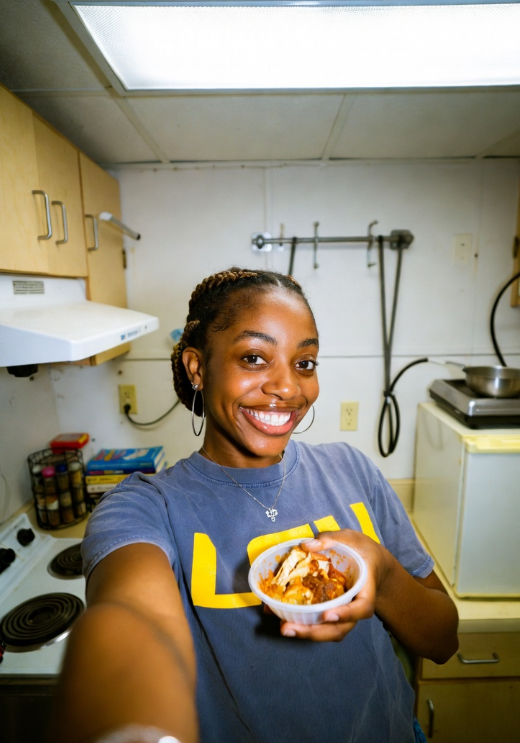
By May. Finals. The last finals before the MCAT. Organic Chemistry II final: the exam that will determine whether my grade rises from A- to A or stays where it has been for four semesters. I studied with the totality of a person who has been fighting this particular war since freshman year and who intends, finally, to win it. The mechanisms. The nomenclature. The synthesis. I drew reaction pathways until my hands ached and then I made jambalaya because aching hands need roux and roux needs aching hands and the circularity is the medicine.
The exam was hard. It was always going to be hard. But the hard felt different this time — not the overwhelmed-hard of freshman year or the desperate-hard of sophomore year, but the competent-hard of a student who knows the material and is being tested at her limit, and the limit is not a wall but an edge, and the standing on the edge is the performance, and the performance was strong. I finished with fifteen minutes left. I checked nothing. I knew.
Grades came a week later: Organic Chemistry II: A. Not A-minus. A. The first A in chemistry. Four semesters of B+ and A-minus and the persistent shadow of "almost" — and then, in the last semester, in the last exam, the shadow lifted and the grade was A and the A was mine. I called MawMaw Shirley. She said, "What happened to the minus?" I said, "It's gone." She said, "Good. The minus was always wrong." She believes this. She has always believed that I was an A student in chemistry, and the B-pluses and A-minuses were the universe making an error that would eventually be corrected. The universe corrected itself. The A is mine. MawMaw Shirley was right, again, about everything.
Cumulative GPA: 3.88. The line holds. The transcript is complete enough now to tell the story: a student who started strong and stayed strong and fought chemistry for four semesters and won. The story is ready for medical school. The MCAT is in six weeks. The roux is darkening.
I made jambalaya the night before the exam because that’s what aching hands reach for — something that requires them, something that pushes back. But the morning the A posted, what I wanted was bread: slow, forgiving, yeasty bread that rises on its own schedule and doesn’t care about your GPA. MawMaw Shirley has made some version of this loaf my entire life, and working the dough felt like calling her before I actually called her — the hands knowing what the voice would say. You knead until it’s right, and then you wait, and then it’s done, and the done is enough.
Home-Style Yeast Bread
Prep Time: 20 min + 90 min rise | Cook Time: 30 min | Total Time: ~2 hours 20 min | Servings: 12 slices (1 loaf)
Ingredients
- 2 1/4 tsp (1 packet) active dry yeast
- 1 cup warm water (105–110°F)
- 1 tbsp granulated sugar, divided
- 1 tsp fine salt
- 2 tbsp vegetable oil, plus more for the bowl
- 3 cups all-purpose flour, plus more for kneading
- 1 tbsp unsalted butter, melted (for brushing)
Instructions
- Proof the yeast. In a large bowl, combine warm water and 1 tsp of the sugar. Sprinkle yeast over the top and let sit 5–10 minutes until foamy. If it doesn’t foam, the yeast is dead — start over with fresh yeast.
- Build the dough. Add remaining sugar, salt, and oil to the yeast mixture and stir to combine. Add flour one cup at a time, stirring after each addition, until a shaggy dough forms and pulls away from the sides of the bowl.
- Knead. Turn dough onto a lightly floured surface and knead for 8–10 minutes until smooth, elastic, and slightly tacky but not sticky. Push the heel of your hand forward, fold the dough back, rotate, repeat. Your hands will know when it’s ready.
- First rise. Shape dough into a ball and place in a lightly oiled bowl, turning once to coat. Cover with a clean kitchen towel and let rise in a warm, draft-free spot for 60 minutes, or until doubled in size.
- Shape. Punch the dough down gently to release gas. Turn onto a lightly floured surface and shape into a tight log roughly the length of your 9x5 loaf pan. Pinch the seam closed and place seam-side down in a greased pan.
- Second rise. Cover loosely and let rise another 30 minutes, until the dough crowns about 1 inch above the rim of the pan. Preheat oven to 375°F during this time.
- Bake. Bake 28–32 minutes until deep golden brown on top and the loaf sounds hollow when tapped on the bottom. Internal temperature should read 190–200°F.
- Finish. Remove from pan immediately and brush the top with melted butter while still hot. Let cool on a wire rack at least 20 minutes before slicing — the interior is still setting and cutting too early will compress the crumb.
Nutrition (per serving)
Calories: 128 | Protein: 3g | Fat: 3g | Carbs: 22g | Fiber: 1g | Sodium: 196mg