
 By
By January 2025. The year I turn forty. The year I go off medication. The year of the experiment. The year that will prove either that the practice is enough or that it is not, and the proving is the living, and the living is the year.
I told my therapist: "I want to stop the SSRI." She was quiet. The quiet was not approval. The quiet was the careful consideration of a therapist who has been watching this patient for twelve years and who has seen the medication work and has seen the patient stable and is now being asked to support a decision she is not sure is wise. She said: "I can support a gradual taper, supervised by your doctor. Not a cold stop." I said: "Gradual. Of course gradual." The gradual was agreed upon. The taper begins this month. The SSRI dose will be reduced over three months: January, February, March. By April, I will be medication-free for the first time since I was fifteen years old. The sentence is both liberation and vertigo. The liberation is the goal. The vertigo is the cost.
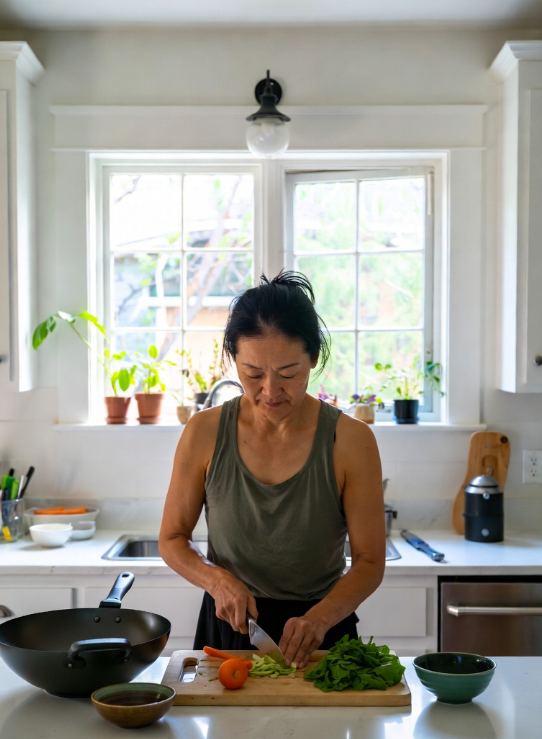
I made Fumiko's ozoni for New Year's morning — Miya made hers, side by side, the annual doubling, two pots, two soups, mother and daughter, the practice doubled. The doubling was the stability. The stability was real. The stability is what I am trusting when I trust that the medication can be removed. The stability is the pot and the dashi and the miso and the chipped bowl and the morning and the practice and the ten years of daily soup that have built something inside me that the medication built alongside but that maybe — maybe — can stand alone.
I wrote a blog post about New Year's resolutions — or the lack thereof. The post was about the practice of not-resolving, of simply continuing, of making the same soup every morning without promising to make it differently. The post was shared three thousand times. The message resonated: stop trying to change. Start continuing. The continuing is the change. The practice is the resolution. The miso soup does not need to be new. The miso soup needs to be made.
After the ozoni was finished and the bowls were in the sink, Miya poured two glasses of these cranberry mimosas — she’d made them last New Year’s too, and the year before that, and the repetition felt exactly right. I had just told her about the taper. She didn’t say much. She handed me the glass, and we clinked, and it was the kind of toast that isn’t about celebration so much as acknowledgment: we are still here, we are still doing this, the soup was good, the year is beginning. If the miso soup is the practice, the mimosa is the punctuation — the small, sparkling signal that the morning is complete.
Holiday Cranberry Mimosas
Prep Time: 5 minutes | Cook Time: 0 minutes | Total Time: 5 minutes | Servings: 6
Ingredients
- 1 bottle (750 ml) dry Champagne or Prosecco, well chilled
- 2 cups 100% cranberry juice, chilled
- 1/2 cup orange juice, freshly squeezed, chilled
- 2 tablespoons simple syrup (optional, to taste)
- Fresh cranberries, for garnish
- Fresh rosemary sprigs, for garnish (optional)
- Orange slices or twists, for garnish (optional)
Instructions
- Combine the juices. In a small pitcher, stir together the cranberry juice and orange juice. Taste and add simple syrup if you prefer a slightly sweeter base. Chill until ready to serve.
- Chill your glasses. Place Champagne flutes in the refrigerator for 10–15 minutes before serving, or set them out at room temperature if you’re serving immediately.
- Pour and top. Fill each Champagne flute about one-third full with the cranberry-orange juice mixture. Slowly pour chilled Champagne or Prosecco over the back of a spoon to the top of the glass, allowing it to settle gently and preserve the bubbles.
- Garnish and serve. Drop 2–3 fresh cranberries into each glass. Add a small sprig of rosemary or an orange twist if desired. Serve immediately.
Nutrition (per serving)
Calories: 115 | Protein: 0g | Fat: 0g | Carbs: 11g | Fiber: 0g | Sodium: 5mg