February is the worst month. I say this with conviction. January has New Year's energy. March has the promise of spring. February has nothing. February is gray and cold and thirty days of waiting (twenty-eight, technically, but it FEELS like thirty).
Dana and I have settled into our second-semester routine. Library table on Tuesdays and Thursdays, coffee from the student union that tastes like it was brewed by someone who hates coffee and humanity equally, and study sessions that are fifty percent studying and fifty percent complaining about the cold. Dana is taking psychology this semester, which means she now analyzes everything I say through a Freudian lens, which is exhausting.
'You talk about your mom's cooking a lot,' she said on Tuesday.
'I eat my mom's cooking a lot. It's relevant.'
'But the way you describe it — it's not about the food. It's about her. You're documenting her.'
Dana is too smart for someone who eats PB&J every day. But she's not wrong. I AM documenting Mom. I just didn't have that word for it until now.
Mom made her beef and broccoli this week — one of her 'fake takeout' recipes that she developed because ordering actual takeout on a military budget was a treat reserved for birthdays and PCS days when the kitchen was in boxes. Her version: flank steak sliced thin against the grain, marinated in soy sauce, cornstarch, and garlic, then stir-fried fast in a screaming hot pan with broccoli florets and a sauce of soy sauce, oyster sauce, brown sugar, and sesame oil. Over rice. Tastes exactly like the Chinese takeout it's pretending to be, costs three dollars instead of fifteen.
I asked Mom where she learned to make it and she said, 'I don't remember. Some base somewhere. Another wife taught me.' This is how recipes travel in the military community — from wife to wife, base to base, scribbled on index cards and passed across kitchen tables. There's no attribution, no credit, no cookbook. Just women feeding families and sharing what they know.
It's a tradition that's invisible to anyone outside it. These recipes — the fake takeout, the casseroles, the slow cooker meals that survive twelve-hour days — they're a body of knowledge that exists entirely in the hands and memories of military spouses. Nobody teaches this in culinary school. Nobody writes a book about it. But it's as real and as important as any cookbook on any shelf.
Someday, maybe, I'll be the one to write it down.
That thought came from nowhere and hit me like a truck. I'm sitting at the kitchen table watching Mom stir-fry beef and broccoli and I'm thinking: someone should write this down. All of it. The budget meals. The deployment cooking. The way these women feed families on nothing and make it look like plenty.
Someone should. Maybe that someone is me.
Or maybe I'm just hungry. Hard to tell at nineteen. (Almost nineteen. December baby. Close enough.)
Watching Mom work that wok — the sizzle, the steam, the way she moved like she’d done it a thousand times because she had — I didn’t want to just observe anymore. I wanted to do it myself, to get my hands into the kind of cooking that had been feeding our family through every deployment and tight month I could remember. So that night I made my own version: hoisin chicken rice bowls, fast and cheap and exactly the kind of meal nobody writes a book about but everybody needs to know.
Hoisin Chicken Rice Bowls
Prep Time: 15 min | Cook Time: 15 min | Total Time: 30 min | Servings: 4
Ingredients
- 1 1/2 lbs boneless, skinless chicken thighs, sliced thin against the grain
- 2 tablespoons cornstarch
- 1/2 teaspoon kosher salt
- 1/4 teaspoon black pepper
- 2 tablespoons vegetable oil, divided
- 3 cloves garlic, minced
- 1 teaspoon fresh ginger, grated
- 2 cups broccoli florets
- 1 red bell pepper, sliced thin
- 1/2 cup shredded carrots
- 3 green onions, sliced, for serving
- Sesame seeds, for serving
- Steamed white rice, for serving
- For the sauce:
- 1/3 cup hoisin sauce
- 3 tablespoons low-sodium soy sauce
- 1 tablespoon rice vinegar
- 1 tablespoon sesame oil
- 1 tablespoon brown sugar
- 1 teaspoon cornstarch
- 2 tablespoons water
Instructions
- Make the sauce. Whisk together hoisin sauce, soy sauce, rice vinegar, sesame oil, brown sugar, cornstarch, and water in a small bowl until smooth. Set aside.
- Prep the chicken. Toss sliced chicken thighs with cornstarch, salt, and pepper until evenly coated. This step is non-negotiable—it gives the chicken that glossy, restaurant-style finish.
- Get the pan screaming hot. Heat 1 tablespoon of vegetable oil in a large skillet or wok over high heat until shimmering and just beginning to smoke. High heat is what makes this taste like takeout instead of a sad home attempt.
- Sear the chicken. Add chicken in a single layer—don’t crowd the pan. Cook undisturbed for 2–3 minutes until golden, then flip and cook another 1–2 minutes. Transfer to a plate.
- Cook the vegetables. Add remaining tablespoon of oil to the pan. Add broccoli and bell pepper. Stir-fry over high heat for 3–4 minutes until broccoli is bright green and just tender-crisp. Add garlic, ginger, and shredded carrots; stir-fry 60 seconds until fragrant.
- Bring it together. Return chicken to the pan. Pour sauce over everything and toss to coat. Cook 1–2 minutes, stirring constantly, until sauce thickens and everything is glossy and well-coated.
- Serve. Spoon over steamed white rice. Top with sliced green onions and a pinch of sesame seeds. Serve immediately while the pan is still talking.
Nutrition (per serving, excluding rice)
Calories: 340 | Protein: 36g | Fat: 13g | Carbs: 18g | Fiber: 2g | Sodium: 820mg
About the cook who shared this
Rachel Abernathy
Week 45 of Rachel’s 30-year story
· San Diego, California
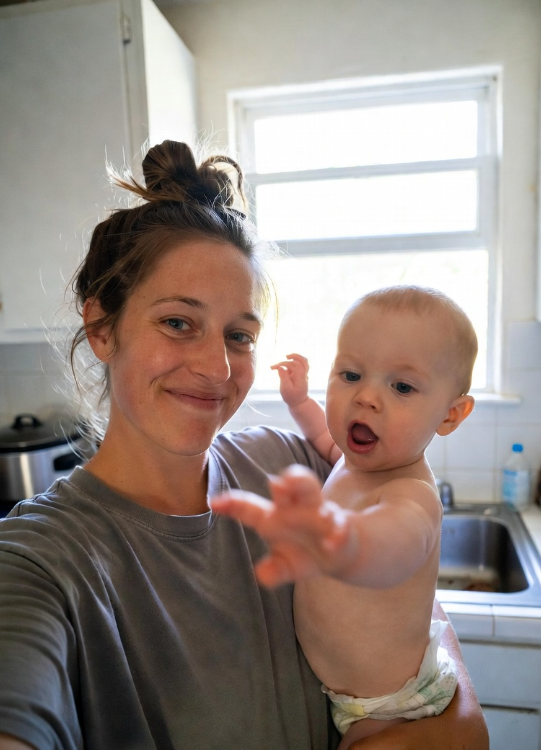
Rachel is a twenty-eight-year-old Marine wife and mom of two who has moved five times in six years and learned to cook a Thanksgiving dinner with half her cookware still in boxes. She married young, survived postpartum depression, and feeds her family of four on a junior Marine's salary with a freezer full of pre-made meals and a crockpot that has never let her down. She writes for the military spouses who are cooking dinner alone in base housing and wondering if they're enough. You are.
