
 By
By The house is quiet in a way it has never been quiet before. Not empty — there are people in and out, Denise every day, Kayla before and after shifts, Patricia from Jacksonville, Earl Jr. stayed through the weekend — but quiet in the way that a house is quiet when the person who made it a home is gone. The recliner is in the living room. I can't move it. I can't sit in it. I can't look at it without seeing him there, eyes closed, remote on the floor, gone.
People bring food. This is what people do in the South when someone dies — they bring food, because grief makes you forget to eat and casseroles are the physical form of "I'm sorry." Sister Mae brought a ham. Gladys brought her peach cobbler, and this time I didn't have a single thing to say about it. The Johnsons brought fried chicken. Miss Corrine, who is eighty-four and can barely carry a bag of groceries, brought a pound cake she made herself, and I cried when I saw it because that woman stood in her kitchen and baked for me, and that is more love than a card or a flower could ever hold.
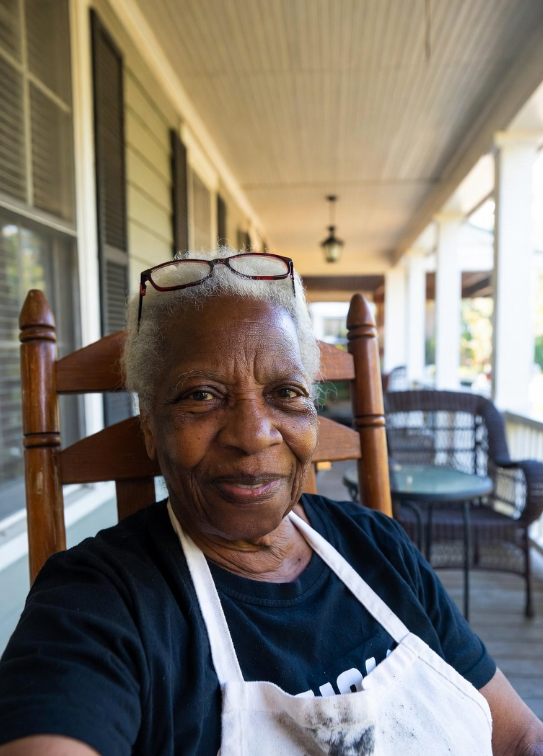
I have not cooked. I don't know how to say that — me, Dorothy Henderson, the woman who has cooked every day since she was ten years old, who has fed four hundred children a day for thirty-three years, who has made Sunday dinner for forty-three years, who has never not cooked — I have not cooked. The kitchen is dark. The stove is cold. The cast iron skillet sits on the burner where I left it after Valentine's Day, and I can't touch it. I can't touch anything that reminds me of making food for a man who isn't here to eat it.
Denise tries. She comes over and makes scrambled eggs, heats up soup, puts a plate in front of me. I eat some of it. Not because I'm hungry — I don't think I'll ever be hungry again — but because Denise needs me to eat, and I can do that for her even when I can't do it for myself.
The flowers from the funeral are wilting on every surface. The house smells like dying flowers and cold food. The pink carnations — his last pink carnations — are still on the kitchen table. I won't throw them away. I know they'll die. Everything dies. Let them die on the table where he put them. Let them stay until they're dust.
I am sixty-three years old and I am alone for the first time in my adult life. The bed is too big. The mornings are too quiet. The evenings are endless. I sit in the kitchen — not cooking, just sitting — and I look at the garden through the window and I see him everywhere. His chair by the beds. His stakes in the tomato cages. His hands in the soil. He is in every corner of this house and he is nowhere in this house, and I don't know how to live in that contradiction.
Sister Mae’s ham has been sitting in my refrigerator, wrapped in two layers of foil, for eleven days. I haven’t been able to touch it — not because I didn’t want to, but because pulling it out meant doing something, and doing something meant getting up, and some mornings getting up is the whole battle. But Denise came over on Tuesday and said, real quiet, “Mama, we ought to use that ham before it turns,” and something in that plain, practical sentence cut through. This soup isn’t me cooking. It’s me letting the ham Sister Mae brought finish what she started — one more act of love, slow and warm, filling the house with something that smells like a kitchen that’s still alive.
Hearty Ham and Bean Soup
Prep Time: 15 minutes | Cook Time: 1 hour 30 minutes | Total Time: 1 hour 45 minutes | Servings: 8
Ingredients
- 2 cups diced cooked ham
- 1 lb dried Great Northern beans (or navy beans), rinsed and sorted
- 1 medium yellow onion, diced
- 3 stalks celery, sliced
- 3 medium carrots, peeled and sliced
- 4 cloves garlic, minced
- 1 ham hock (optional, for deeper flavor)
- 8 cups low-sodium chicken broth
- 2 cups water
- 1 bay leaf
- 1 tsp dried thyme
- 1/2 tsp black pepper
- 1/4 tsp smoked paprika
- Salt to taste
- 2 tbsp olive oil
- Fresh parsley, chopped, for garnish
Instructions
- Soak the beans. Place dried beans in a large bowl, cover with cold water by 2 inches, and soak overnight or at least 8 hours. Drain and rinse before using. For a quick soak, cover beans with water in a pot, bring to a boil for 2 minutes, remove from heat, and let sit 1 hour before draining.
- Saute the aromatics. In a large heavy-bottomed pot or Dutch oven, heat olive oil over medium heat. Add diced onion, celery, and carrots and cook, stirring occasionally, for 6–8 minutes until softened. Add garlic and cook 1 minute more until fragrant.
- Build the soup base. Add the drained beans, diced ham, ham hock (if using), chicken broth, and water to the pot. Stir in the bay leaf, thyme, black pepper, and smoked paprika. Bring to a boil over high heat.
- Simmer low and slow. Reduce heat to low, cover with the lid slightly ajar, and simmer for 1 hour to 1 hour 15 minutes, stirring occasionally, until beans are completely tender and beginning to break down. Add more water or broth if the soup thickens too much.
- Finish and season. Remove the bay leaf and ham hock. If a ham hock was used, pull any meat from the bone, shred it, and return the meat to the pot. Taste and adjust salt as needed. For a creamier texture, use the back of a spoon to smash some of the beans against the side of the pot and stir them in.
- Serve. Ladle into bowls and garnish with fresh chopped parsley. Serve with cornbread or crusty bread on the side.
Nutrition (per serving)
Calories: 285 | Protein: 22g | Fat: 6g | Carbs: 34g | Fiber: 9g | Sodium: 680mg