
 By
By Mid-May. Sofia ran at the state meet on Saturday. She finished fourth in the 800. She ran a 2:11.4. The winner — a senior from a 6A school — ran a 2:09. Sofia missed the podium by one place but the podium counts top three and Sofia was the only freshman in the final and the highest-finishing freshman in the entire field. Her coach hugged her. Anya, who finished sixth and is graduating, hugged her. I hugged her. Lisa hugged her. Diego, who came to the meet — he had no school commitments and made a point of being there — hugged her hard enough to lift her off the ground, which she protested but did not actually try to escape from. Sofia is fourteen. Sofia is going to break that 2:09 by next spring. Sofia is going to be a state champion before she graduates. The trajectory is locked in. The only question is which year.
The drive home from the state meet was two hours. Sofia sat in the back seat with her medal in her lap. (Fourth place gets a medal in Colorado high school track. The state association is generous with hardware.) She did not say much for the first hour. She just looked at the medal. Then she said, "I want to do this in college." Lisa said, "Where." Sofia said, "I do not know. Somewhere where I can also study what I want to study." Diego said, "What do you want to study." Sofia said, "I do not know yet." Diego said, "But you know you want to run." Sofia said, "I know I want to run. The studying part can wait until I figure it out." Lisa and I looked at each other. We did not say anything. Sofia is fourteen. She does not need to have it figured out. Hearing her say "I want to do this in college" was the first time she had articulated a vision for her own future out loud, and I will keep that sentence forever.
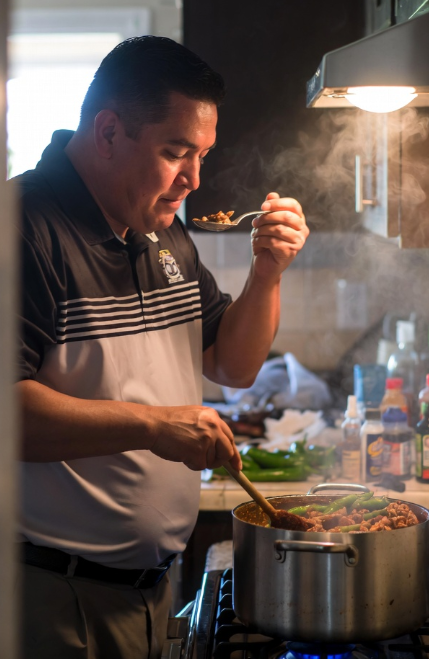
Saturday night I made al pastor. Al pastor is a Mexico City dish — pork shoulder marinated in adobo with pineapple and chiles, slow-cooked or rotisseried until charred at the edges and tender inside, served on small corn tortillas with raw onion, cilantro, lime, and a slice of pineapple. It is one of the great food inventions of the twentieth century. It is not, again, New Mexican. The Lebanese immigrants who brought the spit-roasting technique to Mexico City in the 1920s were not particularly concerned with whether their dish would eventually be adopted by a coach in Denver who would protest about Tex-Mex enchiladas while making al pastor with no apparent sense of contradiction. The contradiction is acknowledged. The al pastor is delicious. We move on.
I do not have a vertical spit. I make al pastor on the Weber kettle with a homemade trompo using a beer can in a pineapple, which is a YouTube technique I learned five years ago and have refined since. You marinate the pork — sliced thin, about a quarter-inch — overnight in achiote, guajillo, ancho, vinegar, garlic, oregano, cumin, and pineapple juice. You stack the slices on a beer can stuck into a hollowed-out pineapple. You cook over indirect heat, basting occasionally with the marinade. You shave slices off the edge as it cooks. The smell when this works is one of the great smells of the year. Lisa came out of the house when I was three hours into the cook and said, "Carlos, I am starving and I will not be able to wait for whatever you are doing to be done." I said, "Twenty more minutes." She said, "Fine. Just so you know." She went back inside.
The al pastor came off the spit at six-thirty. I sliced. I served. Twelve people came to dinner, because we had told the family at lunch that we were celebrating Sofia's state finish, and word had gotten around to our neighbors who had asked very politely if they could stop by, and Lisa had said yes, and so we ended up with the four of us, Hayley, Hayley's parents, the Singhs from across the street, the Petersens from down the block, and Coach Davis and his wife who had driven down from Aurora. Tony brought a bottle of mezcal that he had picked up in Oaxaca three years ago. We did not drink it. (I have not had a drink in twenty-four years, Tony has not had a drink in eight, the rest of the adults at the table did not really drink either.) But Tony brought the bottle as a ceremonial gesture — to commemorate Sofia's race, to acknowledge a Saturday night that mattered. We poured small thimbles of it into shot glasses and we toasted Sofia, and Sofia, who has never had a sip of alcohol in her life, lifted her thimble and said, "Thanks, everyone." She did not drink it. She handed it to Diego, who did not drink it either. We all just lifted our glasses. The toast was the point. The mezcal was the symbol.
The al pastor disappeared. I had cooked enough for twenty-five and we ate every gram of it. Diego ate eight tacos. Tony ate seven. The Singhs' kids — three boys, all under twelve — ate the rest. I had grilled extra pineapple chunks for the side. Lisa had made arroz rojo. The Petersens brought a flan. Hayley ate her al pastor with the practiced enthusiasm of a girl who had figured out, by month two of dating Diego, that the path to the family's heart was through the food. Hayley is going to be okay.
Sunday morning I sat on the patio with Lisa at seven and re-read the program from the meet. Sofia's name was printed in the heat sheet. Fourth place. State finalist. Freshman. I will keep the program for the rest of my life. I will keep the medal too, after Sofia is done caring about it, in the same drawer as Diego's prom card and the photos and the holy cards I have collected from family funerals. The drawer is filling up. The drawer is the closest thing I have to a memoir. Feed your people. The game is won at the table. The game is also won in the eight hundred meters at a state meet on a Saturday in May, at fourth place, by a freshman.
The Petersens brought a flan that night, and it was gone in minutes — but the flavor I kept coming back to all weekend was pineapple: in the marinade, on the grill, in the thimbles of mezcal nobody drank. When a single ingredient threads itself through an entire day like that, you follow it. Hawaiian cake is the version of that instinct that lives in the dessert drawer. It is simple, it feeds a crowd, and it carries the same bright sweetness that made the al pastor smell the way it did at six-thirty on a Saturday in May when Sofia had a fourth-place medal in her lap and a college vision forming somewhere in the back of her mind.
Hawaiian Cake
Prep Time: 15 minutes | Cook Time: 35 minutes | Total Time: 50 minutes | Servings: 12–15
Ingredients
- 2 cups all-purpose flour
- 2 cups granulated sugar
- 2 large eggs
- 1 teaspoon baking soda
- 1/2 teaspoon salt
- 1 teaspoon vanilla extract
- 1 can (20 oz) crushed pineapple, undrained
- 1/2 cup chopped walnuts or pecans (optional)
For the cream cheese frosting:
- 8 oz cream cheese, softened
- 1/2 cup (1 stick) unsalted butter, softened
- 2 cups powdered sugar, sifted
- 1 teaspoon vanilla extract
- Pinch of salt
Instructions
- Preheat and prep. Heat your oven to 350°F. Grease a 9x13-inch baking pan and set aside.
- Mix the batter. In a large bowl, combine the flour, sugar, eggs, baking soda, salt, and vanilla. Stir in the entire can of crushed pineapple — juice and all — until the batter just comes together. Fold in the nuts if using. Do not overmix.
- Bake. Pour the batter into the prepared pan and spread evenly. Bake for 30–35 minutes, until the top is golden and a toothpick inserted in the center comes out clean. Let the cake cool completely in the pan before frosting.
- Make the frosting. Beat the cream cheese and butter together with a hand mixer on medium speed until smooth and fluffy, about 2 minutes. Add the sifted powdered sugar, vanilla, and a pinch of salt. Beat on low until incorporated, then increase to medium-high and beat until light, about 1 more minute.
- Frost and serve. Spread the cream cheese frosting over the cooled cake in an even layer. Cut into squares and serve directly from the pan. Store leftovers covered in the refrigerator for up to 4 days — though at a table of twelve, there will not be any.
Nutrition (per serving)
Calories: 420 | Protein: 5g | Fat: 16g | Carbs: 66g | Fiber: 1g | Sodium: 240mg