
 By
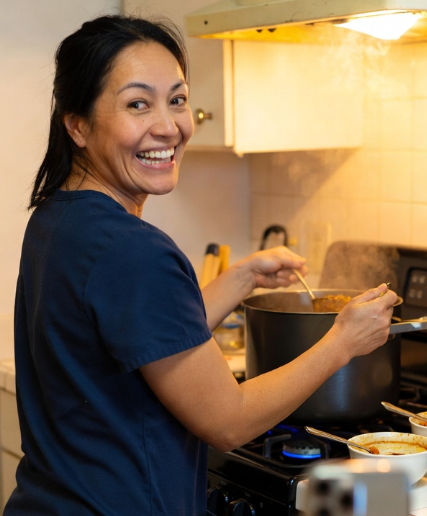
By Halloween week. The Filipino Community Halloween Pageant Saturday. Three hundred people. I was on lumpia duty with Lourdes. We made three hundred fifty lumpia in the Mountain View basement on Friday.
Lourdes is 74. She is in the kitchen. She is luminous. Joseph said something funny Sunday on the phone. I do not remember exactly what. The funny is the brother.
I made lechon kawali Saturday. The pork belly, the brining, the deep fry, the crackle. The kitchen smelled of hot oil for two days.
A reader wrote me a long email this week about her grandmother's adobo, which differed from mine in every measurement. The differences were the conversation. I wrote her back. The writing back is the work.
I sat at the kitchen table Sunday night with the bowl in front of me. The bowl was warm. The bowl was the prayer.
I took a walk on the coastal trail Saturday. The light was good. The body was tired but moving.
Auntie Norma called Sunday afternoon. She is now seventy-nine. She wanted a recipe. I gave it to her. She wanted to know how my week was. I told her, briefly. She told me about her week. The exchange took eighteen minutes. The eighteen minutes was the keeping.
I checked email at the kitchen table while the rice cooked. There were one hundred and twenty unread messages. I closed the laptop. The unread can wait.
The neighbors invited us over for a small dinner Thursday. They are an Iñupiaq family — Aana and her grandson Joe. We ate caribou stew and rice. I brought lumpia. The kitchens of Anchorage have always been the small UN. The food is the proof.
I read a chapter of a novel before bed each night this week. The novel was about a Filipina nurse in California. The novel was good. The novel was, in some way, my own life adjacent.
The grocery store had no calamansi. I substituted lime. The substitution was acceptable. The acceptable is the working version of perfect.
I cleaned the kitchen Sunday afternoon. I wiped the stove. I scrubbed the sink. I reorganized the spice cabinet. The cleaning was the small reset. The reset was the marker. The marker said: the week is over, the next week begins, the kitchen is ready.
The salmon in the freezer is from August. Joseph's catch. The bag is labeled in his handwriting — "for Grace." I will use it next week.
Lourdes called me twice this week. The first call was about a church event. The second was about a recipe variation she had remembered from her childhood. The remembering was the gift.
The light was good Saturday morning. I sat on the porch with a cup of coffee and watched the inlet for forty minutes. The watching was the small therapy. The therapy was free.
The Filipino Community newsletter announced a fundraiser for typhoon relief in Samar. I committed to making three hundred lumpia. The number is the number. The number has always been the number. Three hundred is what I make. The math has stopped surprising me.
I drove the Glenn Highway out to Eklutna on Saturday. The mountains were the mountains. The lake was the lake. The body needed the open road. The open road did its work.
I made tea late at night. The tea was the small comfort. The comfort was the marker.
Auntie Norma called Sunday to ask if I had a recipe for a particular merienda from Iloilo. I did not. I said I would ask Lourdes. I asked Lourdes. Lourdes had it. The chain.
The lechon kawali was the centerpiece, the crackle that filled the kitchen for two days — but after the pageant, after three hundred lumpia, after Auntie Norma and Lourdes and the inbox I closed without opening, what I wanted Saturday morning was something quieter and still crisp. Hash browns. The cast iron, the shredded potato, the hot oil doing its patient work. The kitchen had already proven it could hold the big things. The hash brown is the small proof. The small proof is the one I come back to.
Hash Brown Potatoes
Prep Time: 15 min | Cook Time: 20 min | Total Time: 35 min | Servings: 4
Ingredients
- 2 lbs russet potatoes, peeled
- 1/2 teaspoon kosher salt, plus more to taste
- 1/4 teaspoon black pepper
- 1/4 teaspoon garlic powder (optional)
- 3 tablespoons neutral oil (vegetable or canola), divided
- 1 tablespoon unsalted butter
Instructions
- Grate the potatoes. Using a box grater or food processor, coarsely grate the peeled potatoes into a large bowl.
- Remove moisture. Transfer the grated potatoes to a clean kitchen towel or several layers of cheesecloth. Squeeze firmly and repeatedly until as much liquid as possible has been removed — this is the key to the crackle.
- Season. Return the dried potato shreds to the bowl. Toss with salt, pepper, and garlic powder if using. Mix to distribute evenly.
- Heat the pan. Heat a 10- or 12-inch cast iron or heavy skillet over medium-high heat. Add 2 tablespoons of oil and the butter. When the butter foams and subsides, the pan is ready.
- Press and cook. Add the potato mixture in an even layer, pressing down firmly with a spatula to compact it. Cook undisturbed for 8–10 minutes, until the bottom is deep golden brown and crisp.
- Flip and finish. Slide the hash brown onto a large plate, add the remaining tablespoon of oil to the pan, then invert the hash brown back into the skillet. Cook for another 7–9 minutes until the second side is equally golden and crisp.
- Rest and serve. Transfer to a cutting board, let rest 2 minutes, then cut into wedges. Season with additional salt to taste and serve immediately.
Nutrition (per serving)
Calories: 230 | Protein: 4g | Fat: 11g | Carbs: 30g | Fiber: 2g | Sodium: 310mg