Raj and I had our first real fight as a married couple this week, and it was, predictably, about family.
His mother called on Tuesday to ask what we were doing for her birthday (July 23). Raj said we'd come to their house for dinner. Pushpa said she wanted us to host — at our apartment. Raj agreed without asking me.
The problem isn't hosting. I like hosting. The problem is that Raj committed us to a dinner party for twelve people (his parents, his sister's family, two aunties) in our two-bedroom apartment with one week's notice and didn't think to mention it until Wednesday.
"You could have asked," I said.
"I thought you'd be happy. You love cooking for people."
"I love cooking for people when I have more than five days to plan a dinner for twelve in an apartment where the dining table seats four."
He didn't understand why I was upset. This is the thing about Raj — he is kind and thoughtful in the big moments and completely oblivious in the small ones. He sees "dinner party" and thinks "Priya will make something amazing." He doesn't see the grocery shopping, the menu planning, the cleaning, the logistics of seating twelve people, the invisible labor that makes hospitality look effortless.
We had a sharp exchange — not screaming, we don't scream, but the cold, precise kind of argument that's somehow worse — and then Raj went quiet and I went to the kitchen, because that's what I do. I made rasam. Not because anyone was hungry, but because rasam takes twenty minutes and requires concentration and the pepper and cumin and garlic need me to pay attention to them instead of to my anger.
By the time the rasam was done, I was calmer. Raj came into the kitchen and said, "I should have asked you first. I'm sorry." Simple. Direct. No qualifications.
"Yes," I said. "You should have."
We drank the rasam together, standing at the counter, and talked about how we want to handle family obligations going forward. Rule one: no commitments without consulting each other. Rule two: hosting is a joint decision. Rule three: when in doubt, make rasam.
I'm planning the birthday dinner now. Twelve people, four-seat dining table, one week. I'm going to make it work because I'm Lakshmi Krishnamurthy's daughter and making it work is what we do.
Menu so far: Gujarati dal, jeera rice, paneer tikka, green chutney, gulab jamun for dessert. Pushpa's favorites. I'll make it with love, but I'll also make Raj do the dishes. All of them.
Rasam is my anger recipe, but what I’ve learned is that the medicine isn’t rasam specifically — it’s the act of making something that won’t tolerate distraction. Harissa has exactly that quality: the dried chilies need to be soaked just right, the caraway seeds need to be toasted without burning, the garlic and lemon need to be balanced against the heat, and somewhere in all of that, the cold precise argument you just had starts to lose its grip on you. I make a batch every few weeks now, and it sits in a jar in our fridge as a reminder that Raj does the dishes and I get to cook things that require my whole attention.
Harissa
Prep Time: 20 min | Cook Time: 5 min | Total Time: 25 min | Servings: 12 (makes about 1 cup)
Ingredients
- 10 dried red chilies (such as ancho or guajillo), stems and seeds removed
- 4 cloves garlic, roughly chopped
- 1 teaspoon ground cumin
- 1 teaspoon ground coriander
- 1/2 teaspoon caraway seeds
- 1/2 teaspoon smoked paprika
- 1/2 teaspoon crushed red pepper flakes (optional, for extra heat)
- 3/4 teaspoon kosher salt, plus more to taste
- 2 tablespoons fresh lemon juice
- 4 tablespoons extra-virgin olive oil, divided, plus more for storing
Instructions
- Soak the chilies. Place the dried chilies in a heatproof bowl and cover with boiling water. Let soak for 15–20 minutes until softened and pliable. Drain well, pressing out excess moisture.
- Toast the caraway seeds. While the chilies soak, add the caraway seeds to a small dry skillet over medium heat. Toast, shaking the pan occasionally, for 1–2 minutes until fragrant. Remove immediately and let cool.
- Blend the base. Transfer the drained chilies, toasted caraway seeds, garlic, cumin, coriander, smoked paprika, red pepper flakes (if using), and salt to a food processor or high-speed blender. Pulse several times to break everything down.
- Emulsify with oil and lemon. With the processor running, drizzle in the lemon juice and 3 tablespoons of the olive oil. Blend until a smooth, thick paste forms, stopping to scrape down the sides as needed. If the paste seems too thick, add the remaining tablespoon of olive oil.
- Taste and adjust. Taste the harissa and adjust salt, lemon, or heat to your preference. The flavor will deepen as it sits.
- Store. Transfer to a clean jar and smooth the top. Pour a thin layer of olive oil over the surface to preserve freshness. Seal and refrigerate for up to 3 weeks.
Nutrition (per serving, approx. 4 tsp)
Calories: 58 | Protein: 1g | Fat: 5g | Carbs: 4g | Fiber: 1g | Sodium: 148mg
About the cook who shared this
Priya Krishnamurthy
Week 16 of Priya’s 30-year story
· Edison, New Jersey
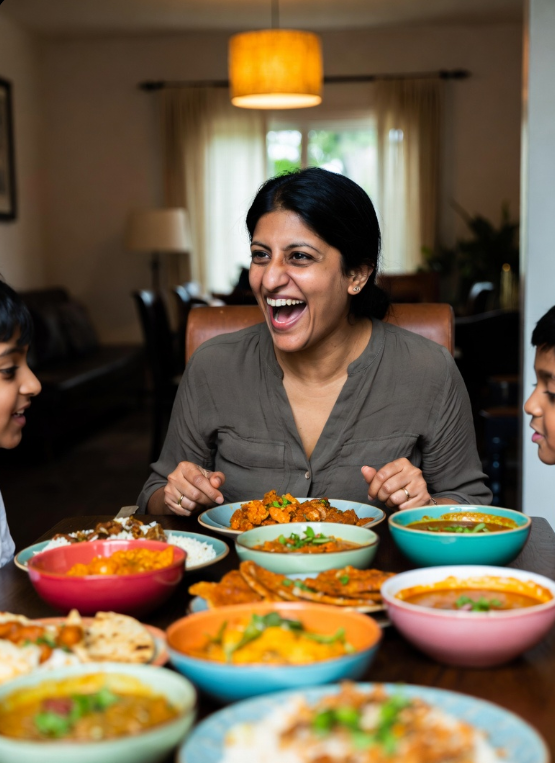
Priya is a pharmacist, wife, and mom of two in Edison, New Jersey — the town she grew up in, surrounded by the sights and smells of her mother's South Indian kitchen. These days, she splits her time between the hospital pharmacy, school pickups, and her own kitchen, where she cooks nearly every night. Her style is a blend of the Tamil recipes her mother taught her and the American comfort food her kids actually want to eat. She writes about the beautiful mess of balancing two cultures on one plate — and she wants you to know that ordering pizza is also an act of love.
