
 By
By The world closed. On March 16, 2020, the governor of Texas issued guidelines. Restaurants and bakeries: no indoor dining. Schools: closed. Gatherings: prohibited. The virus — the thing I said would not come here — came here. It came to El Paso, to the Lower Valley, to Dyer Street, to the door of Panadería Rosa, and the door is now locked to everyone except takeout customers and the fear that has replaced the air inside.
I locked the dining room on Tuesday. I stood at the door and I turned the lock and the click of the lock was the loudest sound I have heard since Rosa's name in Carmen's mouth at 6 AM. The lock said: the bakery is closed. Not the bakery — the dining room. The kitchen is open. The ovens are on. The conchas are being made. But the tables — the eight tables where Doña Esperanza sits every morning and the construction workers eat their burritos and the west-side couple eats their Saturday conchas — the tables are empty, and the emptiness is not the emptiness of closing time but the emptiness of a world that has stopped coming through the door.
Sofia pivoted within twenty-four hours. She set up a takeout counter at the door — a table, a card reader, a sign: TAKEOUT ONLY — CONCHAS, EMPANADAS, TORTAS, SOUP. She posted on Instagram: "We're still here. We're still baking. Come to the door and we'll hand you bread." The post got five hundred likes. The customers came. Not as many as before — maybe half — but they came. They stood outside in the parking lot and waited and I handed them bags of conchas through the door and the handing was the communion, the only physical contact the virus allowed, the passing of bread from my hands to theirs, the bridge between the inside and the outside, between the baker and the world.
Schools are closed. Isabella, Sofia, Diego, and Camila are home. Remote learning begins next week, which means four children on four devices in four rooms pretending to learn while the internet strains and the house vibrates with the particular chaos of children who are supposed to be in school but are not. Diego has already taken apart his webcam and rebuilt it with a better angle. Camila is singing during her Zoom classes, which her teacher either loves or tolerates (I suspect tolerates).
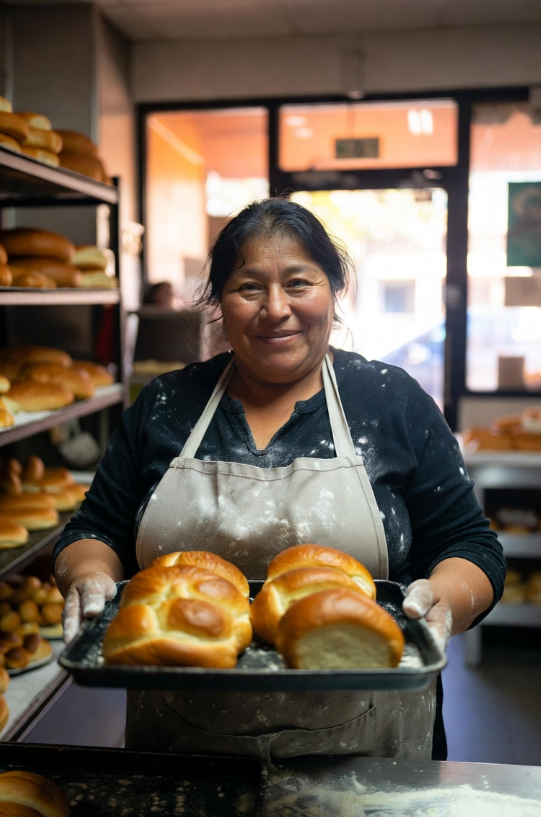
I did not stop baking. I cannot stop baking. The bakery may close its dining room but the kitchen will not close, because the kitchen is the only room that does not need permission from a virus to exist. The conchas will be made. The flour will be mixed. The ovens will turn on at 4 AM. I will be there. The virus can have the tables. It cannot have the kitchen. It cannot have the flour. It cannot have Rosa's recipes. Some things are not negotiable. The bread is not negotiable.
The conchas kept Panaderaía Rosa alive through those first locked weeks — handed through a door, passed bag by bag into the parking lot — and they reminded me that bread does not need a dining room to mean something. When customers at home started asking how to fill the gap on the days they couldn’t make it to the door, I kept coming back to this recipe: soft, pull-apart hamburger buns that anyone can make with pantry staples, the kind of dough that asks you to slow down and use your hands. If my ovens at 4 AM taught me anything during those months, it’s that the act of mixing flour and waiting for it to rise is its own kind of insistence — proof that something living is still happening inside the house.
Hamburger Buns
Prep Time: 20 min | Cook Time: 15 min | Total Time: 2 hr 35 min | Servings: 12
Ingredients
- 1 package (1/4 oz) active dry yeast
- 1 cup warm water (110° to 115°F)
- 1/4 cup sugar
- 3 tablespoons unsalted butter, softened
- 1 large egg, room temperature
- 1 teaspoon salt
- 3 to 3-1/2 cups all-purpose flour, divided
- 1 tablespoon melted butter (for brushing)
- Sesame seeds, optional
Instructions
- Activate yeast. In a large bowl, dissolve yeast in warm water and let stand 5 minutes until foamy. Add sugar, softened butter, egg, salt, and 1 cup of flour; beat on medium speed until smooth, about 2 minutes.
- Build the dough. Stir in enough of the remaining flour, 1/2 cup at a time, to form a soft dough that pulls away from the sides of the bowl but is not sticky.
- Knead. Turn dough out onto a lightly floured surface and knead until smooth and elastic, 6–8 minutes. The dough should spring back when poked.
- First rise. Place dough in a lightly greased bowl, turning once to coat the top. Cover with a clean towel and let rise in a warm place until doubled in size, about 1 hour.
- Shape the buns. Punch dough down. Divide into 12 equal pieces and roll each into a smooth ball. Place balls 3 inches apart on greased baking sheets and press down gently to flatten into a disk about 3-1/2 inches wide.
- Second rise. Cover loosely and let rise until doubled, about 30–35 minutes. Meanwhile, preheat oven to 375°F.
- Finish and bake. Brush tops with melted butter and sprinkle with sesame seeds if using. Bake 12–15 minutes or until golden brown and the buns sound hollow when tapped on the bottom.
- Cool. Transfer to a wire rack and cool at least 10 minutes before slicing. Buns can be stored in an airtight bag at room temperature for up to 3 days, or frozen for up to 2 months.
Nutrition (per serving)
Calories: 168 | Protein: 4g | Fat: 4g | Carbs: 28g | Fiber: 1g | Sodium: 210mg