
 By
By Friday morning, I pulled into the driveway at 7:14 a.m. I know the time because I looked at the clock on the dash and thought: fifty-three hours. That’s how long I’d been at Station 19. We had a shift extension because Martinez called in sick and somebody had to cover. Nobody argues about it. That’s the deal.
The house was quiet. Jessica was already gone—she had an early meeting at the firm in Scottsdale, something about a quarterly audit that she’d mentioned three times and I still couldn’t explain to you. Sofia was at my parents’ house in Maryvale, which is where she goes when my shifts run long. My mom treats those visits like personal vacations. Sofia gets mashed banana and songs in Spanish and my dad’s face making ridiculous expressions every time she looks in his direction. Honestly, the kid’s living her best life.
I showered, changed, stood in my own kitchen for about thirty seconds just to remember what it felt like, then got back in the truck and drove to Maryvale.
My mom answered the door holding Sofia like she was a prize she’d won at a fair. Sofia had what I can only describe as evidence all over her face. Banana, probably. Maybe also something orange—sweet potato, if I had to guess. She saw me and kicked both legs at once the way she does, like her whole body wants to come toward you before her arms have a chance to reach.
My mom handed her over and said, “She was an angel.”
She says this every time. I’ve given up questioning it.
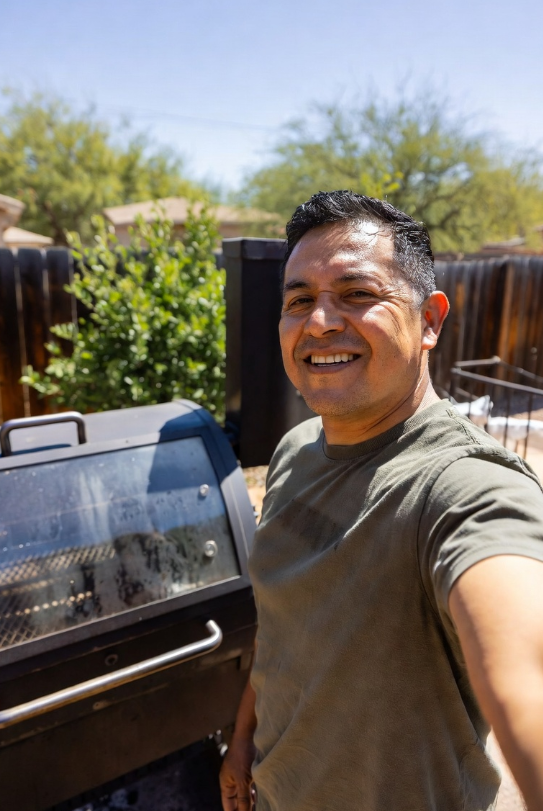
My dad was in the backyard. Of course he was. Even at eight-thirty in the morning, Roberto Rivera is in the backyard. He had coffee and he was looking at his grill the way he looks at it sometimes—not like he’s about to use it, just like he’s checking on it. Making sure it’s still there. Still his.
I stood next to him with Sofia on my hip and we didn’t say much. He asked how the shift was. I told him about the car fire on the I-17—gasoline burn, secondary explosion risk, contained faster than it should have been because Rodriguez was on point. I told him about the grease fire on 35th, which was messier but more routine. I told him about the man in the Walmart parking lot, the churro, the fact that we got him back.
My dad nodded. He’s heard versions of these stories for eleven years. He doesn’t flinch anymore, but he listens in a particular way—with his whole body still, coffee held in both hands. That’s how I know he’s paying attention.
“You eating?” he said.
“I’m cooking tonight,” I said. “Carne asada. Your marinade.”
He looked at me sideways. “You got skirt steak?”
“Picking it up on the way home.”
He nodded again, slower this time, like I’d given the right answer to a question he hadn’t asked out loud.
Here’s what I want to say about my dad’s carne asada marinade: it is the only recipe in my family that exists as an actual, written-down thing. Everything else—my mom’s rice, her guacamole, her Christmas pozole—lives somewhere between her hands and her instincts. You watch, you approximate, you hope. But the carne asada marinade my dad wrote down on a piece of notebook paper sometime in the late eighties, tucked it in the kitchen drawer, and it is still there. I have a photograph of it on my phone. The paper is soft and stained and the handwriting is his, in pencil, and it says at the top: Carne—Roberto.
Lime juice. Garlic. Cilantro. Jalapeño. A little orange juice—that’s the part people don’t expect. The orange rounds out the acid and gives the meat a sweetness that the lime alone doesn’t have. Salt, pepper, a splash of soy sauce that I’m convinced my dad added at some point and never told anyone about until I asked him directly about fifteen years ago. He shrugged and said, “It needed something.” Classic.
The cut is skirt steak, full stop. Not flank, not sirloin. Skirt steak is stringy and tough if you look at it wrong, but it has more fat running through it than most cuts, which means more flavor, and it takes to high-heat grilling in a way that flank just doesn’t. You cook it fast—really fast—and you let it rest, and then you cut it against the grain on a bias and it turns into something almost unreasonably good.
Four hours minimum in the marinade. I know some people go overnight. My dad doesn’t. He says longer than six hours and the lime starts to cook the meat, which isn’t wrong. I usually go four to five, which means I had to get it in the fridge by early afternoon if I was going to grill at dinner.
I got home from Maryvale around ten-thirty. Sofia went in the high chair with Cheerios. I put on a playlist—“Smoke & Fire,” which starts with Tom Petty and ends up somewhere around Kendrick Lamar, which I maintain is a perfectly coherent arc—and I started on the marinade. Pressed garlic, squeezed limes by hand because I’ve never owned a citrus press and I’m not about to start now, pulled cilantro off the stems, sliced the jalapeño thin. The orange juice I measure by feel, which is to say about half an orange, squeezed. The soy sauce is a tablespoon. The salt is generous.
Sofia watched me from the high chair with the patient, evaluating look she has sometimes, like she’s taking notes. She does this. She sits very still and watches with those dark eyes and I have this recurring feeling that she’s going to be the kind of person who understands things before she says them out loud. She’s eight months old and already she’s teaching me things about patience I didn’t know I needed to learn.
I scored the skirt steak lightly, got it in a bag with the marinade, pressed out the air, and put it in the fridge. Then I ate a bowl of leftover rice and fell asleep on the couch with Sofia on my chest, her weight warm and solid and breathing, and the house smelling like lime and garlic and whatever my dad’s been trying to tell me since I was five years old, standing at his elbow in that Maryvale backyard.
Saturday. Jessica was home. Sofia was fed and content and in the backyard shade in her little bouncer seat. The grill was lit—charcoal, always charcoal for carne asada, because gas doesn’t give you the same char, and the char matters, the char is non-negotiable. I had it going hot, banking the coals to one side so I had a sear zone and a cool zone, which is a habit from competition cooking that I can’t shake even on a Tuesday night.
Jessica was sitting in one of the patio chairs with her coffee, watching me work. This is one of my favorite things in the world—not performing for her, just cooking while she’s there. She doesn’t hover. She doesn’t give input unless I ask. She reads or looks at her phone or watches Sofia, and I cook, and the proximity of all of us in the same outdoor space on a weekend morning is something I don’t take for granted.
I’ve been on enough calls to know that the ordinary Saturday—the one where nothing happens and the food is good and your kid is making sounds at a butterfly—is not guaranteed. I don’t say this to be heavy. I say it because gratitude is a practice, and the grill is where I practice it.
The steak came off the marinade and I patted it dry—important step, don’t skip it, wet meat doesn’t sear, it steams—and laid it over the coals. The sound it made was immediate and correct. If your steak doesn’t make that sound when it hits, your grill isn’t hot enough. Three minutes, maybe four. Flip. Same on the other side. The edges were charred, black-brown and a little crispy, the kind of char that reads as bitter until you taste it against the fat and the lime and then it makes total sense.
Off the grill, tented with foil, five minutes of rest. I warmed the tortillas directly on the grill grates, twenty seconds a side, and laid them on a plate under a dish towel to stay soft. While the steak rested I quick-pickled some white onion in lime juice—five minutes is enough if your slices are thin—and set out cilantro, sliced radishes, salsa verde from a jar that I am not apologizing for. Jessica made guacamole and I’m going to say it: she’s gotten good. She’s been watching my mom do it for three years and it shows.
Cut the steak against the grain, on a bias, into slices about the width of a pencil. Pile them on a warm tortilla. Onion, cilantro, a few radish slices, a stripe of salsa verde, a spoonful of guacamole. Fold and hold over the plate because it’s going to drip and that’s exactly what’s supposed to happen.
Jessica ate two and said, “Your dad’s marinade.” Not a question. She can taste it by now.
“His recipe,” I said. “My grill.”
Sofia batted at her bouncer toys. The lemon tree my dad planted was doing whatever lemon trees do in January, which is not much, but it was there. The neighborhood was quiet the way it gets on Saturday afternoons, that specific Phoenix stillness that settles in when the sun is high and there’s nowhere anyone needs to be.
This is the thing. This is the whole thing. Fifty-three hours at Station 19, a man with a heart attack in a parking lot, a grease fire in an apartment that scared a family I will never see again—and then this. Skirt steak over charcoal, my wife eating tacos, my daughter in the sun. You hold people together with food. My dad taught me that from a cinder block grill in this same neighborhood, and I am doing it now with the same marinade he wrote down in pencil thirty years ago.
I don’t need it to be more than that. It’s already everything.
The marinade my dad wrote down in pencil is the recipe I’m sharing here—the same one that brought me back to myself on that Saturday afternoon after fifty-three hours at Station 19. There’s nothing I could have made that would have felt more right: it’s the smell of this neighborhood, the taste of being home, the thing that closes the distance between a parking lot in crisis and my daughter batting at toys in the sun. Here’s how I make it.
Grilled Carne Asada Tacos
Prep Time: 20 minutes (plus 4–5 hours marinating) | Cook Time: 10 minutes | Total Time: 4 hours 30 minutes | Servings: 4–6
Ingredients
For the Marinade- 1/3 cup fresh lime juice (about 3 limes)
- Juice of 1/2 orange
- 1 tablespoon soy sauce
- 4 garlic cloves, pressed or minced fine
- 1/2 cup fresh cilantro, roughly chopped (stems included)
- 1 jalapeño, thinly sliced (seeds in for heat, seeds out if you’re going mild)
- 1 teaspoon kosher salt
- 1/2 teaspoon black pepper
- 2 tablespoons neutral oil (vegetable or canola)
- 2 pounds skirt steak, trimmed
- Kosher salt
- 12 small corn tortillas
- 1/2 white onion, sliced thin and quick-pickled in lime juice for 5 minutes
- 1 cup fresh cilantro, roughly chopped
- 6–8 radishes, sliced thin
- Salsa verde (jarred is fine)
- Guacamole, for serving
- Lime wedges
Instructions
- Make the marinade. Combine lime juice, orange juice, soy sauce, garlic, cilantro, jalapeño, salt, pepper, and oil in a bowl or large zip-lock bag. Stir to combine.
- Marinate the steak. Score the skirt steak lightly on both sides with a knife—just shallow crosshatch cuts to help the marinade penetrate. Add the steak to the bag, press out air, seal, and refrigerate for 4 to 5 hours. Do not go past 6 hours or the lime will start to break down the texture.
- Prep the toppings. Slice the white onion thin and toss with a squeeze of lime and a pinch of salt. Let sit for at least 5 minutes. Slice radishes. Pull cilantro leaves and tender stems. Set everything out.
- Build the fire. Set up your charcoal grill for two-zone cooking—coals banked on one side for high heat, open on the other for a cooler zone. You want the sear zone very hot. Gas grill: crank it to high and let it preheat at least 15 minutes.
- Dry and season the steak. Remove the steak from the marinade and pat dry thoroughly with paper towels. Wet meat won’t sear properly. Hit it with a pinch of kosher salt on both sides.
- Grill the steak. Lay the steak directly over the coals. Cook 3 to 4 minutes without moving it—you want deep color on the first side. Flip once and cook another 3 to 4 minutes. Skirt steak is thin; you’re aiming for medium to medium-well. Pull it off when the edges are charred and the center has some give but isn’t raw.
- Rest the meat. Tent with foil and let the steak rest for 5 minutes minimum. Don’t skip this. The juices redistribute and if you cut it right away you will regret it.
- Warm the tortillas. Lay corn tortillas directly on the grill grates for 20 to 30 seconds per side until they have some color and are pliable. Stack under a clean dish towel to keep warm and soft.
- Slice and serve. Cut the steak against the grain on a bias into thin slices—about 1/4 inch wide. Pile onto warm tortillas, top with pickled onion, cilantro, radishes, salsa verde, and guacamole. Squeeze lime over the top. Fold over the plate, not over the table.
Nutrition (per serving)
Calories: 420 | Protein: 34g | Fat: 18g | Carbs: 28g | Fiber: 4g | Sodium: 610mg