
 By
By April. Spring practice has settled into a rhythm. We are in week three of three. The kids know the calls. The line is moving with cohesion. The defense, which is what I have been most worried about, is starting to read keys correctly and tackle in space. We are still a long way from where we need to be in November, but the foundation is solid. I have the staff working on the summer install. Mike Reyes drew up a new red zone package on the whiteboard Tuesday that I think is going to score us six or seven extra touchdowns this fall. We will see.
Lisa is back on a night-shift stretch this week — three twelves — which means I am running the household alone in the mornings and we are passing each other in the kitchen at six-forty-five when she gets home and I am leaving for school. We have learned, after twenty years, how to make these stretches work. She leaves a pot of coffee on the counter. I leave a foil-wrapped breakfast burrito on the stove. We hug each other for ten seconds at the door. She sleeps. I drive. The kids manage themselves more than they used to, because three of them are old enough to manage themselves and the twins, while still ten, have figured out that everyone is happier if they get their shoes on without three reminders.
Tuesday the twins had a soccer tournament — four games over the weekend, but the first two were Tuesday night and Wednesday night, indoor, at the rec center. Marco scored two goals on Tuesday. Elena had three assists. They play on different teams, which has reduced the household tension considerably from what it was when they played on the same team in second grade. Marco is on a competitive travel team. Elena is on the rec league. The reason for the split is that Elena, while a better player than Marco in most respects, does not enjoy the level of intensity that the travel team requires. She does not want to drive to Greeley on a Saturday for a tournament. She wants to play with her friends on Tuesday nights and to have her weekends free for reading and for going to her friend Anya's house. We let them sort it out. Each of them is happier than they were when they were on the same team and arguing about playing time in the car on the way home.
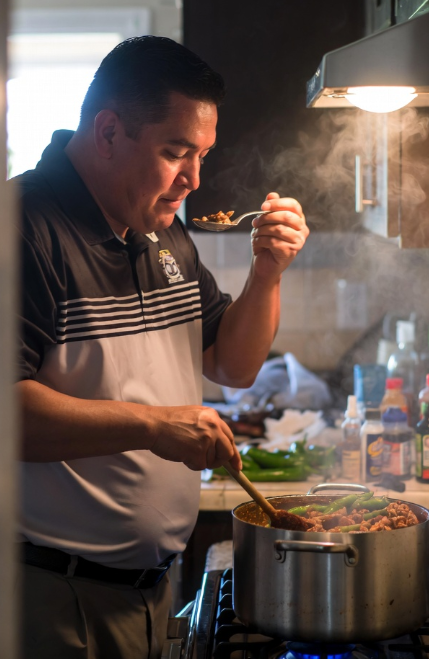
Wednesday I made pinto beans from scratch. Pinto beans are the most underrated food in American cuisine. Black beans get the food magazine attention. Garbanzos get the trendy salads. White beans get the upscale Tuscan presentations. But the humble pinto bean — slow-cooked with onion, garlic, a ham hock or a smoked turkey wing or, in this case, the lamb bone I had saved from Easter (Mamá would be proud) — is the bean that holds up the entire food culture of New Mexico, west Texas, and most of northern Mexico. A pot of pintos cooked correctly will feed a family for three days, will get better each day, and will accept any leftover into its embrace — yesterday's grilled chicken, last night's rice, half a leftover green chile burger chopped up — turning all of it into a single warm bowl that fixes whatever needed fixing.
I started the beans Wednesday morning at six. Soaked them overnight, drained, rinsed, into the pot with onion and garlic and the lamb bone and water. Brought to a simmer. Walked out the door for practice. Lisa, who was sleeping, would wake up around noon and check the pot, add water if needed, give it a stir. By the time I got home at five-thirty, the beans were tender, the broth was rich and smoky and tinged with the deep funk of a slow-cooked lamb bone, and the kitchen smelled the way kitchens are supposed to smell — like food that has taken its time.
The twins ate beans with cornbread. (Cornbread is a southern import that Lisa's mother brought into our family and that has stayed because Lisa makes a good one — buttermilk, cast iron, bacon fat in the skillet for the crust.) Diego ate beans with hot sauce and a tortilla. Sofia ate beans with a fried egg on top, which is the platonic perfect bowl of pintos and which she has been doing since she was nine. Lisa ate her bowl when she got home from her shift the next morning, sitting at the kitchen island in her scrubs, the dawn light coming through the window, the beans warmed on the stove.
Thursday night I sat on the back patio at nine in the evening with a coffee and a book. The book was a coaching memoir by a guy who coached at a tiny college in Iowa for forty years and won three small-college national championships. I have been reading it slowly. Some books deserve to be read slowly. The patio has not been the patio you can sit on in the evening for very long yet — it is still cool at nine, and the chairs are still in the garage from winter, and the umbrella is still in storage. But Thursday night was warm. Sixty-two degrees. The first night of the year that I sat outside and read a book in the dark with no jacket on. The dog from next door barked. Somebody's teenage son was practicing drums in a garage two houses down. The whole neighborhood was in that state of suspended late-evening Thursday calm where nobody is going anywhere and nobody is coming home and time seems to stop for an hour.
I thought about the season. I thought about Diego. I thought about Sofia. I thought about Mamá and Papá. I thought about the lamb bone in the beans. I thought about Ruben, who would have been thirty-nine. I thought about how the whole life of a man is in fact a stack of moments like Thursday on the patio at nine in the evening with a coffee and a book and a memory of the day, and that nobody tells you this when you are twenty-five, and that you have to learn it for yourself, by surviving long enough to notice. I am forty-five. I am noticing. Pinto beans on the stove. Lisa asleep upstairs. Coffee in the cup. Feed your people. The game is won at the table.
The pintos were the anchor of that week — three days of depth and warmth in a pot on the stove — but every good anchor needs something lighter alongside it, something that reminds you the season has actually changed. By Thursday, with the patio finally warm enough to sit on and the neighborhood settling into that suspended calm, I found myself thinking about green beans: fast, bright, barely cooked, finished with tarragon the way my mother’s sister used to do it when the garden started coming in. It is not the bean that holds up a culture, but it is the bean that says spring has arrived, and that week, that mattered too.
Green Beans with Tarragon
Prep Time: 5 minutes | Cook Time: 10 minutes | Total Time: 15 minutes | Servings: 4
Ingredients
- 1 lb fresh green beans, trimmed
- 1 tablespoon unsalted butter
- 1 tablespoon olive oil
- 2 cloves garlic, minced
- 1 1/2 teaspoons fresh tarragon leaves (or 1/2 teaspoon dried)
- 1/2 teaspoon kosher salt, plus more to taste
- 1/4 teaspoon freshly ground black pepper
- 1 teaspoon fresh lemon juice
Instructions
- Blanch the beans. Bring a large pot of salted water to a boil. Add the trimmed green beans and cook for 3 to 4 minutes, until just tender but still bright green and with a little snap. Drain and transfer immediately to a bowl of ice water to stop the cooking. Drain again and pat dry.
- Build the pan sauce. In a large skillet over medium heat, melt the butter with the olive oil. Add the minced garlic and cook, stirring, for about 1 minute until fragrant but not browned.
- Finish the beans. Add the blanched green beans to the skillet and toss to coat in the butter and oil. Cook for 2 to 3 minutes, stirring occasionally, until the beans are heated through and beginning to pick up a little color at the edges.
- Season and serve. Remove the skillet from the heat. Add the tarragon, salt, pepper, and lemon juice. Toss well to combine. Taste and adjust seasoning. Transfer to a serving dish and serve immediately.
Nutrition (per serving)
Calories: 90 | Protein: 2g | Fat: 6g | Carbs: 8g | Fiber: 3g | Sodium: 240mg