The lake was doing what the lake does this week: changing color hourly, sometimes by the minute, the way grief does. Iron gray at dawn. Steel blue by ten. Almost green by noon when the sun broke through. Pewter again by four. Black by six. I walked the lakefront with Sven on Tuesday and Wednesday and Thursday and Saturday, and the lake was different every time, and the lake was the same every time, and both things are how it works.
Jakob (Anna's middle, recently graduated) has a job. He hates the job. He is figuring it out. He called me Tuesday for advice. I told him: that is what your twenties are for. The first job is supposed to be unsatisfying. The first job teaches you what you do not want. He said, "Grandma, that is not super helpful." I said, "It is the truth. Helpful is not always the same as comforting." He laughed. He hung up. He kept the job for now. He will figure it out.
Lena (Anna's youngest, college freshman) is in college now. She calls me sometimes. The calls are about boys, mostly. I listen. I do not give advice. I am eighteen-year-old's grandmother. My credibility on boys is suspect at best. I tell her the kinds of things a grandmother is supposed to tell her: be careful, be brave, trust your gut, do not date the one who reminds you of someone you do not like. She thinks I am wise. I am, in fact, just old. The two get confused sometimes in the right direction.
I cooked Limpa rye bread this week. The slightly sweet Swedish rye, with caraway and orange peel and a touch of molasses. Two long rises. Baked dark. The crust crackles when it cools. The smell of baking limpa is the smell of every kitchen Mamma ever stood in. The smell carries down the hall.
Damiano Thursday: soup. The crowd was the usual size — about a hundred and twenty plates served between five and seven. Gerald and I worked side by side without talking. The not-talking was the friendship. The work has its own rhythm: ladle, hand, smile, ladle, hand, smile. The rhythm carries us through.
I sat in the kitchen at 11 PM with a glass of wine and Paul's photograph. I did not cry. I just sat. The not-crying is its own form of being with him. We did not need to talk all the time when he was alive. We do not need to talk all the time now. The companionable silence has carried over.
It is enough. It has to be. And on a morning like this, with the lake doing what the lake does and the dog at my feet and the bread on the counter and the kitchen warm enough to live in, it is.
Paul used to say that the difference between a place and a home was that a home was a place where you knew, from any room, what was happening in any other room. I knew, from the kitchen, when he was reading in the living room. I knew, from the bedroom, when he was getting coffee in the kitchen. The Kenwood house is still that kind of home. From the kitchen I know that Sven is asleep on his bed in the dining room (the small specific snore). From the kitchen I know what time the radio in the living room is set to come on. The home is the body of knowledge of itself. I still live inside that body of knowledge, even though Paul is not the one creating most of the data anymore.
It is enough.
The limpa I baked this week was for the smell as much as anything — the ritual of the long rise, the crust going dark, the kitchen becoming itself again. If you are baking without wheat, this gluten-free anadama bread walks the same road: molasses for depth, two rises for patience, and a crackled crust that earns its color in a slow oven. It is not limpa, but it is bread in the truest sense — the kind that makes a kitchen warm enough to live in, which is exactly what I needed.
Gluten-Free Anadama Bread
Prep Time: 25 min | Cook Time: 45 min | Total Time: 2 hr 30 min | Servings: 12 slices
Ingredients
- 1 cup boiling water
- 1/2 cup stone-ground yellow cornmeal
- 3 tablespoons unsalted butter, cut into pieces
- 3 tablespoons unsulfured molasses
- 1 teaspoon fine sea salt
- 2 1/4 teaspoons active dry yeast (one 1/4-oz packet)
- 1/4 cup warm water (about 110°F)
- 1 teaspoon granulated sugar
- 2 1/2 cups gluten-free all-purpose flour blend (with xanthan gum)
- 2 large eggs, lightly beaten
- 1 teaspoon apple cider vinegar
Instructions
- Make the cornmeal mush. Pour boiling water over cornmeal in a large mixing bowl. Add butter, molasses, and salt. Stir until butter is fully melted. Set aside and let cool to lukewarm, about 20 minutes — the mixture must not be hot when the yeast is added.
- Proof the yeast. Combine yeast, warm water, and sugar in a small bowl. Stir gently and let stand 5–10 minutes until the mixture is foamy and fragrant.
- Combine wet ingredients. Add the proofed yeast mixture, beaten eggs, and apple cider vinegar to the cooled cornmeal mush. Stir until evenly combined.
- Add the flour. Add the gluten-free flour blend 1/2 cup at a time, stirring well after each addition. The finished dough will be thick and sticky — softer than traditional bread dough. This is correct.
- First rise. Cover the bowl tightly with plastic wrap or a clean damp towel. Set in a warm, draft-free spot and let rise for 1 hour, until the dough is visibly puffed.
- Shape and second rise. Grease a 9x5-inch loaf pan. Scrape the dough into the pan and smooth the top with wet fingertips. Cover loosely and let rise 30–40 minutes, until the dough just crowns above the rim of the pan.
- Bake. Preheat oven to 375°F. Bake 40–45 minutes until the crust is deep mahogany and an instant-read thermometer inserted in the center reads 205°F. If the top browns too quickly, tent loosely with foil after the first 25 minutes.
- Cool before slicing. Turn the loaf out onto a wire rack. Let cool at least 30 minutes — the interior continues to set as it cools, and slicing too early will give you a gummy crumb.
Nutrition (per serving)
Calories: 185 | Protein: 4g | Fat: 4g | Carbs: 34g | Fiber: 2g | Sodium: 210mg
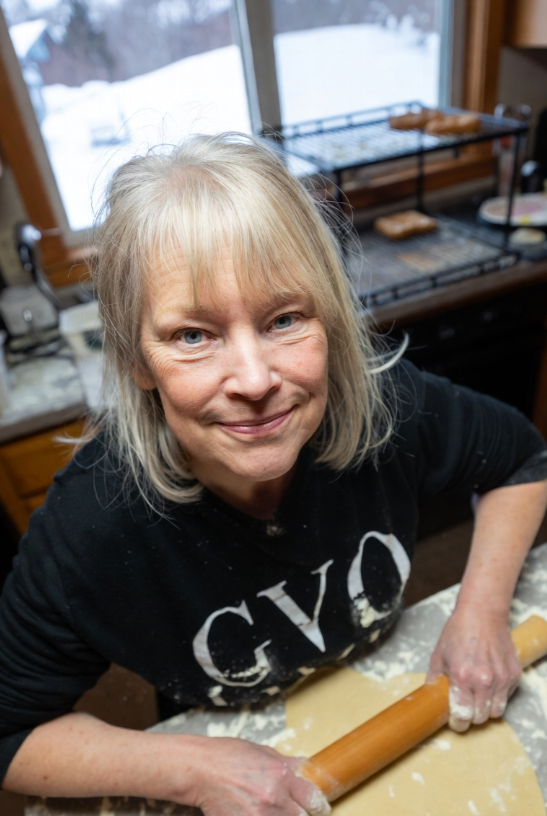
About the cook who shared this
Linda Johansson
Week 356 of Linda’s 30-year story
· Duluth, Minnesota
Linda is a sixty-three-year-old retired nurse from Duluth, Minnesota, living alone in the house where she raised her children and said goodbye to her husband. She lost Paul to ALS in 2020 after two years of watching the kindest man she'd ever known lose everything but his dignity. She cooks Scandinavian comfort food and Minnesota hotdish and the pot roast Paul loved, and she sets two places at the table out of habit because it makes her feel less alone. Every recipe she writes is a person she's loved.
