
 By
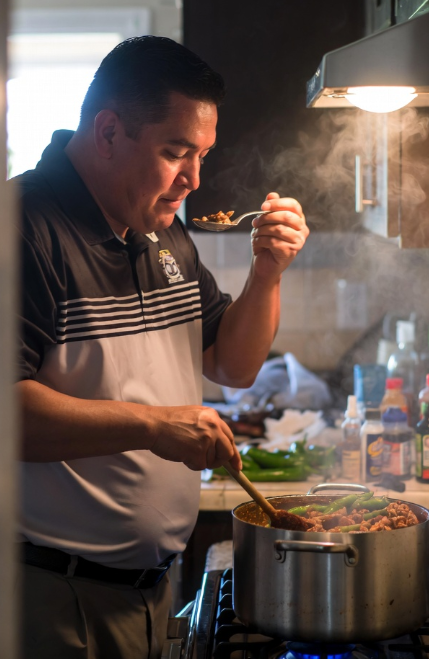
By It’s Father’s Day morning and I’ve been up since 5:47, which is four minutes after the twins decided the day had started. Marco and Elena are three years old, and they operate on a schedule that has nothing to do with the calendar or common decency. Diego’s nine and still asleep—he’s got my metabolism, the lucky kid. Sofia’s seven and already outside doing something that involves a soccer ball and the neighbor’s fence, which I’m choosing not to investigate until after coffee. Lisa got pulled in for a double at Denver Health last night. ER doesn’t take holidays. I’ve known this for eleven years of marriage and I still feel it every time she walks out the door in scrubs on a Sunday.
So it’s me and four kids in a house in Denver at six in the morning, and instead of doing the sensible thing—frozen waffles, cereal, the kind of breakfast that requires no skill and no cleanup—I’m standing at my kitchen counter with a bag of flour and my mother’s voice in my head.
My name is Carlos Medina. I coach football at a 5A high school here in Denver, which means I spend eleven months of the year thinking about blocking schemes and the twelfth month wishing I was thinking about blocking schemes. I’m thirty-seven years old, I grew up in Las Cruces, New Mexico, and I cook like a man who is trying to carry home in his hands everywhere he goes. Because that’s exactly what I’m doing.
I want to tell you about sopapillas.
If you didn’t grow up in New Mexico, you might know sopapillas from the basket they bring you at a Tex-Mex chain restaurant—those puffy little pillows of fried dough that you eat with honey while you wait for your fajitas. Those are fine. They’re not what I’m talking about. What I’m talking about are my mother’s sopapillas: made from scratch, fried in oil until they balloon up like little pillows of pure joy, served hot with a squeeze bottle of honey and absolutely nothing else, because nothing else is needed. Gloria Medina has been making them the same way for forty-five years. Her mother made them before her. Her mother’s mother made them before that. The Medinas have been in New Mexico since before there was a New Mexico, and sopapillas have been on our table for most of that time, and if you think I’m going to apologize for caring deeply about a piece of fried dough, you are on the wrong website.
I grew up in a house where food was not decoration. My dad, Hector, was a welder at White Sands Missile Range. My mom worked the cafeteria line at Las Cruces High. We were five kids, two parents, one house, and a freezer perpetually packed with Ziploc bags of roasted Hatch green chiles that Gloria put up every September. Green chile went into everything—eggs, stew, enchiladas, the occasional cookie that I’ll tell you about another time. The smell of chiles roasting in a drum on a hot September morning is the smell of my entire childhood. I can be standing in a grocery store parking lot in Denver, Colorado, and if someone’s roasting peppers somewhere in the zip code, I am eight years old in Las Cruces again and everything is fine.
But sopapillas were special. Sopapillas weren’t Tuesday dinner. Sopapillas came out when something mattered—when someone was celebrating, or someone was grieving, or someone had come home.
My brother Ruben is a Marine. Has been since he was eighteen years old, which means he’s spent most of his adult life in places most Americans couldn’t find on a map, doing things he doesn’t talk about when he comes home. When he does come home—when he walks through my mother’s front door in Las Cruces and drops his gear and hugs her for a long time—the first thing he says, every single time, is: “Mom. Sopapillas.”
Not hello to everyone in the room. Not let me put my stuff down. Sopapillas. Before his boots are even off.
And Gloria goes to the kitchen and she makes them, right then, and the whole family crowds into the kitchen and watches the dough puff up in the oil, and Ruben stands at the counter and eats four of them before they’re cool enough to hold, and that moment—that specific moment, the steam, the honey, the sound of my brother laughing—is what I mean when I say food is not decoration. That’s not a recipe. That’s a resurrection. That’s a woman telling her son: you are home, you are safe, you are fed, I have been waiting.
I’ve eaten my mother’s sopapillas my entire life and I never once tried to make them myself until about eight months ago, when we drove down to Las Cruces for Thanksgiving and Gloria finally let me stand next to her at the stove and watch with actual attention instead of just hovering for a bite. I took notes on my phone like I was watching film. She thought this was ridiculous. “It’s just flour and water,” she said. “You roll it out, you cut it, you fry it.” Coaches will recognize this. This is the thing your best player says about the thing they do so well they can’t explain it. It’s never just flour and water. It’s forty-five years of hands that know the dough.
The secrets, as best as I can decode them: the dough has to rest. You cannot rush it. Twenty minutes minimum, covered on the counter, and if you try to skip this step you will end up with sopapillas that don’t puff, which is the only failure state that matters. They need to puff. A flat sopapilla is a philosophical problem. The oil temperature matters more than almost anything—Gloria does it by feel, dropping a small piece of dough in and watching how fast it comes up. I use a thermometer because I am a coach and I believe in measurable data. And you roll the dough thin—thinner than you think, about an eighth of an inch—because the magic happens when the hot oil hits that thin dough and the steam inside has nowhere to go but up.
I made them for the first time in January, in this kitchen in Denver, with Diego watching from a barstool with the skeptical expression of a nine-year-old who has eaten the real thing and knows the difference. They were… not bad. They puffed. Not every one, but most of them. Diego ate three without commentary, which in this family is a five-star review. I called Gloria and told her. She said, “Good. Now make them better.”
I’ve made them six times since. I’m not at Gloria’s level. I may never be at Gloria’s level. But this morning, Father’s Day, six in the morning, twins running circles around the kitchen island, Sofia just came in from outside with dirt on her knees and a look of complete innocence, I am making sopapillas. Because it’s the first morning in a while where I have the time to stand at a stove and make something that matters. Because my kids deserve the thing I grew up with, even if we’re eight hundred miles from the Rio Grande. Because somewhere in Las Cruces, Gloria is probably in her kitchen right now, and making her recipe in my kitchen feels like a phone call that doesn’t cost anything.
And because Ruben ships out again next month, and the last time I talked to him I asked what he wanted when he got back, and he said what he always says.
Sopapillas. Before his boots are off.
That’s all I need to know. Let’s make some dough.
Gloria never wrote it down—it’s all in her hands, the way she pinches the dough and knows when it’s right—so what I have is years of watching and a recipe I pieced together from memory and two phone calls I’m not ashamed to say I cried on. I’ve made it enough times now that my version is close, maybe not identical, but close enough that my kids don’t know the difference and that’s its own kind of victory. Here’s how I do it.
Gloria’s Sopapillas
Prep Time: 15 min | Cook Time: 25 min | Total Time: 1 hr (includes 20 min dough rest) | Servings: 24 sopapillas
Ingredients
- 2 cups all-purpose flour, plus more for dusting
- 1 tsp baking powder
- 1/2 tsp salt
- 1 tsp sugar
- 2 tbsp lard (Gloria’s choice) or vegetable shortening (acceptable) or unsalted butter (will work, not traditional)
- 3/4 cup warm water (not hot—warm, like bathwater)
- Vegetable oil or canola oil for frying (enough for 2 to 3 inches depth in your pan)
- Honey, for serving—the good kind, not the bear-shaped plastic bottle kind
Instructions
- Mix the dry ingredients. In a large bowl, whisk together the flour, baking powder, salt, and sugar. Don’t skip the sugar—it’s a small amount but it helps with browning and flavor.
- Cut in the fat. Add the lard or shortening in small pieces and work it into the flour with your fingertips until the mixture looks like coarse crumbs. You want the fat evenly distributed throughout. This is the same technique as pie dough and it matters just as much.
- Add the water and bring the dough together. Pour in the warm water a little at a time, mixing with a fork or your hands until the dough comes together into a shaggy ball. It should not be sticky. If it’s sticky, add a little flour. If it won’t come together, add a splash more water. Turn it out onto a floured surface and knead gently for two minutes until smooth.
- Rest the dough. This is non-negotiable. Wrap the dough in plastic wrap or cover the bowl with a damp towel and let it rest on the counter for at least 20 minutes. Set a timer. Go watch your kids. Come back. The gluten needs to relax or the dough will fight you when you roll it and the sopapillas won’t puff properly.
- Heat the oil. While the dough rests, heat 2 to 3 inches of oil in a heavy-bottomed pot or deep skillet over medium-high heat. You want the oil to reach 375 degrees F. Use a thermometer. Gloria doesn’t use a thermometer. You should use a thermometer. Do not let the oil smoke.
- Roll and cut the dough. On a lightly floured surface, roll the dough out to about 1/8-inch thickness. Thinner than you think. If you hold a piece up to the light you should almost be able to see through it. Cut into rectangles or squares roughly 3 by 4 inches. You don’t need a ruler. Imperfect shapes fry just as well.
- Fry in batches. Carefully lay two or three pieces of dough into the hot oil. Do not crowd the pan—they need room to puff. Within 30 seconds, the dough should start to balloon up. If it doesn’t puff within a minute, your oil is not hot enough. Fry for about 1 minute per side, until golden and puffed. They move fast once they start going.
- Drain and serve immediately. Transfer to a paper towel-lined plate for 30 seconds, then serve right away. Hot is the only way. Cold sopapillas are a different food entirely and not a better one. Serve with honey and eat them while they’re still steaming. Bite a corner off first and drizzle the honey inside. That’s how you do it. That’s how you’ve always done it.
Nutrition (per serving)
Calories: 78 | Protein: 1g | Fat: 3g | Carbs: 11g | Fiber: 0g | Sodium: 62mg