The house feels different without Mamma's voice on the phone. Tuesday mornings used to be Mamma calling at 10 AM to ask what I was making. Now Tuesday mornings are quiet. I make coffee. I look at the phone. I do not call her. I cannot call her. I sit and I drink the coffee and Sven (the puppy) tries to climb into my lap and the silence is not unbearable but it is new.
Elsa called from Voyageurs. She said the loons came back this week. She said Mamma always loved the loons. She said it had not been the same year without her. I said no. It had not been. We talked for ten minutes. Elsa does not call often. The calls she does make are small and dense, like a hard candy. I save them. I roll them around in my mind for days afterward.
Astrid drove up from the Twin Cities for a long weekend. We sat in Mamma's kitchen at Fifth Street (Erik has not sold the house yet; we are not ready). We made meatballs together, in Mamma's kitchen, in Mamma's bowl, on Mamma's stove. We did not say much. We worked side by side the way we worked side by side as girls — at thirteen and ten, at nineteen and sixteen, now at sixty-something and sixty-something. The hands knew. The kitchen knew. The kitchen carried us through.
I cooked Pumpkin bread this week. The October loaf. Walnuts. Best the second day.
Damiano Thursday: soup. The crowd was the usual size — about a hundred and twenty plates served between five and seven. Gerald and I worked side by side without talking. The not-talking was the friendship. The work has its own rhythm: ladle, hand, smile, ladle, hand, smile. The rhythm carries us through.
I sat in the kitchen at 11 PM with a glass of wine and Paul's photograph. I did not cry. I just sat. The not-crying is its own form of being with him. We did not need to talk all the time when he was alive. We do not need to talk all the time now. The companionable silence has carried over.
It is enough. It has to be. And on a morning like this, with the lake doing what the lake does and the dog at my feet and the bread on the counter and the kitchen warm enough to live in, it is.
Paul used to say that the difference between a place and a home was that a home was a place where you knew, from any room, what was happening in any other room. I knew, from the kitchen, when he was reading in the living room. I knew, from the bedroom, when he was getting coffee in the kitchen. The Kenwood house is still that kind of home. From the kitchen I know that Sven is asleep on his bed in the dining room (the small specific snore). From the kitchen I know what time the radio in the living room is set to come on. The home is the body of knowledge of itself. I still live inside that body of knowledge, even though Paul is not the one creating most of the data anymore.
I keep a small notebook on the kitchen counter — green spiral-bound, from the drugstore. I write in it most days. The notebook holds the things I do not want to forget — Erik's stories about Pappa, Karin's notes about Mormor, Sophie's first words about her babies, the recipes I have changed slightly and want to remember in their changed form. The notebook is a small museum. The museum will go to Anna eventually, and then to Sophie, and then to Sophie's daughter Ingrid, and then onward.
It is enough.
The pumpkin bread was already on the counter by the time I thought to write any of this down — best the second day, the way it always is — but what I kept coming back to was the gingersnaps I’d made the week before, the ones that filled the Kenwood house with something that smelled like October and like every kitchen I have ever loved. When the silence on Tuesday mornings gets too wide, I bake something spiced. The oven runs. The smell finds every room. The house, for a little while, sounds like itself again.
Gingersnap Cookies
Prep Time: 20 min | Cook Time: 12 min | Total Time: 32 min | Servings: 48 cookies
Ingredients
- 2 cups all-purpose flour
- 2 tsp baking soda
- 1 1/2 tsp ground ginger
- 1 tsp ground cinnamon
- 1/2 tsp ground cloves
- 1/4 tsp salt
- 3/4 cup unsalted butter, softened
- 1 cup granulated sugar, plus 1/4 cup for rolling
- 1 large egg
- 1/4 cup unsulphured molasses
- 1 tsp pure vanilla extract
Instructions
- Heat the oven. Preheat to 375°F (190°C). Line two baking sheets with parchment paper and set aside.
- Combine the dry ingredients. In a medium bowl, whisk together the flour, baking soda, ginger, cinnamon, cloves, and salt until evenly blended.
- Cream the butter and sugar. In a large bowl, beat the softened butter and 1 cup of sugar together with a hand mixer or stand mixer on medium speed until light and fluffy, about 2–3 minutes.
- Add the wet ingredients. Beat in the egg, molasses, and vanilla extract until fully incorporated and smooth, scraping down the sides of the bowl as needed.
- Bring the dough together. Reduce mixer speed to low and gradually add the flour mixture, mixing just until no dry streaks remain. Do not overmix. The dough will be soft but workable.
- Shape and coat. Place the remaining 1/4 cup sugar in a shallow dish. Roll the dough into 1-inch balls, then roll each ball in the sugar to coat evenly. Arrange on the prepared baking sheets about 2 inches apart.
- Bake. Bake for 10–12 minutes, until the tops are crackled and the edges are just set. The centers will look slightly underdone — that is correct. Do not overbake.
- Cool. Let the cookies rest on the baking sheet for 5 minutes before transferring to a wire rack. They firm up as they cool and develop their characteristic snap.
Nutrition (per serving, 2 cookies)
Calories: 118 | Protein: 1g | Fat: 6g | Carbs: 16g | Fiber: 0g | Sodium: 108mg
About the cook who shared this
Linda Johansson
Week 446 of Linda’s 30-year story
· Duluth, Minnesota
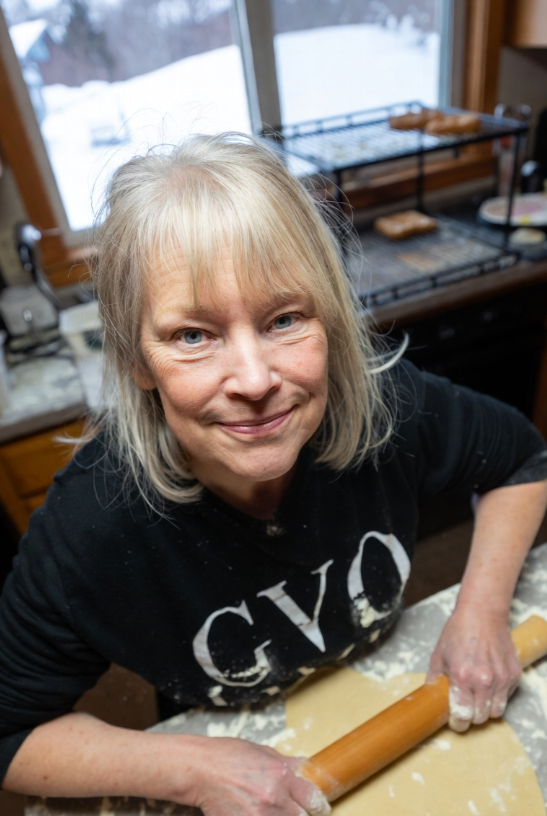
Linda is a sixty-three-year-old retired nurse from Duluth, Minnesota, living alone in the house where she raised her children and said goodbye to her husband. She lost Paul to ALS in 2020 after two years of watching the kindest man she'd ever known lose everything but his dignity. She cooks Scandinavian comfort food and Minnesota hotdish and the pot roast Paul loved, and she sets two places at the table out of habit because it makes her feel less alone. Every recipe she writes is a person she's loved.
