
 By
By Termination dust on the Chugach. The body still in winter mode. A Code Blue Wednesday morning that we did not save. I stood in the parking lot for fifteen minutes before I got in my car.
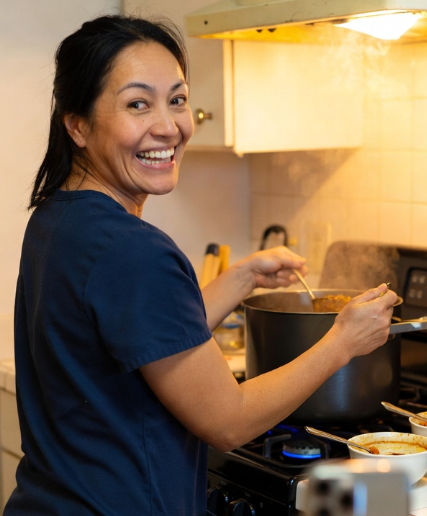
Lourdes is 74. She is in the kitchen. She is luminous.
I made pork adobo Sunday. The pork shoulder, the slow simmer, the fat rendering. The dish that scales. The dish that keeps.
A reader wrote me a long email this week about her grandmother's adobo, which differed from mine in every measurement. The differences were the conversation. I wrote her back. The writing back is the work.
I read for forty minutes before sleep. The reading was the small surrender. The surrender was the rest.
Auntie Norma called Sunday afternoon. She is now seventy-nine. She wanted a recipe. I gave it to her. She wanted to know how my week was. I told her, briefly. She told me about her week. The exchange took eighteen minutes. The eighteen minutes was the keeping.
The Anchorage sky was the Anchorage sky. The mountains were the mountains. The inlet was the inlet. The geography was the geography.
I drove home Tuesday evening and the sun set at three forty-five and the highway was already iced at the bridges and the radio was on a station I did not recognize and I did not change it.
The break room had cake Tuesday. Someone's birthday. We ate the cake. We did not ask whose birthday. The cake was the cake.
The neighbors invited us over for a small dinner Thursday. They are an Iñupiaq family — Aana and her grandson Joe. We ate caribou stew and rice. I brought lumpia. The kitchens of Anchorage have always been the small UN. The food is the proof.
The Filipino Community newsletter announced a fundraiser for typhoon relief in Samar. I committed to making three hundred lumpia. The number is the number. The number has always been the number. Three hundred is what I make. The math has stopped surprising me.
The grocery store had no calamansi. I substituted lime. The substitution was acceptable. The acceptable is the working version of perfect.
I cleaned the kitchen Sunday afternoon. I wiped the stove. I scrubbed the sink. I reorganized the spice cabinet. The cleaning was the small reset. The reset was the marker. The marker said: the week is over, the next week begins, the kitchen is ready.
Angela texted me a photo of the kids. I texted back a heart. The exchange took thirty seconds. The thirty seconds was the keeping.
I read a chapter of a novel before bed each night this week. The novel was about a Filipina nurse in California. The novel was good. The novel was, in some way, my own life adjacent.
The light was good Saturday morning. I sat on the porch with a cup of coffee and watched the inlet for forty minutes. The watching was the small therapy. The therapy was free.
A reader from New Jersey wrote in about her grandmother's adobo, which used pineapple. I had never heard of pineapple in adobo. I tried it. It was strange. It was also good. The strange and the good are not opposites.
The Filipino Community newsletter announced the Saturday gathering. I will be on lumpia duty. I am always on lumpia duty.
Auntie Norma called Sunday to ask if I had a recipe for a particular merienda from Iloilo. I did not. I said I would ask Lourdes. I asked Lourdes. Lourdes had it. The chain.
The therapy session this month was about pacing. Dr. Reeves said, "Grace. The pacing is the love for the future self." I am working on the pacing. The pacing is harder than the loving.
The grocery store had no calamansi that Sunday, and I substituted lime without ceremony, and the week turned out to be exactly that kind of week—full of acceptable substitutions that held. This ginger lime pork tenderloin isn’t adobo, but it carries the same logic: soy, acid, something bright, patience, pork. It keeps. It reheats on a Tuesday when the highway is iced at the bridges and the radio is on a station you don’t recognize. The strange and the good are not opposites, and neither are the lime and the calamansi. The dish is the dish. The dish is enough.
Ginger Lime Pork Tenderloin
Prep Time: 15 min (plus 30 min marinating) | Cook Time: 25 min | Total Time: 1 hr 10 min | Servings: 4
Ingredients
- 1 1/2 lbs pork tenderloin, silver skin trimmed
- 3 tablespoons soy sauce
- 3 tablespoons fresh lime juice (about 2 limes)
- 1 teaspoon lime zest
- 2 tablespoons honey
- 1 tablespoon fresh ginger, finely grated
- 3 cloves garlic, minced
- 1 tablespoon sesame oil
- 1 tablespoon olive oil
- 1/2 teaspoon black pepper
- 1/4 teaspoon red pepper flakes (optional)
- 2 tablespoons fresh cilantro, chopped, for garnish
- Lime wedges, for serving
Instructions
- Make the marinade. In a small bowl, whisk together the soy sauce, lime juice, lime zest, honey, ginger, garlic, sesame oil, black pepper, and red pepper flakes if using. Taste. Adjust lime or soy to your preference.
- Marinate the pork. Place the trimmed pork tenderloin in a zip-top bag or shallow dish. Pour the marinade over the pork, turning to coat evenly. Seal and refrigerate for at least 30 minutes, or up to 8 hours.
- Bring to room temperature. Remove the pork from the refrigerator 15 minutes before cooking. Preheat your oven to 400°F.
- Sear. Heat the olive oil in an oven-safe skillet (cast iron works well) over medium-high heat until shimmering. Remove the pork from the marinade, reserving the marinade. Sear the pork on all sides until golden brown, about 2 minutes per side.
- Roast. Pour the reserved marinade into the skillet around the pork. Transfer the skillet to the oven and roast until an instant-read thermometer inserted into the thickest part reads 145°F, about 15–18 minutes.
- Rest. Transfer the pork to a cutting board and let it rest for 5 minutes. Meanwhile, place the skillet over medium heat and simmer the pan juices for 2–3 minutes until slightly reduced.
- Slice and serve. Slice the tenderloin into 1/2-inch medallions. Arrange on a platter, spoon the pan sauce over the top, and garnish with fresh cilantro. Serve with lime wedges and rice.
Nutrition (per serving)
Calories: 285 | Protein: 36g | Fat: 10g | Carbs: 13g | Fiber: 0g | Sodium: 680mg