
 By
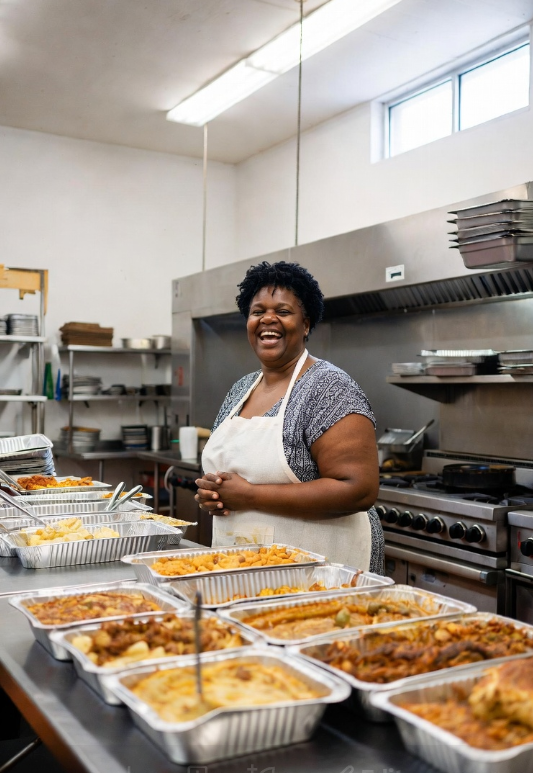
By October leaves on Forest Glen. The pecans dropping in the side yard. I gathered some for pies. Tuesday at the church. Bernice's Table fed eighty this week. The kitchen team handled it. I am the conductor and they are the orchestra and we are getting better every week.
Calvin preached Sunday on David and Goliath. The church said amen. I talked to Marcus this morning at the kitchen window with my coffee. I told him the kitchen was holding. He did not answer in words. He does not need to.
Pot roast Sunday. Chuck. Onions, carrots, celery, garlic, beef broth, a splash of red wine that the church does not need to know about. Five hours low and slow.
Destiny came for Sunday dinner. She talked about her work. The work is hard. She is good at hard work.
Sunday dinner held. The table held. The chair was set.
I stood at the kitchen window with my coffee Tuesday morning. Six o'clock. The light just coming. The yard quiet. Talking to Mama about the day ahead. The talking is its own prayer, sugar.
Calvin and I watched the news Wednesday evening. He fell asleep in the recliner. I covered him with the afghan that Bernice crocheted before she died. The afghan is holding.
I read for an hour Sunday night before bed. The Bible, then a book Doris sent me about the civil rights movement in Birmingham. The book made me think about Bernice in the church kitchen during the bombings.
I made coffee at five Tuesday morning. Strong, with cream, no sugar (the diabetes). I stood at the kitchen window. The yard was still in dark. The day ahead was the day ahead. I went into it.
Sunday after service Calvin and I drove past the new sanctuary site. The choir loft windows were going in. We sat in the car and looked. He did not speak. I did not speak. The watching was the prayer.
The kitchen smelled like garlic and onion all afternoon Wednesday. Calvin came home from his Bible study and stood in the doorway and said, Loretta, what are we eating. I said, baby, you will see. He said, that is a yes from me. He has been saying that for fifty years.
Calvin Jr. called Tuesday night. He was tired. He had been at work twelve hours. I told him, baby, eat something. He said, Mama, I will. I said, what did you eat last. He said, a granola bar. I said, baby, that is not eating. He laughed.
I sat on the porch Saturday afternoon. The neighborhood was quiet. Mr. Henderson across the street waved. I waved back. The porches are the original social network, sugar. We have been at this since Eden.
I had a small cry Wednesday morning at the kitchen window. No reason in particular. The grief comes when it comes. I made coffee. I went on. That is how this works.
The garden in the side yard, sugar. The tomatoes are coming on. The okra is up. The collards are getting big. I will be canning by August. I always say I am not going to can. I always end up canning.
Sister Beulah came by Tuesday afternoon to drop off the bulletins. She stayed for coffee. We talked about the church, about her grandbaby, about the heat. The visit was the visit.
A young woman from the new members class came to me Sunday. She was nervous. She said, Mother Simms, my husband and I are expecting our first and I do not know how to cook. I said, baby, come to the Saturday class. She said, I'm coming. The chain extends.
The pot roast was already on my mind that Sunday — five hours low and slow, the house smelling like garlic and onion all afternoon, Calvin standing in the doorway asking what we were eating and me telling him he would see. This German Pork Roast follows that same slow, patient logic: you put good things together, you give them time, and the kitchen does the rest. It is the kind of roast that rewards you for not rushing, and some Sundays that lesson is exactly what the table needs.
German Pork Roast
Prep Time: 20 minutes | Cook Time: 3 hours 30 minutes | Total Time: 3 hours 50 minutes | Servings: 6–8
Ingredients
- 3 to 4 lb bone-in pork shoulder roast
- 2 teaspoons salt
- 1 teaspoon black pepper
- 1 teaspoon garlic powder
- 1 teaspoon smoked paprika
- 1/2 teaspoon caraway seeds
- 1/2 teaspoon dried thyme
- 2 tablespoons vegetable oil
- 1 large yellow onion, roughly chopped
- 4 cloves garlic, smashed
- 2 medium carrots, cut into chunks
- 2 stalks celery, cut into chunks
- 1 cup beef or pork broth
- 1/2 cup dry white wine or additional broth
- 1 tablespoon Dijon mustard
- 1 bay leaf
Instructions
- Preheat and season. Preheat your oven to 325°F. Pat the pork roast dry with paper towels. Combine salt, pepper, garlic powder, paprika, caraway seeds, and thyme, then rub the mixture all over the roast on every side.
- Sear the roast. Heat the vegetable oil in a large Dutch oven over medium-high heat. Sear the roast on all sides until deeply browned, about 3–4 minutes per side. Remove the roast and set aside.
- Build the base. Reduce heat to medium. Add onion, carrots, and celery to the same pot and cook, stirring occasionally, until softened and lightly golden, about 5 minutes. Add the smashed garlic and cook 1 minute more.
- Deglaze and add liquid. Pour in the wine (or broth) and scrape up any browned bits from the bottom of the pot. Stir in the broth and Dijon mustard. Nestle the bay leaf into the vegetables.
- Slow roast. Return the pork roast to the pot, fat side up. The liquid should come about one-third of the way up the roast. Cover tightly with a lid or foil and roast in the oven for 3 to 3 1/2 hours, until the meat is fork-tender and pulling away from the bone.
- Rest and serve. Remove the roast from the oven and let it rest, uncovered, for 15 minutes before slicing or pulling. Discard the bay leaf. Spoon the pan juices and vegetables over the meat when serving.
Nutrition (per serving)
Calories: 410 | Protein: 38g | Fat: 24g | Carbs: 6g | Fiber: 1g | Sodium: 620mg