
 By
By The end of a year. Not the calendar year — my internal year, the year that runs from summer to summer in Alaska, the year that begins when the light arrives and ends when the light arrives again, the cycle that is more real than the January-to-December cycle because the light is the real clock and the light says: you made it. Another year. The light is here. You survived the dark. Again.
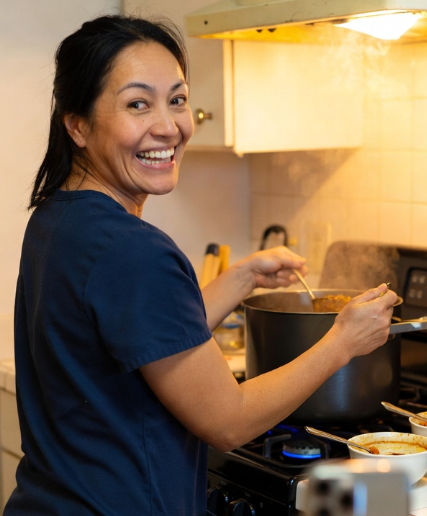
The inventory: I am thirty-four. I work the ER. I write the blog. I cook every day. I visit Lourdes on Saturdays. I hold Mia whenever Angela lets me. I talk to Joseph on the phone and worry about him on the water. I call Mark in San Diego and hear the twins in the background. I see Dr. Reeves on Wednesdays. I take sertraline every morning. I leave the stove light on every night. I do not sit on the floor. I sit at the table. The table is the throne. The table is the victory. The table is where Grace Santos eats her adobo at thirty-four, in the light, in the summer, in the life that she built from a kitchen floor and a clove of garlic and the absolute refusal to stop cooking.
I made moose adobo. Pete's moose. The thesis recipe. The intersection. The dish that couldn't exist anywhere except in the overlap of a Filipino kitchen and an Alaskan wilderness. The moose braised in vinegar and soy and the kitchen smelled like the intersection and the intersection smelled like home. Home. The word that contains everything: the kitchen, the table, the stove light, the garlic, the standing. Home is where the adobo is. The adobo is here. I am home.
The moose adobo is the thesis, but garlic is the through-line—it has always been garlic, the thing I reach for first, the smell that tells me I am still here and still cooking. These garlic butter potatoes are what I make alongside the big dishes, the anchor on the plate, the humble side that asks nothing of you except that you show up and eat at the table. If the adobo is the story, the garlic potatoes are the sentence that makes the story possible—simple, repeatable, and tasting exactly like home every single time.
Garlic Butter Potatoes
Prep Time: 10 minutes | Cook Time: 25 minutes | Total Time: 35 minutes | Servings: 4
Ingredients
- 1 1/2 lbs baby Yukon Gold potatoes, halved
- 3 tablespoons unsalted butter, melted
- 4 cloves garlic, minced
- 1 tablespoon olive oil
- 1/2 teaspoon kosher salt, plus more to taste
- 1/4 teaspoon black pepper
- 1/4 teaspoon smoked paprika
- 2 tablespoons fresh parsley, chopped
- 1 tablespoon grated Parmesan (optional)
Instructions
- Preheat. Heat your oven to 425°F. Line a large baking sheet with parchment paper or foil and set aside.
- Parboil the potatoes. Place the halved potatoes in a medium pot, cover with cold salted water, and bring to a boil. Cook for 8–10 minutes until just fork-tender but not falling apart. Drain well and let steam dry for 2 minutes.
- Make the garlic butter. In a large bowl, whisk together the melted butter, olive oil, minced garlic, salt, pepper, and smoked paprika.
- Coat and arrange. Add the drained potatoes to the bowl and toss thoroughly until every piece is coated. Spread them cut-side down in a single layer on the prepared baking sheet.
- Roast. Roast for 20–25 minutes, until the cut sides are deep golden and crispy and the edges are beginning to caramelize. Do not stir—let them sit against the pan so they develop a proper crust.
- Finish and serve. Remove from the oven and immediately toss with fresh parsley and Parmesan if using. Taste and adjust salt. Transfer to a serving bowl and bring straight to the table.
Nutrition (per serving)
Calories: 220 | Protein: 3g | Fat: 11g | Carbs: 28g | Fiber: 3g | Sodium: 310mg