
 By
By Second week back. Three shifts — Monday, Wednesday, Friday. The rhythm is holding. I walk in, I work, I walk out. I don't linger. I don't check my phone for ER updates on my days off. I don't replay. This is the new Grace, the one who puts the chart down, and she is a stranger to me still, this woman who leaves work at work, but I'm learning her the way you learn any new person: cautiously, with curiosity, with the understanding that first impressions aren't everything.
Wednesday was hard. Motorcycle accident — young guy, maybe twenty-five, no helmet. I won't describe the injuries because I'm practicing not carrying them home, but I will say that my hands did what they always do: they moved fast and certain, starting the IV, prepping for imaging, doing the things I trained for. The body remembers competence even when the mind is fragile. He made it to surgery. I don't know the outcome. That's part of the new boundary — I don't follow up on days off. The ER is a river and I can't track every piece of water downstream.
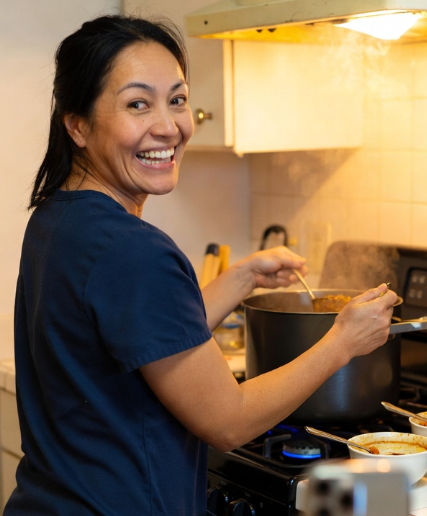
On my day off, I made lechon kawali. Pork belly, deep-fried. The recipe that requires a gallon of oil and produces pork so crispy it shatters. Lourdes's lechon kawali is the stuff of legend in the Filipino community — she brings it to every gathering and it disappears in minutes. Mine is a faithful copy, which means: boil the pork belly with peppercorns, bay leaves, and garlic until tender. Let it dry completely in the fridge — this is critical, Lourdes would say, tapping the cold, dry pork with her fingernail. "If it's wet, it will spit at you." Then into the oil, skin-side down, until it crackles and turns the color of a sunset.
The frying is violent. Oil pops and spits and the kitchen fills with a haze that smells like every Filipino party I've ever attended. I stood at the stove with a splatter guard and tongs and the controlled focus of a nurse monitoring a patient — because that's what frying is, really. Monitoring. Adjusting. Knowing when to intervene and when to let the heat do its work.
I ate the lechon kawali with vinegar dipping sauce and rice and called Angela. She asked how the week was. "I'm back," I said. She was quiet for a moment. "I know," she said. "I've been watching." That's Angela. She watches. She waits. She shows up when the floor gives way. I hope she never has to do it again, but knowing she would — that she's standing by — is the net I didn't know I needed.
Lechon kawali is the recipe I return to when I need to feel like myself again — the hot oil, the controlled chaos, the moment the skin cracks and everything smells like home. But when I want that same tactile satisfaction on a smaller scale, something I can fry without committing a gallon of oil and an entire afternoon, I turn to this fried Manchego. It has the same logic: the breading station, the hot pan, the splatter guard, the discipline of watching and waiting. The apricot-sage dipping sauce is the vinegar dip’s more dressed-up cousin — still tangy, still bright, still the thing that cuts through the richness and reminds you there’s balance in everything.
Fried Manchego Cheese with Apricot-Sage Dipping Sauce
Prep Time: 15 min | Cook Time: 10 min | Total Time: 25 min | Servings: 4
Ingredients
- 8 oz Manchego cheese, cut into 1/2-inch thick slices or triangular wedges
- 1/2 cup all-purpose flour
- 2 large eggs, beaten
- 1 cup panko breadcrumbs
- 1/2 tsp smoked paprika
- 1/4 tsp black pepper
- 1/4 tsp kosher salt
- Vegetable oil, for shallow frying (about 1/2 inch depth in pan)
- For the Apricot-Sage Dipping Sauce:
- 1/2 cup apricot preserves
- 2 tbsp apple cider vinegar
- 1 tbsp fresh sage leaves, finely minced
- 1 tsp Dijon mustard
- Pinch of red pepper flakes
Instructions
- Make the dipping sauce. In a small saucepan over low heat, combine the apricot preserves, apple cider vinegar, minced sage, Dijon mustard, and red pepper flakes. Stir until the preserves melt and everything is smooth, about 3–4 minutes. Remove from heat and set aside to cool slightly. The sauce can be made up to two days ahead and stored in the refrigerator.
- Set up your breading station. Place the flour in one shallow bowl, the beaten eggs in a second, and combine the panko, smoked paprika, salt, and pepper in a third. Line a baking sheet with paper towels and set it near the stove.
- Bread the cheese. Working one piece at a time, dredge each slice of Manchego in flour and shake off the excess. Dip into the egg, letting any drip off, then press firmly into the panko mixture on both sides, coating completely. Set the breaded pieces on a clean plate. For extra crunch, you can refrigerate the breaded cheese for 10 minutes before frying.
- Heat the oil. Pour vegetable oil into a heavy skillet (cast iron works well) to a depth of about 1/2 inch. Heat over medium-high until a pinch of breadcrumb dropped in sizzles immediately — around 350°F. Use a splatter guard if you have one.
- Fry the cheese. Working in batches to avoid crowding, carefully lower the breaded Manchego slices into the hot oil. Fry for 1 to 2 minutes per side, until deep golden and crisp. The cheese will begin to ooze at the edges — that’s the signal to flip quickly and get it out of the pan. Transfer immediately to the paper-towel-lined sheet.
- Serve. Arrange the fried Manchego on a plate and serve at once alongside the warm apricot-sage dipping sauce. Fried cheese waits for no one — eat it while it crackles.
Nutrition (per serving)
Calories: 390 | Protein: 15g | Fat: 23g | Carbs: 31g | Fiber: 1g | Sodium: 530mg