
 By
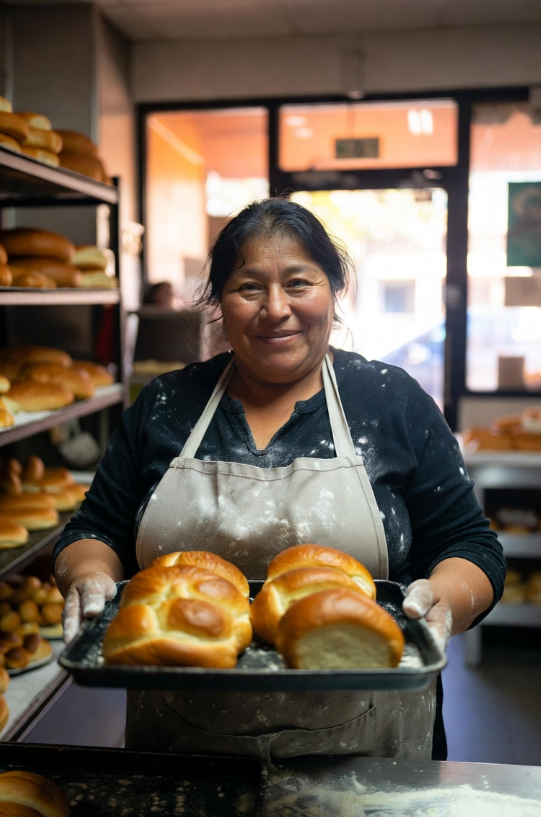
By Two weeks since Rosa. The world has not stopped, which feels like an insult. The sun comes up and the bakery opens and the conchas bake and the customers come and no one outside this family knows that the woman these recipes belong to is in the ground. I want to put a sign on the door: "The woman who invented this bread is dead. Please eat slowly. Please taste her." But you don't do that. You smile. You sell conchas. You say "Have a nice day" and you mean it and you don't mean it and both things are true.
I am writing in the notebook every night. Rosa's recipes — I have forty-seven so far. The notebook is filling up with my handwriting, which is not beautiful the way Isabella's is but is mine, and the recipes are not in order, they come as I remember them, triggered by smells and seasons and the particular slant of afternoon light that reminds me of Anapra. Tuesday I remembered her calabacitas — the zucchini sautéed with corn and tomato and cheese — and I wrote it down at 11 PM, sitting on the bathroom floor because the bedroom light would wake Luis, and I wrote it in the dark, mostly, feeling the pen on the paper, trusting my hands to remember the letters the way they remember the dough.
Sofia asked to see the notebook. I let her. She sat at the kitchen table and read every page, slowly, touching the words with her finger like they were sacred, and then she looked up and said, "We should make all of these at the bakery." She is eleven. She is already thinking about legacy. She is already thinking about what comes next. I said, "We will, mija. One at a time." She nodded. That was enough.
Diego built a catapult. From popsicle sticks and rubber bands and a plastic spoon. He launched an eraser across the living room and hit Luis in the head while Luis was watching football, and Luis said a word I will not repeat, and Diego said, "It works!" with such pure scientific joy that punishment felt beside the point. I confiscated the catapult. Diego rebuilt it the next day. I confiscated it again. He rebuilt it again. We are locked in an arms race that I am losing because he has physics on his side and I have only maternal authority, which physics does not respect.
Camila asked if Abuela Rosa can hear her from heaven. I said yes. She said, "Good," and then sang "Twinkle, Twinkle, Little Star" at the ceiling, very loudly, for four minutes. When she finished she said, "I sang it in English and Spanish so she'd understand both." She is four and she is bilingual and she is singing to the dead and I cannot decide if this is heartbreaking or the most beautiful thing I have ever witnessed. I choose both.
I made calabacitas this week — the recipe I wrote down on the bathroom floor. Zucchini, fresh corn cut from the cob, diced tomato, onion, garlic, and queso fresco stirred in at the end so it melts into strings. Rosa served this as a side dish but we ate it as a main course with tortillas because we were poor and sides become mains when there is nothing else, and the beauty of poverty is that it teaches you that a side dish is a meal if you have enough tortillas. We have enough tortillas. We always have enough tortillas. That is the one thing in my life that is never in short supply.
I went to Mass on Sunday and lit the candle for Rosa and it felt different now — not a candle for a sick person but a candle for a dead person, and the shift between those two things is a continental drift, slow and enormous and changing the shape of everything. I knelt and prayed and the stone floor was cold under my knees and I thought: I am kneeling where I always kneel and praying what I always pray and everything is the same and nothing is the same. This is grief. Not the big dramatic moments — those pass. It is the ordinary moments that are changed. The candle. The kneeling. The phone that doesn't ring at midnight on your birthday. Grief lives in the ordinary. It furnishes the rooms you already know.
The calabacitas I wrote down that night — on the bathroom floor, in the dark, trusting my hands to remember — are Rosa’s, and they will stay Rosa’s, tucked into the notebook Sofia reads with her fingertips. But when I needed to cook something that felt like that dish for the rest of the family, something with zucchini and tomato and the same quiet comfort, I turned to this linguine. It is not the same. It doesn’t try to be. It is its own thing — fast, fresh, ready in twenty minutes on a weeknight when grief sits heavy and no one has energy for more — and sometimes that is exactly what a side dish becoming a main course looks like.
Fresh Zucchini and Tomato Linguine
Prep Time: 10 minutes | Cook Time: 10 minutes | Total Time: 20 minutes | Servings: 4
Ingredients
- 12 oz linguine
- 2 tablespoons olive oil
- 4 cloves garlic, minced
- 1 small yellow onion, thinly sliced
- 2 medium zucchini, halved lengthwise and sliced into half-moons
- 2 cups cherry tomatoes, halved (or 2 medium roma tomatoes, diced)
- 1/2 teaspoon red pepper flakes (optional)
- 1/2 teaspoon salt, plus more for pasta water
- 1/4 teaspoon black pepper
- 1/4 cup fresh basil leaves, torn
- 1/3 cup grated Parmesan or crumbled queso fresco
- 1 tablespoon fresh lemon juice
Instructions
- Cook the pasta. Bring a large pot of salted water to a boil. Cook linguine according to package directions until al dente. Reserve 1/2 cup of pasta water before draining.
- Saute the aromatics. While pasta cooks, heat olive oil in a large skillet over medium-high heat. Add onion and cook 2—3 minutes until softened. Add garlic and red pepper flakes and cook 30 seconds until fragrant.
- Cook the zucchini. Add zucchini to the skillet in a single layer. Let it sit undisturbed for 1—2 minutes to develop a little color, then stir and cook another 2 minutes until just tender but not mushy.
- Add the tomatoes. Stir in the tomatoes, salt, and black pepper. Cook 2—3 minutes until tomatoes begin to break down and release their juices.
- Toss with pasta. Add drained linguine to the skillet. Toss to combine, adding reserved pasta water a splash at a time until the sauce loosely coats the noodles. Stir in lemon juice.
- Finish and serve. Remove from heat. Scatter torn basil over the top and finish with Parmesan or queso fresco. Serve immediately, with warm tortillas or crusty bread alongside if you like.
Nutrition (per serving)
Calories: 420 | Protein: 14g | Fat: 11g | Carbs: 67g | Fiber: 5g | Sodium: 380mg