
 By
By Hana's due date was March 12. She arrived six weeks early, which means today is the day she was supposed to arrive and instead she is almost two months old and sleeping in a patch of sunlight on the living room floor like a very small, very serious cat. The math of motherhood: your child arrives early or late and the due date becomes irrelevant and you realize that all the planning — the timeline, the schedule, the color-coded spreadsheet James made — was just a way of managing anxiety, and the actual child does not care about your spreadsheet.
I brought Hana to the SoDo kitchen on Wednesday for the first time since Grace sent me home. Grace was ready. She had set up a small area in the break room — a portable crib, a changing station, a blanket. She said, "I prepared." I said, "Grace. You didn't have to—" She said, "The baby comes to the kitchen. The kitchen must be ready for the baby." She held Hana while I did two hours of recipe development for the April box. Hana slept on Grace's chest. Grace spoke to her in Korean — soft, constant, a running narration of the kitchen activities: "Your mother is tasting the gochujang. The gochujang is too sweet. She will add more salt." Grace is narrating the world to my daughter in Korean. My daughter's first language of the kitchen is Korean, spoken by a sixty-eight-year-old grandmother who is not her grandmother but is, in every way that matters, her Korean grandmother in Seattle. The grandmothers multiply. Hana has four: Karen, Jisoo, Ming, Grace. She is the most grandmothered child in the Pacific Northwest.
Karen called on Tuesday to ask about Hana's two-month checkup. She asks about every appointment, every milestone, every ounce gained. She is tracking Hana's growth with the attention she once gave to Stephanie's science fair projects. I told her Hana is thriving — gaining weight, sleeping longer stretches, beginning to track objects with her eyes. Karen said, "At two months you could track a ceiling fan for twenty minutes. You were hypnotized by ceiling fans." I said, "That explains my career in tech." She laughed. The laugh was good. The laugh was Karen.
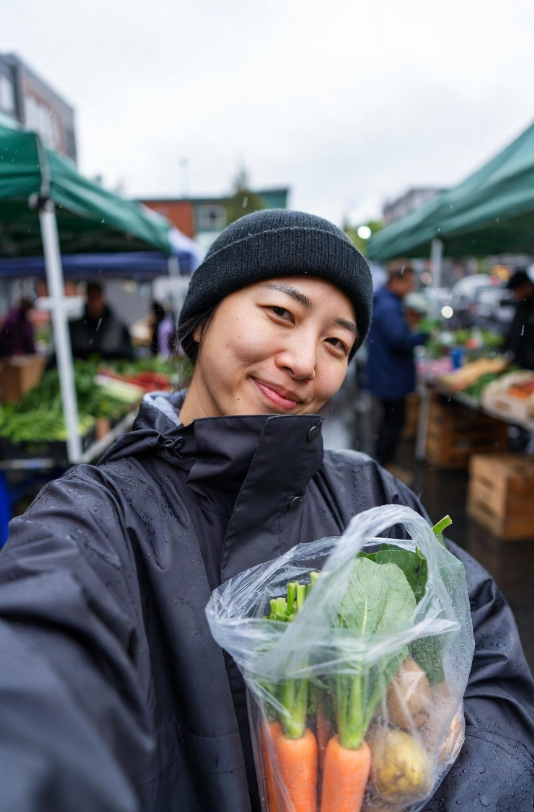
The recipe this week is a spring roll — not Korean, not Taiwanese, just a fresh vegetable spring roll that I made for lunch on Thursday because the farmers market had the first spring lettuces and I wanted something green and alive after a winter of soups and stews. Rice paper, softened in warm water. Filled with lettuce, cucumber, avocado, rice noodles, mint, cilantro. Rolled tightly. Dipped in a peanut sauce — peanut butter, soy sauce, rice vinegar, lime, sriracha, water. The rolls are light and crunchy and feel like spring, which is arriving in Seattle the way spring always arrives: tentatively, beautifully, with cherry blossoms and rain and the sense that the dark months are over and something new is growing. Something new is always growing. In the garden. In the kitchen. In the crib. In me.
Thursday’s farmers market had the first real color of the season — those early lettuces, yes, but also strawberries and kiwi and the kind of fruit that feels like proof that winter is actually, finally, over. I’d been feeding a kitchen and a newborn and four grandmothers worth of love all at once, and what I wanted was something I could set on the table and just look at for a moment before anyone touched it — something that looked exactly like how spring feels when it finally arrives in Seattle. This fruit centerpiece was that thing. It’s not a recipe so much as an arrangement of gratitude.
Fresh Fruit Centerpiece
Prep Time: 20 minutes | Cook Time: 0 minutes | Total Time: 20 minutes | Servings: 8
Ingredients
- 1 small pineapple, peeled, cored, and cut into spears or chunks
- 1 pint fresh strawberries, hulled and halved
- 1 cup red grapes, rinsed and patted dry
- 1 cup green grapes, rinsed and patted dry
- 3 kiwis, peeled and sliced into rounds
- 1 cup blueberries, rinsed
- 1 mandarin orange or clementine, peeled and segmented
- 1/2 cantaloupe, seeded and cut into bite-sized pieces or scooped into balls
- Fresh mint sprigs, for garnish
- 1/2 lemon, for light squeezing over cut fruit to prevent browning
Instructions
- Prep all fruit. Wash, dry, peel, and cut all fruit as indicated above. Pat everything thoroughly dry so the arrangement holds its shape and doesn’t become watery on the platter.
- Choose your vessel. Select a large flat platter, a wide shallow bowl, or a wooden board. A white plate or natural wood board lets the colors stand out the most.
- Anchor with the largest pieces. Arrange the pineapple spears and cantaloupe pieces first, placing them at opposite ends or fanning them from the center. These larger pieces create structure for everything else.
- Fill in with color contrast. Tuck strawberries and kiwi rounds along the edges of the pineapple and cantaloupe, alternating red and green for visual balance. Cluster the red and green grapes in small bunches between the larger fruit.
- Add the small jewels. Scatter blueberries and clementine segments into any gaps, filling the arrangement so no platter surface shows through.
- Brighten cut surfaces. Squeeze a light mist of lemon juice over any cut surfaces — particularly the strawberries and kiwi — to keep everything fresh and vibrant.
- Finish with mint. Tuck fresh mint sprigs throughout the arrangement for color, fragrance, and a final sense of spring. Serve immediately, or cover loosely and refrigerate for up to 2 hours before serving.
Nutrition (per serving)
Calories: 85 | Protein: 1g | Fat: 0g | Carbs: 21g | Fiber: 3g | Sodium: 5mg