
 By
By The apartment is eighty percent boxes. Sean and I have been packing every night after the kids are in bed, and the living room now has a shrinking island of the things we are still using and a growing continent of cardboard. Sean labeled a box "KITCHEN -- PANS" and then twenty minutes later labeled another box "KITCHEN -- PANS" and we decided it was fine because we are going to unpack them all on the same day anyway. The specificity of the system collapses in the last week. You just get things into boxes.
Liam has understood he is moving. For three weeks he has treated "the new house" as an abstraction. This week something shifted and he understood it as a place that will replace this place. He asked Tuesday morning if his crib was coming. I said no, his new big-boy bed was waiting at the new house. He said "who lives there now." I said "no one, Buddy. It is going to be ours." He said "who lived there before." I said "a nice teacher who is not there anymore." He said "did she die." I said "no, Buddy, she moved to live near her grandchildren." He said "do we know her." I said "no." He said "will she come back." I said "no, Buddy. It will be our house." He sat with this for a minute and then said "okay." But I could tell it was the kind of okay that is not yet an okay. It is the kind of okay that is a holding position while he does more thinking. I am ready for the processing to take a week or a month. That is fine. Moves are big.
Nora is not processing. She is packing her notebook in her notebook box, which is a small cardboard shoebox Sean gave her labeled "NORA NOTEBOOKS." She puts her notebook in. She takes it out. She puts it in. She carries the box around the apartment and puts it down in different rooms. She is preparing, in her way, for a transition she cannot articulate. I watch her work. Twenty-three-month-olds are not supposed to conceptualize change. She is doing some form of it anyway.
The clinic is finally past the Omicron peak. We are still short-staffed. I signed up for two extra shifts this weekend even though I was not supposed to because someone had to, and I am the one who has extra shifts in her, and I am tired but still upright. I will sleep after we move.
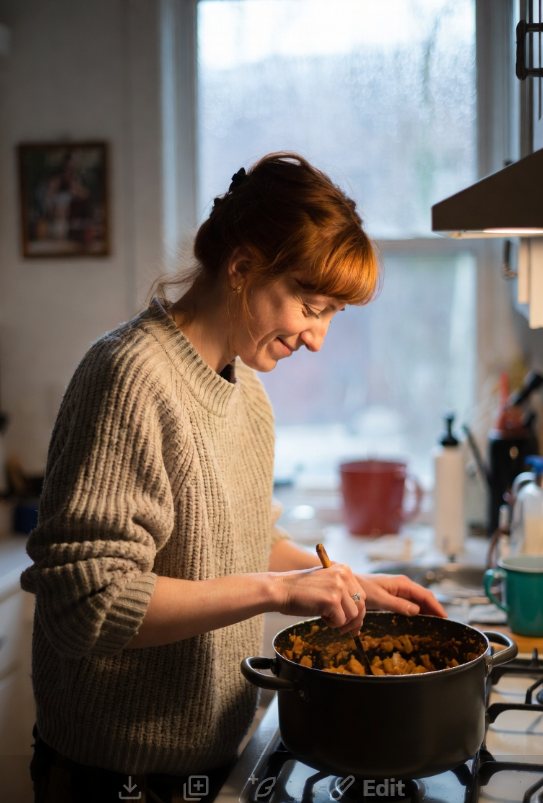
Cooked Tuesday: a pot of chicken soup, the version with the thick broth and the lemon, frozen in portions. Cooked Wednesday: a large lasagna, cut and frozen in slabs. Cooked Thursday: a beef stew, frozen in quart bags. Cooked Saturday: three trays of baked rigatoni. My freezer looks like the stockpile of a person preparing for a small siege. Sean and I will eat from it for two weeks. We will not cook for the first fourteen days in the new house. That is the plan. Maureen will disagree with the plan. Maureen will, in fact, drop off additional food in the first week and tell us she had "extras." We will accept the additional food because this is the way the family moves someone into a new house.
The beef stew I made on Thursday is already gone — Sean found it at midnight between two stacks of boxes and I cannot even be upset about it. This pot roast is the version I keep coming back to when I need something that will survive the freezer and still taste like an actual meal on the other side of it: deep, savory, the kind of thing that makes the new house smell like home on the first night you actually sit down to eat. I sliced it into portions just like everything else this week, labeled the bags in my least ambiguous handwriting, and stacked them next to the rigatoni. They’re ready. So, eventually, are we.
Flavorful Pot Roast
Prep Time: 20 min | Cook Time: 3 hr 30 min | Total Time: 3 hr 50 min | Servings: 8
Ingredients
- 3 to 4 lb boneless beef chuck roast
- 2 tablespoons olive oil
- 1 teaspoon salt
- 1/2 teaspoon black pepper
- 1 teaspoon garlic powder
- 1 teaspoon onion powder
- 1 teaspoon dried thyme
- 1 teaspoon dried rosemary
- 1 large onion, roughly chopped
- 4 cloves garlic, smashed
- 4 medium carrots, cut into 2-inch pieces
- 4 medium potatoes, quartered
- 2 stalks celery, cut into 2-inch pieces
- 2 cups beef broth
- 1 cup red wine or additional beef broth
- 2 tablespoons tomato paste
- 1 tablespoon Worcestershire sauce
- 2 bay leaves
Instructions
- Preheat and season. Preheat your oven to 325°F. Pat the chuck roast dry with paper towels. Combine salt, pepper, garlic powder, onion powder, thyme, and rosemary, then rub the mixture evenly over all sides of the roast.
- Sear the roast. Heat olive oil in a large Dutch oven over medium-high heat. Add the roast and sear without moving it for 4 to 5 minutes per side, until a deep brown crust forms. Transfer the roast to a plate.
- Build the base. Reduce heat to medium. Add the chopped onion and celery to the pot and cook for 3 to 4 minutes, stirring to loosen any browned bits. Add the smashed garlic and cook 1 minute more. Stir in the tomato paste and cook for 2 minutes.
- Deglaze and combine. Pour in the red wine (or broth) and scrape up any remaining browned bits from the bottom of the pot. Add the beef broth and Worcestershire sauce and stir to combine.
- Braise low and slow. Return the roast to the pot. Nestle in the carrots, potatoes, and bay leaves. The liquid should come about halfway up the roast; add more broth if needed. Cover tightly and transfer to the oven.
- Cook until tender. Braise for 3 to 3 1/2 hours, or until the beef is fork-tender and pulling apart easily. Check halfway through and add a splash of broth if the liquid has reduced too much.
- Rest and serve or freeze. Remove the bay leaves. Let the roast rest for 10 minutes before slicing or shredding. To freeze, portion the meat and vegetables into quart freezer bags with spoonfuls of the braising liquid. Freeze flat for up to 3 months. Reheat in a saucepan over medium-low heat, covered, until warmed through.
Nutrition (per serving)
Calories: 410 | Protein: 38g | Fat: 18g | Carbs: 22g | Fiber: 3g | Sodium: 520mg