
 By
By The last week of February. We had the first off-season throwing session this week — a Saturday morning at the school, indoor, just the receivers and the QBs and a few of the coaches. Voluntary. Which means everyone showed up, because in this program voluntary means mandatory and the kids understand the math. Diego threw with a torque he did not have last year. He has put on six pounds of muscle since November. He looks the part now. The catches were sharp. The QB, a junior named Marcus Williams, has clearly been putting in the same kind of off-season Diego has been putting in. The chemistry between them is going to be a real thing in the fall. I watched from the corner of the gym and I tried not to grin like a fool. I grinned anyway. Tony Davis caught me and said, "Coach, you are showing your hand." I said, "Tony, the hand is too good to hide." He laughed.
Sofia had her first big indoor meet on Saturday afternoon, which meant I drove from the school to the meet and got there ten minutes before her race. She runs the 1600. I have learned, since Sofia became a runner, that the 1600 is a different animal from any race I ever cared about. There is no instant gratification. The race is four minutes long, sometimes longer for fourteen-year-old girls, and the drama of it is internal — the runner against herself, against the pace, against the wall at lap three when the legs go and the chest burns and the part of you that wants to quit gets very loud. The runners around you are other people running their own internal race. You do not block. You do not tackle. You do not even really pass — you just continue, and other people stop continuing, and you become farther ahead than you were before.
Sofia ran a 5:42. Personal best. She was sixth in a field of twenty-two. The first three runners were juniors and seniors at much bigger schools. The coach told me afterward she has another twenty seconds to find this season. I told the coach I believed her. Sofia came over to me after the cool-down and said, "Did you see it." I said, "I saw the last three laps." She said, "What did you think." I said, "I think you ran your race. I think the second lap was a tick fast and the fourth lap was a tick slow, but the third lap was perfect." She said, "How do you know." I said, "I have been watching athletes my whole life, Soph. I know what I am looking at." She nodded. She walked off to find her teammates. I sat in the bleachers for another twenty minutes and I watched the rest of the meet and I thought about how strange it is that I have a daughter who runs four-minute miles and a son who catches footballs and twins who can stack an enchilada at ten years old, and that any of this is real, and that I helped make all of it.
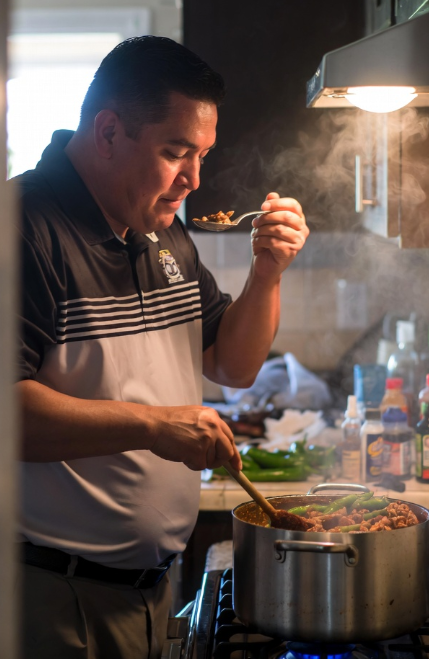
Sunday morning I made green chile burgers for lunch — sixteen of them, because Diego had two friends over to watch a basketball game and his friends are seventeen and a half and they eat like grown men, and Marco wanted two burgers, and Lisa was home and wanted one, and I wanted two, and Sofia wanted half of one with extra mushrooms. The math worked out to sixteen patties. I make my burger patties from a blend — eighty-twenty ground chuck, mostly, with a little bit of brisket trim mixed in when I have it, which I did not this week, so it was straight chuck. Salt, pepper, garlic powder, and a single secret weapon — a tablespoon of crushed roasted green chile mixed directly into the meat. Not the topping. The patty itself. The chile becomes part of the burger's soul instead of an afterthought.
I grilled them on the Weber kettle on the back patio. February in Denver, twenty-eight degrees, snow on the lawn, and I am at the grill with a beanie pulled down over my ears and tongs in one hand and a coffee in the other. Diego's friends came outside to ask how long. I told them five more minutes. The taller one, a kid named Trevor, said, "Coach, do you grill all year." I said, "All year. Every year. There has not been a winter weekend in twenty years that I did not grill at least once." He said, "That is hardcore." I said, "It is not hardcore. It is just dinner."
The burgers came in. Each one got two slices of medium cheddar, a topping of more roasted green chile, a slab of red onion, lettuce, tomato, and a homemade sauce that is mayo, lime juice, more chile, and a dash of Worcestershire. The buns I had toasted on the comal in butter. We sat in the kitchen and ate and watched the basketball game. Diego ate three. Trevor ate three. The other friend, a kid named Jaylen, ate three. Marco ate two. Sofia ate her half. Lisa ate one. I ate two. Elena, who normally avoids chile, ate one with no chile, which I made her separately. Eleven and a half burgers consumed. Four and a half patties left, which became Diego's lunch on Monday and Tuesday.
Sunday night I sat in my chair in the den and read the Sunday paper, which is something almost no one does anymore, and which I refuse to give up. Lisa was in the kitchen finishing a crossword. The kids were doing whatever they were doing. The house was loud and warm and the food was put away and the dishes were drying and the season was coming, and the team was going to be good, and Sofia was going to be fast, and the twins were going to grow another quarter inch this month, and I was forty-five, and we were okay. We were okay.
Those sixteen patties got eaten and I was glad, but the green chile burger is a weekend weapon—it takes a crowd to justify it, and you need the grill and the cold and the ritual of standing outside with a beanie on. On the weeks when it’s just us, or when the weather finally breaks the wrong way even for me, I reach for this flank steak instead. It has the same quality I look for in any Sunday cook: a little patience up front, a sauce that does real work, and a result that makes the table go quiet for a moment before anyone says a word. That’s the only review I need.
Flank Steak with Creamy Peppercorn Sauce
Prep Time: 10 minutes | Cook Time: 20 minutes | Total Time: 30 minutes | Servings: 4
Ingredients
- 1 1/2 lbs flank steak
- 1 teaspoon kosher salt
- 1 teaspoon coarsely ground black pepper
- 1/2 teaspoon garlic powder
- 1 tablespoon olive oil
- 1 tablespoon unsalted butter
- 2 cloves garlic, minced
- 1/3 cup beef broth
- 3/4 cup heavy cream
- 1 tablespoon whole black peppercorns, lightly crushed
- 1 teaspoon Dijon mustard
- 1 teaspoon Worcestershire sauce
- Salt to taste
- Fresh parsley, chopped, for garnish
Instructions
- Season the steak. Pat the flank steak dry with paper towels. Season both sides evenly with salt, black pepper, and garlic powder. Let the steak rest at room temperature for 10 minutes while you gather your sauce ingredients.
- Sear the steak. Heat olive oil in a large cast-iron or heavy skillet over high heat until just smoking. Add the flank steak and sear undisturbed for 4 to 5 minutes per side for medium-rare, or until it reaches your preferred internal temperature (130—135°F for medium-rare). Do not move the steak while it sears—let the crust build.
- Rest the meat. Transfer the steak to a cutting board and tent loosely with foil. Let it rest for 8 to 10 minutes. Do not skip this step.
- Build the sauce. Reduce the heat to medium. Add butter to the same skillet. Once melted, add the minced garlic and crushed peppercorns. Cook for 1 minute, stirring, until fragrant. Pour in the beef broth and scrape up any browned bits from the bottom of the pan.
- Finish the sauce. Add the heavy cream, Dijon mustard, and Worcestershire sauce. Stir to combine. Simmer for 4 to 5 minutes, stirring occasionally, until the sauce thickens enough to coat the back of a spoon. Taste and adjust salt as needed.
- Slice and serve. Slice the flank steak thinly against the grain—this is not optional, it is what makes the cut tender. Arrange on a platter or individual plates. Spoon the peppercorn sauce generously over the top and finish with chopped fresh parsley.
Nutrition (per serving)
Calories: 480 | Protein: 38g | Fat: 34g | Carbs: 4g | Fiber: 0g | Sodium: 520mg