
 By
By A year. One year since the breakdown. I don't know the exact date — the floor happened sometime in early March 2016, and Angela found me on the fourth day, and the math puts it somewhere in the first week of March. I'm not going to calculate it precisely because the precision doesn't matter. What matters is the distance: one year between the floor and now. One year between the woman who couldn't stand up and the woman who stands at a stove every night and makes food and writes about it and goes to the ER and comes home and does it again.
Dr. Reeves acknowledged the anniversary in our session. She doesn't celebrate — that's not her style — but she noted it, the way a nurse notes a vital sign that's trending in the right direction. "How do you feel about where you are?" she asked. I said: "I feel like I'm cooking." She waited. I said: "I mean, I feel like I'm in the middle of a recipe. Not done. Not raw. Somewhere in the simmer. Things are combining but I can't taste the final product yet." She nodded. She didn't say anything else. Sometimes Dr. Reeves's silences are more therapeutic than her words.
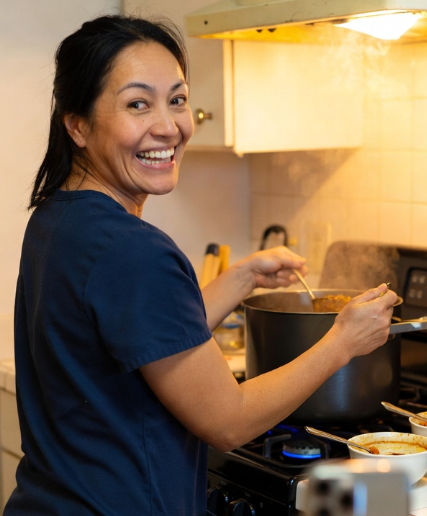
I made chicken curry — Filipino-style, not Indian, which means coconut milk and potatoes and bell peppers and a curry powder that Lourdes buys from the Asian grocery because the McCormick kind is "too yellow, not enough flavor." Filipino curry is milder than Indian, creamier, sweeter from the coconut milk. It's not a traditional dish — it came to the Philippines through centuries of trade — but Filipinos adopted it and adapted it and now it's ours, the way everything in Filipino cuisine is adopted and adapted, borrowed from Spain, China, India, America, and made into something that tastes like the Philippines even though the ingredients came from everywhere else.
The curry simmered while I sat at the kitchen table and thought about the year. The therapy. The medication. The blog — six posts now, a small readership growing slowly. The ER, still hard, still haunted, still the place where I do the thing I was made to do, with boundaries that keep me from being consumed by it. The cooking, always the cooking, the thread that runs through everything, the thing that kept me alive when alive felt like an obligation rather than a gift.
I ate the curry with rice and thought: one year. The simmer continues. The heat is steady. I don't know what this becomes, but I know the ingredients are right — therapy, medication, food, family, writing, work. Combine. Stir. Wait. One more year. One more squeeze. One more bowl of something warm in a cold place. That's the recipe. I'm following it.
That bowl of curry became the meal I needed to mark the end of a year I almost didn’t survive — warm, layered, built from disparate things that somehow belong together. I made it the same way I’ve been learning to make a life: slowly, with attention, trusting that the ingredients are right even when the outcome is uncertain. Here’s how I made it.
Filipino Chicken Curry with Coconut Milk and Potatoes
Prep Time: 15 min | Cook Time: 40 min | Total Time: 55 min | Servings: 4
Ingredients
- 1 1/2 lbs boneless, skinless chicken thighs, cut into 2-inch pieces
- 2 tablespoons neutral oil (vegetable or canola)
- 1 medium yellow onion, sliced thin
- 4 cloves garlic, minced
- 1 tablespoon fresh ginger, grated
- 2 tablespoons curry powder (preferably from an Asian grocery — richer flavor than standard blends)
- 1 1/2 cups chicken broth
- 1 can (13.5 oz) full-fat coconut milk
- 2 medium Yukon Gold potatoes, peeled and cut into 1-inch cubes
- 1 medium red bell pepper, sliced into strips
- 1 medium green bell pepper, sliced into strips
- 1 tablespoon fish sauce (or soy sauce)
- 1 teaspoon sugar
- Salt and black pepper to taste
- Cooked white rice, for serving
- Sliced scallions, for garnish (optional)
Instructions
- Brown the chicken. Season chicken pieces with salt and pepper. Heat oil in a large heavy pot or Dutch oven over medium-high heat. Add chicken in a single layer and cook 3–4 minutes per side until golden. Remove chicken and set aside — it will finish cooking in the curry.
- Build the base. Reduce heat to medium. In the same pot, add onion and cook 4–5 minutes until softened and translucent. Add garlic and ginger, stirring for 1 minute until fragrant.
- Bloom the curry powder. Add curry powder to the onion mixture and stir constantly for 1 minute, coating everything and letting the spices toast slightly in the oil. This step deepens the flavor considerably.
- Add liquid and potatoes. Pour in chicken broth and coconut milk, stirring to combine. Add the potatoes and the browned chicken back into the pot. Bring to a gentle boil, then reduce heat to low.
- Simmer low and slow. Cover and simmer on low for 20 minutes, stirring occasionally, until potatoes are nearly fork-tender and the chicken is cooked through.
- Add bell peppers and season. Stir in the red and green bell pepper strips. Add fish sauce and sugar. Simmer uncovered for another 8–10 minutes until peppers are just tender and the sauce has thickened slightly. Taste and adjust seasoning with salt, pepper, or an extra splash of fish sauce.
- Serve. Ladle over steamed white rice. Garnish with scallions if desired. The curry holds well — it’s often better the next day once the flavors have fully combined.
Nutrition (per serving)
Calories: 480 | Protein: 34g | Fat: 26g | Carbs: 28g | Fiber: 4g | Sodium: 620mg