I baked at 6 AM because the house was too quiet and the oven is the surest way I know to make a house feel inhabited. The oven generates heat, smell, the small ticks of metal expanding, the predictable rise of dough on the counter, the timer I can hear from three rooms away. The oven is, in some real sense, my roommate. I have not told this to my children. They would gently suggest something. The oven and I prefer no suggestions.
Erik came over Sunday. He chopped wood for me without being asked — the pile by the back door was getting low, and Erik had noticed, and Erik had brought his ax, and Erik had spent forty-five minutes splitting and stacking and not making a single comment about how the wood needed to be done. He drank coffee. He left. The whole visit was forty-five minutes. It was perfect. Erik is a perfect brother in the specific way of Scandinavian brothers — silent, useful, present.
Mamma called Tuesday. Her voice was small but her mind was sharp. She wanted to talk about Pappa, of all people. About the time he fixed her bicycle in 1962. About how he always said "there" when he had finished a job, the same way every time, the small declarative finality. She had not thought of this in years, she said. The memory came to her in the kitchen, while she was peeling an apple. I listened. I did not interrupt. The memory was unprovoked and total. The memory is everything.
I cooked Pot roast with red wine and rosemary this week. Paul's recipe. Chuck roast browned hard in the dutch oven, then onion, garlic, carrots, red wine, beef stock, a sprig of rosemary, three hours at 325 in the oven, lid on. The meat is so tender it falls when the spoon touches it. Served over mashed potatoes with the pan gravy.
The Damiano Center on Thursday. The pot was bigger than usual — fifty-five gallons. The crowd was bigger than usual. The need does not respect the calendar. There is no holiday from hunger. There is no week off from the soup. We make the soup. They come for the soup. The pattern is reliable.
I thought about my own mother today. The full thought of her — Mamma at thirty in the kitchen on Fifth Street, Mamma at sixty in the kitchen on Fifth Street, Mamma at ninety in the kitchen on Fifth Street, Mamma in hospice in 2024 with her eyes closed and her hand in mine. The full arc of a person fits in a single thought, sometimes, if you let it. The thought is the inheritance. The thought is the visit.
It is enough. Paul is not here. Mamma is not here. Pappa is not here. Erik is not here. They are all here in the kitchen, in the smell, in the taste, in the wooden spoon and the bread pans and the marble slab. The dead are not where the body went. The dead are in the kitchen.
The Damiano Center has changed slowly over the years. The director has changed three times in the period I have volunteered. The volunteer roster has rotated, with new faces every year. The pot — the actual physical fifty-gallon stock pot — has been replaced once. The recipe has not changed. The recipe is a constant. The constancy is the gift the recipe gives to a place where so much else is in flux.
It is enough.
The pot roast is Paul’s recipe — it belongs to a Sunday, to a dutch oven, to a grief that has settled into something I can carry — but the thing I made at six in the morning, before Erik came, before Mamma called, before Thursday and the fifty-five-gallon pot, was simpler than that. It was scones. Flour and butter and the small reliable chemistry of the oven doing what ovens do. These English scones are not dramatic. They are not a statement. They are exactly what you make when the house is too quiet and you need something that rises on its own and smells like a person lives here.
English Scones
Prep Time: 15 min | Cook Time: 15 min | Total Time: 30 min | Servings: 8
Ingredients
- 2 cups all-purpose flour
- 1 tablespoon baking powder
- 1/4 teaspoon fine salt
- 2 tablespoons granulated sugar
- 6 tablespoons cold unsalted butter, cut into small cubes
- 2/3 cup cold whole milk, plus more for brushing
- 1 large egg
- 1/2 teaspoon pure vanilla extract
Instructions
- Heat the oven. Preheat your oven to 425°F (220°C). Line a baking sheet with parchment paper and set it aside.
- Combine dry ingredients. In a large bowl, whisk together the flour, baking powder, salt, and sugar until evenly combined.
- Cut in the butter. Add the cold butter cubes to the flour mixture. Using your fingertips or a pastry cutter, work the butter into the flour until the mixture resembles coarse, pea-sized crumbs. Work quickly so the butter stays cold.
- Mix the wet ingredients. In a small bowl or measuring cup, whisk together the milk, egg, and vanilla extract.
- Bring the dough together. Pour the wet ingredients into the flour mixture and stir gently with a fork just until a shaggy dough forms — do not overwork it. Turn the dough out onto a lightly floured surface and pat it together gently into a disk about 3/4 inch thick.
- Cut the scones. Using a sharp 2 1/2-inch round cutter, press straight down (do not twist) to cut out scones. Gather the scraps, pat together once more, and cut any remaining scones. Place on the prepared baking sheet about 1 inch apart.
- Brush and bake. Brush the tops lightly with a little cold milk. Bake for 13–15 minutes, until risen and golden on top. The undersides should be a deep golden brown.
- Cool briefly. Transfer to a wire rack. Serve warm with butter, clotted cream, or jam. They are best the day they are made, and especially in the first hour.
Nutrition (per serving)
Calories: 215 | Protein: 5g | Fat: 10g | Carbs: 27g | Fiber: 1g | Sodium: 190mg
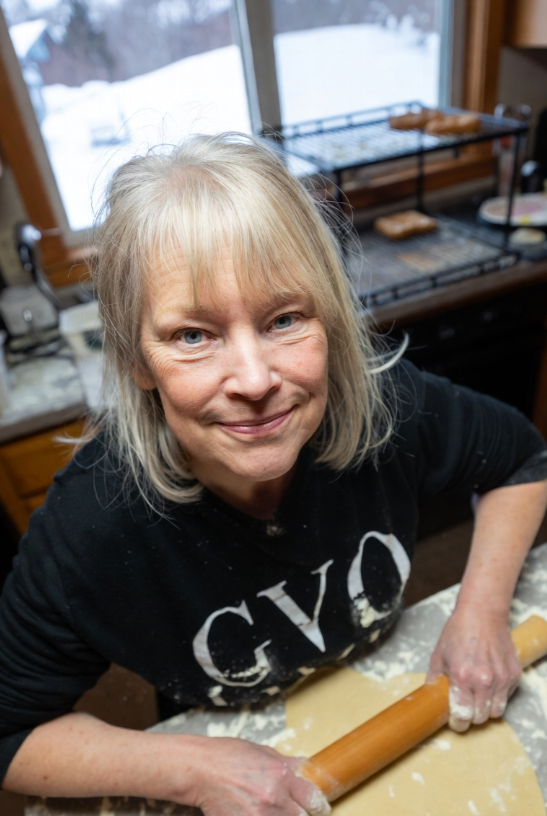
About the cook who shared this
Linda Johansson
Week 355 of Linda’s 30-year story
· Duluth, Minnesota
Linda is a sixty-three-year-old retired nurse from Duluth, Minnesota, living alone in the house where she raised her children and said goodbye to her husband. She lost Paul to ALS in 2020 after two years of watching the kindest man she'd ever known lose everything but his dignity. She cooks Scandinavian comfort food and Minnesota hotdish and the pot roast Paul loved, and she sets two places at the table out of habit because it makes her feel less alone. Every recipe she writes is a person she's loved.
