
 By
By Branding for the late calves Thursday. We had a small bunch born in May and June from heifers who took the bull late, eighteen head, and you can hold them off until they are too big to handle easy or you can do them in July when the days are long and the temperatures are tolerable in the early morning. I do them in July. We started at six. By ten we were done and the calves were running back to their mothers like they had been insulted but not injured, which is more or less correct. The work is the work. You do not love it. You do it because the alternative is unidentified animals.
\nPatrick sat in the shade of the chute and watched. He could not work the rope or the iron but he could call out which calf needed which mark and he did, and his voice still carries, and the four neighbors I had brought in to help all knew Patrick and they treated him with the deference men give other men whose work has earned them deference. He was tired by ten. I drove him to the porch. He slept four hours in the chair without moving. Mom checked on him every twenty minutes. I had told her not to. She had told me to mind my business. I stopped telling her.
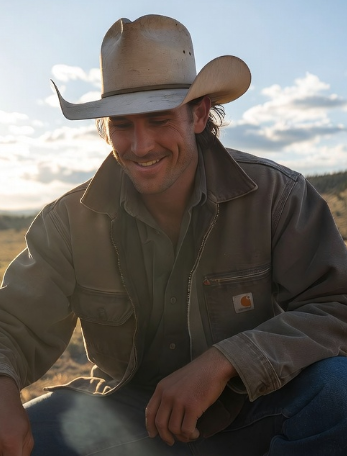
\nI did farrier work three days this week. Two ranches in Yellowstone County, one in Musselshell. Long days, eighty miles of driving, four horses per day at the high end. The forge work in July is hot — you are heating steel to red and you are standing over it in ninety-degree air and the sweat runs into your eyes and the leather apron gets heavy with damp and by the end of the day you have a salt rim on your shirt that looks like a topographical map. I do not love July farrier work. I do it because it pays the medications and the feed bills and because the work itself is, even hot, satisfying. A horse comes in walking lame and goes home walking sound. There are not many trades where the result is that visible. I am grateful for it most days. Some days I just want a fan.
\nThe book got a small mention in a national magazine — The Atlantic, of all places, a roundup piece about regional food writing. Two sentences. They quoted a paragraph from the November chapter, the one about cooking elk over juniper coals. Sarah called Friday and read it to me. I said, that is something. She said, that is a lot of something. I told her I had a horse to shoe at one and could she email it to me. She laughed and said yes. The Atlantic. I do not read The Atlantic. I am not going to start now. But two sentences in The Atlantic is something my mother will frame and put on the kitchen wall and I will not stop her.
\nCooked Monday from the garden. Late July is the abundance week. Tomatoes in the basket, cucumbers in the basket, summer squash in the basket, peppers coming in, basil three feet tall and going to seed if I do not pinch it. I made a tomato sandwich for lunch — white bread, mayonnaise, salt, pepper, two slices of tomato so thick they would not stay in the bread, eaten over the sink because the juice would have ruined any plate. The best lunch of the year. The kind of lunch you cannot explain to anyone who has only had a grocery store tomato. The food writers who wrote about regional ingredients before there were magazine sections about it knew this. The book of mine, the small chapter about July, says all this in better sentences. I read the chapter back Sunday afternoon. It was strange to read words I had written and recognize them and also be a stranger to them. Books do that. The version of you who wrote a thing is gone by the time anyone else reads it. I am not sad about this. I am noticing it.
\nSaturday I cooked over the firepit again — three of the AA guys this time, not a planned thing, they just came by, and I had ribs going since noon. Beef ribs, the big four-bone plate ribs, rubbed with salt and pepper only, smoked low at two-fifty for six hours over apple wood. The crust was dark and the bones pulled clean and we ate them with our fingers and there were no leftovers. Marcus was there again. He has come every weekend since the first one. He brought his own plate and a six-pack of root beer because he does not drink either, and we drank root beer and ate beef ribs and watched the sun go down over the Bulls, and at one point Marcus said, This is medicine, and I said, I know, and we did not say anything else for a long time and then we said goodbye and he drove home in the dusk and the fire burned down and I went inside to sleep and slept hard. Some weeks the fire is enough. Some weeks it is more than enough.
Saturday’s ribs fed the Saturday crowd, and that was right for Saturday — open fire, root beer, watching the sun go down over the Bulls with Marcus and whoever else needed a place to be. But the rest of the week was farrier days and branding and eighty miles of driving, and on those days you do not have a firepit and six hours and a cold evening coming. On those days you need something you can wrap in foil, carry in a truck, and eat one-handed while the forge cools. The English pasty is exactly that — beef and potato and onion folded into pastry and baked until the crust is gold and the filling has gone tender and savory and the whole thing will keep you on your feet through whatever the afternoon asks of you.
English Pasties
Prep Time: 35 min | Cook Time: 55 min | Total Time: 1 hr 30 min | Servings: 6
Ingredients
- 3 cups all-purpose flour
- 1 tsp salt (for pastry)
- 3/4 cup cold unsalted butter, cut into cubes
- 1/2 cup ice water (more as needed)
- 1 lb beef skirt steak or chuck, trimmed and cut into 1/4-inch cubes
- 1 1/2 cups russet potato, peeled and cut into 1/4-inch cubes
- 3/4 cup turnip or swede, peeled and cut into 1/4-inch cubes
- 1 medium yellow onion, finely diced
- 1 1/2 tsp kosher salt (for filling)
- 1 tsp black pepper
- 1 tbsp unsalted butter, cut into small pieces (for filling)
- 1 egg, beaten (for egg wash)
Instructions
- Make the pastry. Combine flour and 1 tsp salt in a large bowl. Cut in cold butter with a pastry cutter or your fingers until the mixture resembles coarse crumbs. Add ice water one tablespoon at a time, mixing until the dough just comes together. Divide into 6 equal balls, wrap in plastic, and refrigerate for 30 minutes.
- Prepare the filling. In a bowl, combine diced beef, potato, turnip, and onion. Season with kosher salt and black pepper. Toss to distribute evenly. Do not pre-cook — everything goes in raw and steams inside the pastry.
- Preheat oven. Heat oven to 400°F. Line two baking sheets with parchment paper.
- Roll and fill. On a lightly floured surface, roll each dough ball into a circle roughly 8 inches across. Pile a generous scoop of filling (about 3/4 cup) onto one half of each circle, leaving a 3/4-inch border. Dot the filling with a few small pieces of butter.
- Crimp and seal. Fold the empty half of dough over the filling to form a half-moon. Press the edges firmly together, then fold and crimp the sealed edge upward — the traditional rope crimp runs along the top. Cut a small vent in the top of each pasty. Brush all over with beaten egg.
- Bake. Place pasties on prepared baking sheets and bake at 400°F for 20 minutes, then reduce heat to 350°F and bake an additional 35 minutes, until the crust is deep golden and the filling is tender when pierced through the vent with a skewer.
- Rest and serve. Let pasties rest 10 minutes before eating. They are good hot, good warm, and good cold out of foil at the side of a truck. Carry them however the day requires.
Nutrition (per serving)
Calories: 540 | Protein: 24g | Fat: 27g | Carbs: 50g | Fiber: 3g | Sodium: 510mg