
 By
By New Year's Eve. 2017 ends and 2018 begins and I am standing in my kitchen at midnight with Luis and the children and the sound of fireworks from the neighborhood and Camila singing into her new microphone at a volume that would violate several noise ordinances if the neighbors weren't all doing the same thing. We eat grapes — twelve grapes at midnight, one for each month, a Mexican tradition that Rosa swore brought good luck and that I follow because tradition is stronger than skepticism, and also because the grapes are good.
I ate my twelve grapes. One for each month of 2018. I made a wish for each one — January: the bakery. February: Luis. March: the children. April: health. May: Sofia. June: Isabella. July: Diego. August: Camila. September: Rosa's memory. October: Alejandro. November: the recipes. December: more. Always more. Not more money or more success but more of this — more midnight, more grapes, more children singing, more Luis standing next to me, more of the ordinary extraordinary life that Rosa built with her hands and passed to mine.
2017 was a year. Not a good year or a bad year — just a year, a full rotation around the sun, fifty-two weeks of bread and children and grief and growth and the steady turning of the bakery's wheel. We grew. The bakery grew. The children grew. The grief didn't shrink but the life around it expanded, and expansion is the answer to grief — not shrinking the sadness but growing the joy until the joy is bigger, until the ratio favors the light.
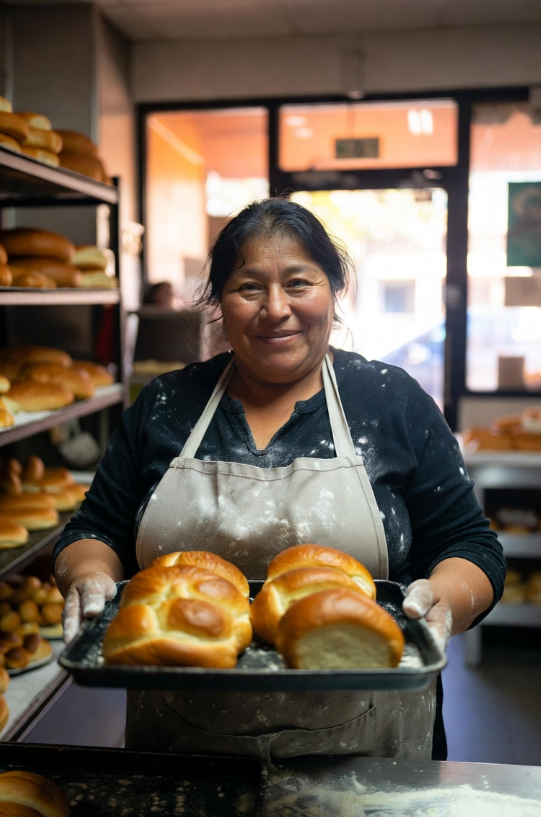
I made rosca de reyes dough for January 6. The annual tradition: sweet bread, candied fruit, the hidden baby Jesus, the promise that whoever finds it hosts a party on Candelaria. The dough proofed overnight in the bakery kitchen, rising slowly in the cool January air, and I thought: this is faith. Not the kneeling, not the praying, not the candles. This. Putting dough in a bowl and trusting it to rise in the dark. That is faith. Rosa knew this. Every baker knows this. You mix the ingredients and you wait and you trust, and in the morning the dough has risen, and the rising is the miracle, and the miracle happens every day, and every day you are surprised by it, and the surprise is the prayer.
The rosca dough was already sleeping in the bakery kitchen, and I was still thinking about those twelve grapes and all the wishes folded inside them, when I realized I wanted to bake something the next morning that carried the same feeling — dough trusted to rise, a quiet overnight miracle, the kind of bread that asks you to believe before you see. Bagels have always felt like that to me: humble rings, nothing fancy, but you boil them before you bake them, and that small act of patience is everything. Rosa would have laughed at me getting philosophical about bagels, but she also would have eaten three of them warm with butter, so I think she would understand.
Fantastic (and Easy!) Homemade Bagels
Prep Time: 20 minutes + overnight rest | Cook Time: 25 minutes | Total Time: 9 hours (mostly hands-off) | Servings: 8 bagels
Ingredients
- 1 1/2 cups warm water (about 110°F)
- 2 1/4 teaspoons active dry yeast (one standard packet)
- 1 tablespoon granulated sugar, divided
- 3 1/2 cups bread flour, plus more for dusting
- 1 1/2 teaspoons fine sea salt
- 1 tablespoon neutral oil (vegetable or canola), plus more for the bowl
- 1 tablespoon honey or barley malt syrup (for the boiling water)
- 1 egg, beaten with 1 tablespoon water (egg wash)
- Optional toppings: everything bagel seasoning, sesame seeds, poppy seeds, flaky salt
Instructions
- Proof the yeast. In a large bowl, combine the warm water, yeast, and 1 teaspoon of the sugar. Stir gently and let sit for 5–10 minutes until foamy. If it doesn’t foam, your yeast is not active — start over with fresh yeast.
- Make the dough. Add the flour, remaining sugar, salt, and oil to the yeast mixture. Stir until a shaggy dough forms, then turn out onto a lightly floured surface and knead for 8–10 minutes until the dough is smooth, firm, and slightly tacky but not sticky. It should spring back when poked.
- First rise. Lightly oil the bowl, place the dough inside, and cover tightly with plastic wrap. Refrigerate overnight, or for at least 8 hours. This slow, cold rise is where the flavor develops — trust the dark and the time.
- Shape the bagels. Remove the dough from the refrigerator and let it sit at room temperature for 30 minutes. Divide into 8 equal pieces (about 90g each). Roll each piece into a smooth ball, then press your thumb through the center and gently stretch the hole to about 1 1/2 inches wide. The hole will shrink during baking, so make it larger than you think you need.
- Second rise. Place shaped bagels on a parchment-lined baking sheet, cover loosely with a clean kitchen towel, and let rest at room temperature for 30–45 minutes until slightly puffed.
- Preheat and prepare the water bath. Preheat your oven to 425°F. Bring a large wide pot of water to a boil. Add the honey or barley malt syrup to the water and stir to combine. This is what gives bagels their characteristic chew and shine.
- Boil the bagels. Working in batches of 2–3, gently lower the bagels into the boiling water. Boil for 1 minute per side (2 minutes total), then use a slotted spoon or spider to lift them out and return them to the parchment-lined sheet. Do not skip this step — it is what makes a bagel a bagel.
- Top and bake. Brush each boiled bagel generously with the egg wash. Sprinkle with your preferred toppings. Bake at 425°F for 20–22 minutes, rotating the pan once halfway through, until deep golden brown and firm to the touch.
- Cool before cutting. Transfer to a wire rack and let cool for at least 15 minutes before slicing. The interior finishes setting as they cool, and cutting too early will leave the crumb gummy. They are worth the wait.
Nutrition (per serving)
Calories: 230 | Protein: 8g | Fat: 3g | Carbs: 44g | Fiber: 2g | Sodium: 370mg