March 15, 2021. One year.
I woke at 3:42 AM. Not from an alarm — from the body's memory, the clock inside the cells that remembers the hour, the minute, the exact moment when the breathing changed and the monitor changed and the hand I was holding became the hand of a man who was gone.
3:42. I lay in bed — Paul's side of the bed, where I've slept for a year — and I breathed. My own breathing, unassisted, free. The bedroom was silent. No machines. No hissing. No beeping. Just the silence of a house at 3:42 AM in March in Duluth.
I got up. I went to the kitchen. I put on the percolator. I sat at the table with Sven at my feet. The Advent star was in the window — always in the window, the permanent light. The kitchen was dark except for the star and the small light over the stove.
I said: "One year, Paul. Another year. I'm still here."
At six AM, I baked cardamom bread. The bread whose smell was the last thing. The dough rose and the oven heated and the house filled with the smell of cardamom and butter and the smell was Paul and the smell was March and the smell was one year of continuing.
The kids called. Anna at eight. Peter at nine. Elsa came at ten. Sophie at noon (between shifts — she's on the COVID ward, still, the work that never stops). Each call was brief, warm, weighted. "How are you, Mom?" "I'm here." "We love you." "I love you too."
Elsa and I went to the cemetery at two PM. We stood at Paul's grave. The headstone, one year older, the granite the same. THE LAKE IS STILL HERE. I read the words. Elsa read the words. The lake was visible through the trees, half-frozen, beginning to open.
Elsa said, "The ice is going out." I said, "It always goes out." She said, "That's the point, isn't it?" I said, "That's the point."
The ice goes out. Every year. No matter what. The lake opens. The ships return. The world continues. The ice doesn't hold forever. Nothing holds forever. But the going-out is the proof that what was frozen can become fluid again, that what was locked can become free, that the year of ice gives way, eventually, to the year of water.
I went home. I ate the cardamom bread — warm, with butter. At the table. Two places. One plate. One empty plate.
I said: "Good bread, Paul." I said: "Tack." Thank you. The same word. The word I said a year ago, in Swedish, at 3:42 AM, holding his hand.
Tack, Paul. For the thirty-one years. For the kitchen. For the table. For the ships and the books and the cards and the bad drawings and the good jokes. For the reading. For the voice. For the hand I held.
Tack.
The ice is going out. The bread is warm. The year is done.
The next year begins.
I baked cardamom bread that morning because it was the bread Paul loved, but bread — any bread — is what grief asks for: something that rises in the warm dark, something you shape with your hands, something that fills the house with a smell that means home. This Easy English Muffin Bread is the recipe I reach for when I need to bake and I need it to be simple — no fuss, no shaping, just flour and yeast and warmth doing what they always do. You make it in a loaf pan. You slice it thick. You eat it warm with butter, at the table, and that is enough. That has always been enough.
Easy English Muffin Bread
Prep Time: 15 min | Cook Time: 30 min | Total Time: 1 hr 15 min (includes rise) | Servings: 12 slices
Ingredients
- 3 cups all-purpose flour, divided
- 2 1/4 teaspoons active dry yeast (1 standard packet)
- 1 tablespoon granulated sugar
- 1 1/4 teaspoons salt
- 1/4 teaspoon baking soda
- 1 cup whole milk
- 1/4 cup water
- Cornmeal, for dusting the pan
- Butter, for serving
Instructions
- Prepare the pan. Grease a standard 9x5-inch loaf pan generously with butter or nonstick spray, then dust the bottom and sides with cornmeal. Set aside.
- Warm the liquids. In a small saucepan, warm the milk and water together over low heat until just lukewarm, about 110°F. Do not boil. Remove from heat.
- Mix the dry ingredients. In a large bowl, whisk together 2 cups of the flour, the yeast, sugar, salt, and baking soda until evenly combined.
- Combine and stir. Pour the warm milk mixture into the flour mixture and stir vigorously with a wooden spoon until smooth, about 1 minute. Add the remaining 1 cup of flour and stir until a thick, sticky batter forms. It will not be a traditional kneadable dough — that’s correct.
- Fill the pan and let rise. Spoon the batter into the prepared loaf pan and smooth the top with a damp spatula. Sprinkle a light dusting of cornmeal over the surface. Cover loosely with a clean kitchen towel and set in a warm spot to rise until the batter crowns just above the rim of the pan, about 45 minutes.
- Bake. Preheat the oven to 400°F. Bake the loaf for 25 to 30 minutes, until the top is deep golden brown and the bread sounds hollow when tapped on the bottom. An internal thermometer should read 190°F.
- Cool and slice. Let the bread rest in the pan for 5 minutes, then turn it out onto a wire rack. Allow it to cool for at least 10 minutes before slicing. Serve warm with good butter.
Nutrition (per serving)
Calories: 135 | Protein: 4g | Fat: 1g | Carbs: 27g | Fiber: 1g | Sodium: 210mg
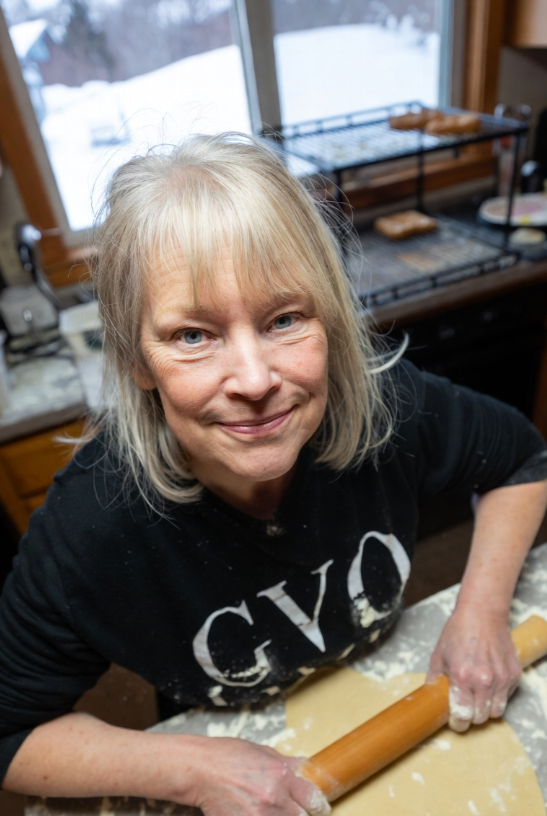
About the cook who shared this
Linda Johansson
Week 258 of Linda’s 30-year story
· Duluth, Minnesota
Linda is a sixty-three-year-old retired nurse from Duluth, Minnesota, living alone in the house where she raised her children and said goodbye to her husband. She lost Paul to ALS in 2020 after two years of watching the kindest man she'd ever known lose everything but his dignity. She cooks Scandinavian comfort food and Minnesota hotdish and the pot roast Paul loved, and she sets two places at the table out of habit because it makes her feel less alone. Every recipe she writes is a person she's loved.
