
 By
By First Friday in February. We had the coaching staff over for the annual offseason dinner. Eight assistants, two coordinators, the head trainer, the equipment guy, the team chaplain, plus wives, plus a few kids running around — twenty-six people in my house, eating off paper plates because nobody owns enough real plates for that, sitting on every available surface, the back patio fully occupied even in February because Denver was having one of those false-spring weeks where the sun came out and you could fool yourself into thinking winter was over.
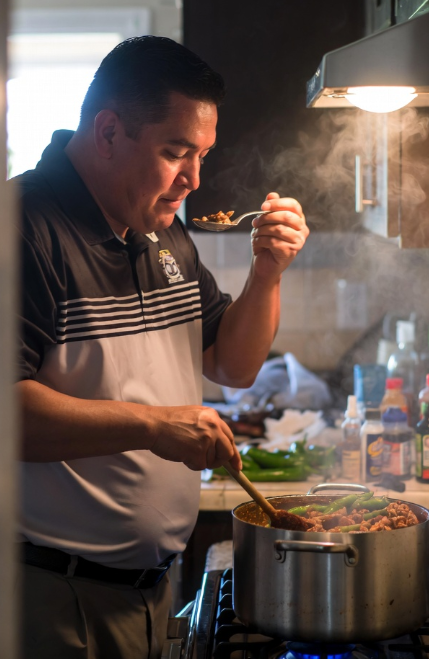
I made posole. I made a lot of posole. Pozole rojo, with pork shoulder, hominy, dried New Mexico red chiles, oregano, garlic, the whole production. I made it for forty even though I knew we were twenty-six because that is the rule — when you are cooking for the staff, you make extra, because the wife of the line coach is going to take some home, and the chaplain is going to want a quart for his sister, and there will be three or four guys who eat two bowls and would have eaten three if they were not embarrassed. The posole started at six in the morning. It was ready at three in the afternoon. By the time the staff arrived at six the smell had penetrated every textile in the house and Lisa, who left for her shift at four, said the truck still smelled like posole when she got to work and a patient in triage asked her if she had been at a Mexican restaurant.
The point of the dinner is not the dinner. The point of the dinner is the conversation. Before the season starts, before the kids show up in August, before the schedule and the weight room and the recruiting and the parents and the boosters and the noise, you sit your staff down with a bowl of soup and you tell them what you see. What you saw last year. What you want to see this year. Who you trust. Who needs to grow. What we are going to do differently. The staff dinner is where the season is built.
I told them about Diego. Not as my son — they all know my son — but as a player on the roster. I told them I have been worried about asking too much of him this year. I told them I have been worried about asking too little, which is the opposite worry, and which feels worse. I told them I want this season for him, but I want it for the team more, and that if those two things ever have to be separated, I am going to choose the team. They nodded. The offensive coordinator, a guy named Mike Reyes who has been with me for four years, said, "Coach, you have been telling yourself that for three years. You are going to coach the kid. Just coach the kid." Everyone laughed. I laughed. He was right. I have been wrestling with the dual role since Diego made varsity and I am not going to solve it in February, and I am probably not going to solve it ever, and the best I can do is be honest about it and trust the staff to flag me when I am being unfair in either direction.
I told them I want to win. I told them I have been to the semifinals three times in twelve years between Albuquerque and Denver and I have lost three times in the semifinals and I am tired of getting close. I said this without hand-waving and without coachspeak, because the staff has earned the truth, and the truth is that I want to win a state championship before I die, and I want to win it for Ruben, and I want to win it with my son on the field, and I would rather not pretend that I am at peace with whatever happens. I am not at peace with whatever happens. I want this thing.
Mike said, "Coach, we want it too." The defensive coordinator, Tony Davis, who is a Black guy from the South Side of Chicago who came west in 2018 and never went back, said, "Carlos, this is the team. This year. The line is right. The skill is right. The depth is right. We win this thing." I nodded. I did not respond out loud. I made everyone get another bowl of posole. The chaplain blessed the food and the season and the families and the boys. We sat in my dining room and on my back patio and we ate and we laughed and the kids ran in and out and Tony Davis showed me a video of his daughter doing gymnastics. Mike Reyes told a story about his uncle in Mexico City that I have heard four times and that gets better each time. The trainer told us about a new ankle protocol he wanted to implement. The equipment guy complained about the helmet vendor.
It was the kind of evening you do not appreciate while it is happening. You appreciate it later, when the season is over, and you are sitting in a different empty room, and you remember that February dinner, that posole, that staff. The staff is everything. A head coach is only as good as the people who let him steal credit from them. I have stolen plenty of credit in my career. The staff has let me. They will let me again this year, if we are lucky and we are good and the ball bounces our way three or four times in November. Posole tomorrow. There is half a pot left. Lisa will have it for breakfast when she wakes up. I will have it for lunch. The kids will fight over it after school. That is the cycle. That is the offering. Feed your people. The game is won at the table.
The posole was the anchor that night, but cochinita pibil has been on my rotation almost as long — it is the same philosophy in a different form: a tough cut of pork, low heat, time, acid, and patience. When I do not have the nine hours for a full pozole rojo, or when Lisa asks me to change it up, this is where I land. The achiote and citrus do the same thing the dried chiles do: they work while you are not watching, so that by the time people sit down, the house already smells like the decision was a good one. Make it for a crowd. That is what it is for.
Easy Cochinita Pibil
Prep Time: 20 minutes | Cook Time: 3 hours 30 minutes | Total Time: 3 hours 50 minutes | Servings: 8
Ingredients
- 3 lbs pork shoulder, cut into 2-inch chunks
- 3 oz achiote paste
- 1/2 cup fresh orange juice
- 1/4 cup fresh lime juice
- 3 tablespoons apple cider vinegar
- 4 cloves garlic, minced
- 1 teaspoon ground cumin
- 1 teaspoon dried oregano (Mexican oregano preferred)
- 1/2 teaspoon ground black pepper
- 1 teaspoon kosher salt, plus more to taste
- 2 bay leaves
- 1 medium white onion, thinly sliced
- Banana leaves or aluminum foil, for wrapping
- Corn tortillas, for serving
- Pickled red onions, for serving
- Fresh cilantro, for serving
- Lime wedges, for serving
Instructions
- Make the marinade. In a blender, combine the achiote paste, orange juice, lime juice, apple cider vinegar, garlic, cumin, oregano, black pepper, and salt. Blend until completely smooth.
- Marinate the pork. Place the pork shoulder chunks in a large zip-lock bag or baking dish. Pour the achiote marinade over the pork and turn to coat thoroughly. Cover and refrigerate for at least 2 hours, or overnight for best results.
- Preheat and prep. Preheat your oven to 325°F. Line a large Dutch oven or deep baking dish with banana leaves or two layers of heavy-duty aluminum foil, leaving enough overhang to wrap up and over the pork.
- Layer and wrap. Scatter the sliced onion across the bottom of the lined pot. Add the marinated pork along with all of the marinade and the bay leaves. Fold the banana leaves or foil up and over the pork to form a tight seal, trapping the steam inside.
- Braise low and slow. Cover the pot with a tight-fitting lid or additional foil. Transfer to the oven and cook for 3 to 3 1/2 hours, until the pork is completely tender and pulls apart easily with a fork.
- Shred and finish. Carefully open the packet — watch the steam. Remove the bay leaves. Using two forks, shred the pork directly in the cooking liquid, stirring to coat all the meat in the braising juices. Taste and adjust salt as needed.
- Serve. Pile the cochinita pibil onto warm corn tortillas. Top with pickled red onions, fresh cilantro, and a squeeze of lime. Serve immediately with extra braising liquid on the side for anyone who wants it saucier.
Nutrition (per serving)
Calories: 310 | Protein: 34g | Fat: 16g | Carbs: 8g | Fiber: 1g | Sodium: 420mg