
 By
By Sixty-three thank-you notes.
I know that number exactly because I counted them last night while sitting at the kitchen table with a hand cramp that made me feel approximately ninety-three years old. Sixty-three notes, each one personalized, because Amma raised me to understand that a generic thank-you note is a moral failing. You don’t write “Thank you for the lovely gift” to someone who spent real money and real thought on you. You write about the gift. You write about what it means. You write, apparently, until your right hand stages a small rebellion.
Raj suggested emails. I won’t tell you what I said, but I will tell you he went back to his cardiology journals without further comment.
The gifts, for the record, have been wonderful and slightly overwhelming. Three pressure cookers — we kept the nicest one, returned the other two with extremely warm thank-you notes. A set of copper-bottom pots from Amma’s friend Kamala Aunty that I’m afraid to use because they look like they belong in a museum. And from Raj’s aunt, a KitchenAid mixer in a shade of red that I have already used four times this week, twice for practical reasons and twice just to feel the weight of it humming on my counter.
But the gift I keep thinking about is from Arvind.
My brother sent a Williams Sonoma gift card — not enormous, but generous for someone in his tax bracket — with a note in his handwriting, which is still the handwriting of a teenage boy no matter how old he gets: For your kitchen, Akka. Don’t spend it on something practical. Get something fun.
I got a hand-cranked pasta maker. Arvind would approve. I haven’t used it yet, but it’s sitting on the counter looking extremely Italian and full of potential, and sometimes that’s enough.
The apartment is starting to feel like a place where people live. There’s a couch in the living room now — IKEA, but with throw pillows that make it look like we have taste. There are sheets on the bed. And the kitchen, which I described last week as my first act of real homemaking, is becoming the kind of room I wanted it to be. Spices organized alphabetically. Amma’s mortar and pestle on the counter. The new KitchenAid in red. The pasta maker, full of Italian promise.
It’s starting to look like a kitchen that means something.
—
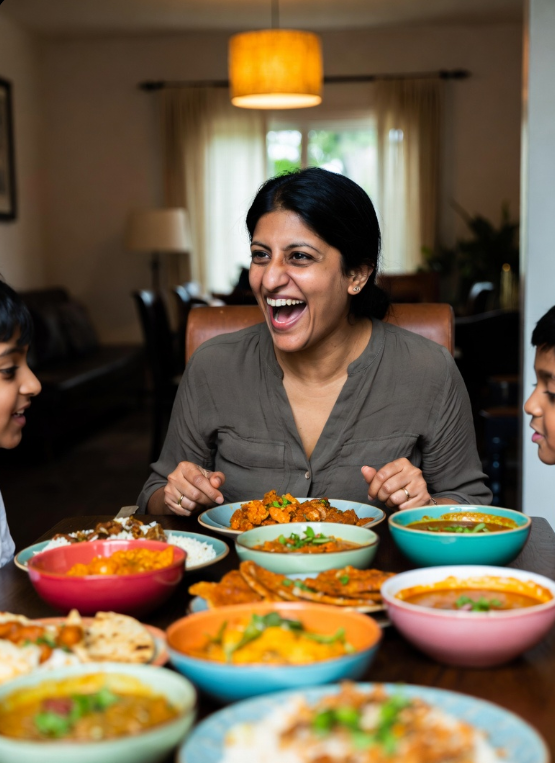
We’re going to my parents’ house for dinner tomorrow, the first Sunday meal there since the wedding. Amma will make her full spread — sambar, rasam, rice, kootu, poriyal, appalam — because she has made this same Sunday dinner for thirty years and she will not be changing the menu on your account or anyone else’s. I used to take this for granted in the way you take gravity for granted. It’s just there. It’s always been there. Why would it ever not be there?
I understand now that it won’t always be there. That’s a recent understanding, and it sits in my chest like something swallowed wrong.
Last week I watched Amma make rasam — really watched her, the way you don’t when you’ve seen something a thousand times. She didn’t measure anything. Not the tamarind, not the tomatoes, not the black pepper. She tasted as she went, adjusting with a confidence that looked effortless but obviously isn’t. I asked her, “How much tamarind, Amma?” She held up a piece about the size of a lime and said, “This much.” I said, “But how do you know?” She looked at me the way she looks at people who ask obvious questions. “I know,” she said. And then she dropped it in the water.
Forty years of cooking, compressed into two words. I know.
I’ve been thinking about this constantly. The knowing that lives in hands and not in recipes. The knowledge that doesn’t transfer through language because it was never stored in language to begin with — it was stored in repetition, in muscle memory, in decades of standing at that same stove adjusting the same flavors until the adjustment became automatic. How do you write that down? How do you preserve something that only exists in motion?
I don’t have an answer yet. But I think I need to start trying.
—
This week’s recipe came from necessity and from the thank-you note crisis. By Wednesday, my right hand was staging its protest, and I needed something I could make mostly left-handed. Something that didn’t require fine knife work or precise technique. Something that smelled, when it hit the oil, like my mother’s kitchen.
I made chickpea curry. Chana masala, sort of — or at least my apartment version of it, which borrows from the North Indian original and then makes several unauthorized detours through my Tam Brahm upbringing. Amma would have notes. Amma always has notes. But Raj ate two servings standing at the counter before I’d even finished cooking the rice, which I’m taking as a positive review.
The thing about chickpea curry is that it’s one of those dishes that rewards impatience. You don’t have to babysit it. You bloom your spices in hot oil, you build your base, you add the chickpeas and let the whole thing simmer down into something thick and dark and deeply savory, and then you walk away and write thank-you notes until your hand cramps up. The pot will be fine. The pot is doing its own work.
I used canned chickpeas, which Amma would clock immediately and file under evidence of my moral decline. But I also added a pinch of asafoetida (hing) and tempered my mustard seeds in ghee before building the sauce, which is very much Amma’s influence showing up uninvited in a nominally North Indian dish. I can’t help it. Tamil Nadu is always in my hands, even when I’m making something from five states away.
When the mustard seeds hit the ghee and started popping, when the curry leaves went in and the kitchen filled with that smell — green and sharp and deeply specific — I stopped writing mid-sentence on thank-you note number forty-seven and just stood in the kitchen for a moment. Breathing it in. Thinking about Amma’s kitchen on Sunday mornings. Thinking about how ordinary extraordinary things can seem until suddenly they don’t.
Raj came in, sniffed, and said, “That smells like the food at my friend Deepak’s house when we were kids.”
“His mom Tamil?” I asked.
“Probably,” Raj said. “His mom was an incredible cook.”
I took that as the highest possible compliment and finished my thank-you notes in an extremely good mood.
—
One more thing before the recipe: I’m going to start writing down Amma’s recipes. Not just the ingredients — those I mostly know — but the technique. The way she smells the tamarind before she decides how much to use. The way she listens to the oil before she adds the mustard seeds. The way she says “enough” to every question about measurement because forty years of cooking has made the question irrelevant.
I don’t know how to translate “enough” into a recipe. I’m going to spend a long time trying.
Tomorrow at dinner, I’m going to watch her hands.
That compliment — that maybe I’d cooked something that tasted like someone’s Tamil grandmother made it — sent me straight to the kitchen the next morning, still riding the feeling. I wanted to make something that actually smelled like Amma’s house, the way it fills up with mustard seeds hitting hot ghee before anything else has even happened. This chickpea curry is the dish I reach for when I need that smell — it’s not her exact recipe, not yet, but it’s the closest I’ve gotten on my own.
Easy Chickpea Curry — The Recipe That Smells Like My Mother’s Kitchen Before She Forgot
Prep Time: 10 minutes | Cook Time: 30 minutes | Total Time: 40 minutes | Servings: 4
Ingredients
For the temper (tadka):- 2 tablespoons ghee (or neutral oil if you prefer)
- 1 teaspoon mustard seeds
- 1/2 teaspoon cumin seeds
- 8–10 fresh curry leaves (dried works in a pinch, but fresh is worth finding)
- 1/8 teaspoon asafoetida (hing) — optional but deeply recommended
- 2 dried red chiles, broken in half
- 1 medium yellow onion, finely diced
- 4 cloves garlic, minced
- 1 tablespoon fresh ginger, grated
- 2 medium tomatoes, roughly chopped (or one 14-oz can diced tomatoes, drained)
- 1 teaspoon ground coriander
- 1 teaspoon ground cumin
- 1/2 teaspoon turmeric
- 1/2 teaspoon Kashmiri chili powder (or paprika for less heat)
- 1/2 teaspoon garam masala
- 3/4 teaspoon salt, plus more to taste
- 2 cans (15 oz each) chickpeas, drained and rinsed
- 1/2 cup water
- 1 teaspoon tamarind paste (or a squeeze of lemon juice — but tamarind, if you have it)
- Fresh cilantro, chopped, for serving
- Cooked rice or warm roti, to serve
Instructions
- Bloom the spices. Heat the ghee in a heavy-bottomed pan or Dutch oven over medium-high heat. When it shimmers, add the mustard seeds and cover the pan loosely — they will pop dramatically. Once the popping slows (about 30 seconds), add the cumin seeds, curry leaves, asafoetida, and dried red chiles. Stand back. Let it sizzle for another 30 seconds until deeply fragrant.
- Build the base. Add the diced onion. Cook, stirring occasionally, until the onion is soft and starting to turn golden at the edges, about 8–10 minutes. Don’t rush this. The onion is the foundation.
- Add the aromatics. Add the garlic and ginger. Cook, stirring constantly, for 1–2 minutes until raw smell is gone.
- Add the tomatoes and spices. Add the tomatoes, then the coriander, cumin, turmeric, chili powder, garam masala, and salt. Stir to combine. Cook over medium heat, stirring occasionally, until the tomatoes break down and the whole mixture darkens and thickens — about 8–10 minutes. The oil should start to separate around the edges. This is what you want.
- Add the chickpeas. Add the drained chickpeas and water. Stir well to coat everything in the masala. Bring to a simmer, then reduce heat to medium-low and cook uncovered for 10 minutes, stirring occasionally, until the sauce thickens and clings to the chickpeas.
- Finish and adjust. Stir in the tamarind paste. Taste. Add salt if needed. If it’s too thick, add a splash of water. If it’s too thin, let it cook another few minutes. You’re looking for a thick, deeply colored sauce that coats the back of a spoon. You’ll know when it’s right. (Sorry. That’s what Amma would say too.)
- Serve. Top with fresh cilantro. Serve over rice or with warm roti. Eat a serving while standing at the counter before dinner is officially ready, because you’ve earned it.
Nutrition (per serving)
Calories: 310 | Protein: 13g | Fat: 9g | Carbs: 44g | Fiber: 11g | Sodium: 480mg