March. The month the world changes. Not yet — not this week — but the air is different. The news is constant. The virus has a number that doubles daily and a name that I'll never forget and a shadow that's falling across everything.
But in this house, in this week, the virus is secondary. Because Paul is declining.
The breathing: thirty-five percent. The ventilator at maximum non-invasive support. Margaret came on Monday and adjusted the settings and looked at me and I looked at her and we had the conversation that hospice nurses and oncology nurses have with our eyes — the conversation that says: we're nearing the end.
Nearing. Not at. Nearing. The word is a distance — close, closer, almost. Not yet. But nearing.
Paul's eyes are less active. He opens them for shorter periods. The communication — even the eye-to-eye kind — is briefer. He looks at me in the morning, when the mask comes off, and the look says: I'm here. Still here. And then the eyes close, not in sleep but in exhaustion, the exhaustion of a body that's running on thirty-five percent of normal breathing and that requires every ounce of energy just to continue.
I read to him. Every night. The Swedish novel. The fisherman's wife. The wife is still waiting. The boat has not returned. The sea is enormous and cold. The wife knows the boat may not return. She waits anyway. She lights the lamp in the window. She keeps the soup warm on the stove. She waits.
I read these words to Paul and the words are fiction and also not fiction. I am the fisherman's wife. The lamp is the advent star. The soup is the wild rice soup. The sea is the disease. The boat is Paul.
I called Anna on Wednesday. "Come," I said. Just the word. She said, "We're coming." I called Peter. "Come." He said, "I'm booking a flight." I called Elsa. She said, "I'm already on my way."
Come. The word that summons. The word that says: the nearing is near.
I baked bread. The promise. The smell. Paul's eyes opened when the bread came out of the oven. He looked toward the kitchen. The look said: bread. The look said: you're here. The look said: I'm still here.
I held his hand. "I'm here, Paul," I said. "I'm right here."
His eyes looked at mine. The look was enough. The look was everything.
Still here. Still nearing. Still holding.
The bread is warm. The lamp is lit. I wait.
The bread I describe in the story isn’t Limpa — not this time. I didn’t have the hours or the steadiness for a long Swedish rye that week. What I had was butter, flour, eggs, and the need to do something with my hands that would fill the house with warmth and smell like home. This braided loaf — golden and soft and impossibly comforting — is what came out of the oven, and it was enough. It was everything. If you are waiting for someone, or holding someone, or simply need your kitchen to feel like shelter, bake this. Braid it slowly. Let it rise. Let it fill the house.
Easy Breakfast Braid
Prep Time: 25 min | Cook Time: 25 min | Total Time: 50 min (plus 1 hr rise) | Servings: 10 slices
Ingredients
- 2 1/4 tsp active dry yeast (1 standard packet)
- 3/4 cup warm milk (110°F)
- 3 tbsp granulated sugar, divided
- 2 1/4 cups all-purpose flour, plus more for kneading
- 1/2 tsp salt
- 2 tbsp unsalted butter, softened
- 1 large egg, at room temperature
- 1/2 tsp pure vanilla extract
- 1 egg, beaten (for egg wash)
- 1 tbsp coarse sugar or pearl sugar, for topping (optional)
Instructions
- Activate the yeast. In a small bowl, combine warm milk, 1 tbsp of the sugar, and the yeast. Stir gently and let stand 5–10 minutes until foamy and fragrant.
- Mix the dough. In a large bowl, whisk together the flour, salt, and remaining 2 tbsp sugar. Add the softened butter, egg, vanilla, and the yeast mixture. Stir until a shaggy dough forms.
- Knead. Turn dough onto a lightly floured surface and knead for 7–8 minutes until smooth, soft, and slightly tacky. Add flour one tablespoon at a time only if the dough is sticking excessively.
- First rise. Place dough in a lightly greased bowl, cover with a clean kitchen towel or plastic wrap, and let rise in a warm place for 1 hour or until doubled in size.
- Divide and braid. Punch dough down gently. Divide into three equal portions. Roll each into a rope about 16 inches long. Lay the three ropes side by side on a parchment-lined baking sheet. Pinch together at one end and braid loosely to the other end; pinch to seal. Tuck the ends under slightly.
- Second rise. Cover loosely and let the braid rest 20–25 minutes while you preheat the oven to 350°F (175°C).
- Egg wash and bake. Brush the braid gently with beaten egg and sprinkle with coarse sugar if using. Bake 22–26 minutes, until deep golden brown and the loaf sounds hollow when tapped on the bottom.
- Cool and serve. Let rest on the pan for 10 minutes before transferring to a wire rack. Serve warm, torn by hand or sliced, with butter or jam.
Nutrition (per serving)
Calories: 178 | Protein: 5g | Fat: 4g | Carbs: 30g | Fiber: 1g | Sodium: 138mg
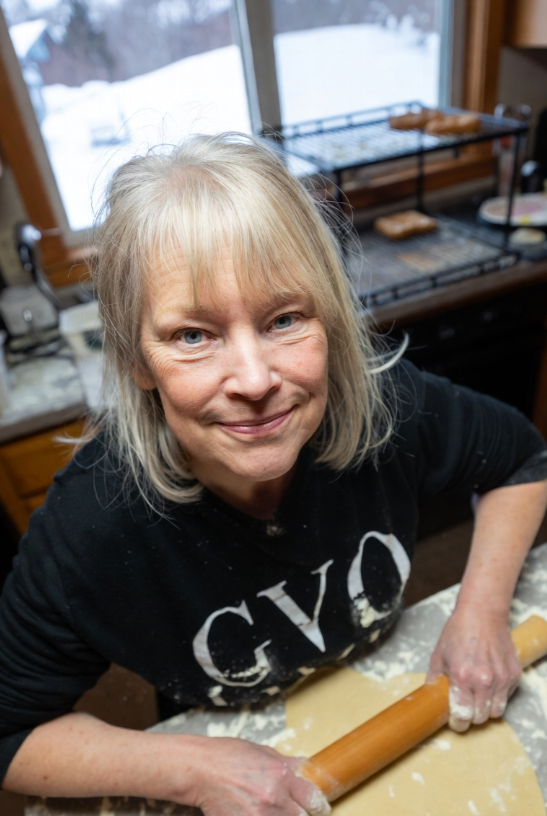
About the cook who shared this
Linda Johansson
Week 203 of Linda’s 30-year story
· Duluth, Minnesota
Linda is a sixty-three-year-old retired nurse from Duluth, Minnesota, living alone in the house where she raised her children and said goodbye to her husband. She lost Paul to ALS in 2020 after two years of watching the kindest man she'd ever known lose everything but his dignity. She cooks Scandinavian comfort food and Minnesota hotdish and the pot roast Paul loved, and she sets two places at the table out of habit because it makes her feel less alone. Every recipe she writes is a person she's loved.
