
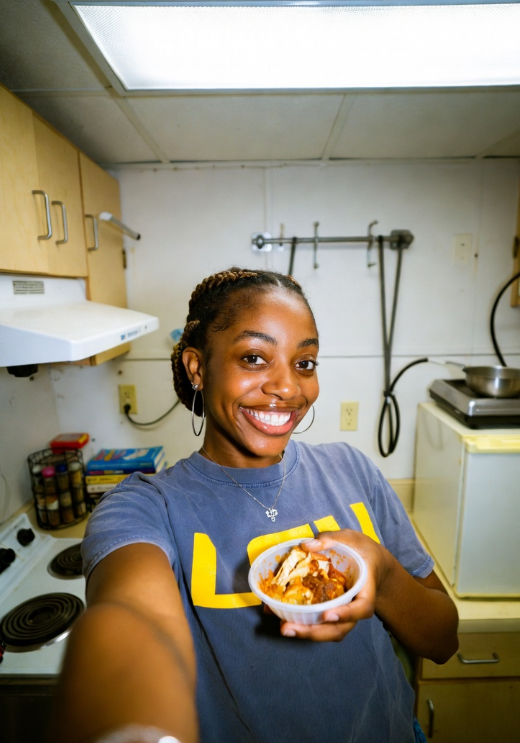
 By
By Mardi Gras. February in Baton Rouge means king cake and parades and the particular energy of a state that has decided, collectively, to have a party before Lent begins. The campus was festive in the way that campuses are festive — students in purple, gold, and green, king cake in every department lounge, a general loosening of the usual academic tension. I bought a king cake from Rouses, which MawMaw Shirley would consider a betrayal. I also made one from scratch, which MawMaw Shirley would consider a redemption. The scratch one was better. The Rouses one was eaten first. This is the paradox of convenience: people reach for the easy thing even when the better thing is right there, and the cook's job is not to judge but to keep making the better thing and trusting that eventually the reaching will change direction.
I went home for Mardi Gras Day — Tuesday — because in the Robinson house, Mardi Gras is an excused absence from everything. Mama made jambalaya. Daddy pretended he was not going to eat king cake and then ate three slices. Kayla wore beads from a parade she had attended in downtown Baton Rouge and described the floats in the kind of detail that only an art student would notice or care about. The day was loud and sweet and full, the way Mardi Gras should be — excess before restraint, celebration before sacrifice, the eating before the fasting.
I brought the scratch king cake. Mama tasted it and said, "This is your best one." I have been making king cake since I was fifteen and the progression is visible: each year the braid is tighter, the sugar is more even, the filling is more balanced. Growth looks like king cake, if you are paying attention. Each year a little better. Each year a little closer to the thing you are trying to make. Never rushing. Always braiding.
MawMaw Shirley did not come to Mardi Gras this year. She said she was tired, which is MawMaw Shirley code for "I am choosing rest," which is new, because MawMaw Shirley has never chosen rest over family in my lifetime. I called her. She said she was fine. She sounded fine. But the choosing-rest is a data point, and I am a science student, and data points accumulate into patterns, and the pattern is: MawMaw Shirley is seventy-eight and the body is making decisions that the spirit disagrees with. I noticed. I did not say anything. The arrangement holds.
The king cake I brought home that Mardi Gras Tuesday was better than anything from the store — tighter braid, more balanced filling, another year of progress in every layer. That same spirit of careful, practiced pastry work is exactly what drew me to Dutch Letters: a laminated, almond-filled dough shaped into letters, where the craft is in the folding and the patience, and where each time you make them you get a little closer to the thing you’re reaching for. They’re not king cake, but they speak the same language — the one about dough and time and hands that have learned something.
Dutch Letters
Prep Time: 45 minutes + 1 hour chilling | Cook Time: 25 minutes | Total Time: 2 hours 10 minutes | Servings: 12
Ingredients
- 2 cups all-purpose flour
- 1/2 teaspoon salt
- 1 cup (2 sticks) cold unsalted butter, divided
- 1/2 cup cold water
- 1 cup almond paste (not marzipan)
- 1/2 cup granulated sugar
- 1 large egg, divided (half for filling, half for egg wash)
- 1/2 teaspoon almond extract
- 1 tablespoon water (for egg wash)
- 2 tablespoons coarse or pearl sugar, for topping
Instructions
- Make the dough. Combine flour and salt in a large bowl. Cut 3/4 cup of the cold butter into small cubes and work it into the flour with your fingers until you have pea-sized crumbles. Add cold water a little at a time, stirring just until the dough comes together. Do not overwork. Shape into a flat rectangle, wrap in plastic, and refrigerate for 30 minutes.
- Layer the butter. Place the remaining 1/4 cup cold butter between two sheets of parchment and pound it into a thin, flat rectangle roughly 4 by 6 inches. Keep it cold.
- Laminate the dough. On a lightly floured surface, roll the chilled dough into a rectangle about twice the size of your butter slab. Place the butter in the center, fold the dough over it like an envelope, and seal the edges. Roll out gently to a long rectangle, then fold into thirds like a letter. Wrap and refrigerate 30 minutes. Repeat the roll-and-fold once more, then refrigerate until ready to use.
- Make the almond filling. In a bowl, beat together almond paste, granulated sugar, half the beaten egg, and almond extract until smooth. The filling should be thick and spreadable, not runny.
- Shape the letters. Preheat oven to 375°F. Roll the laminated dough to about 1/8-inch thickness. Cut into strips roughly 2 inches wide and 10 inches long. Spoon a thin rope of almond filling down the center of each strip. Fold the long edges up and over the filling, pinching firmly to seal. Shape each sealed roll into a letter — S-curves and straight lines both work well — and place seam-side down on a parchment-lined baking sheet.
- Egg wash and sugar. Whisk the remaining egg with 1 tablespoon water. Brush each pastry generously with egg wash and sprinkle with coarse sugar.
- Bake. Bake for 22–25 minutes, until deep golden brown and the layers are visibly puffed and flaky. Let cool on the pan for 10 minutes before transferring.
Nutrition (per serving)
Calories: 285 | Protein: 4g | Fat: 17g | Carbs: 30g | Fiber: 1g | Sodium: 105mg