
← Back to Blog

Dal Makhani — The Recipe That Simmers While Everything Becomes

The food journal has become something else. Something I didn't plan. I started writing Amma's recipes. Then I started writing her stories. Then I started writing my stories — the ones that live between her recipes and mine, the connective tissue of inheritance and adaptation that makes a recipe into a life. Last night I wrote about the first time I made sambar alone. I was twenty-two, in my first apartment near the pharmacy school campus, and I had Amma's recipe written on an index card in her handwriting. I followed it exactly. Every measurement, every step, every instruction. And it came out wrong — too thin, too sour, the dal not cooked enough. I called Amma and described it. She listened, then said: "You didn't use enough asafoetida." I looked at the recipe card. It said "a pinch." She said, "Not a pinch. A generous pinch." I said, "What's the difference?" She said, "You'll know when you know." I wrote this down. All of it. The index card, the generous pinch, the difference between a recipe and knowing. It's not a recipe anymore — it's a story about a mother and a daughter and the space between "a pinch" and "enough." I think... I think this might be a blog. Or a book. Or something. I don't know what it is yet. But the writing is coming fast now, faster than I can organize it, and the pages are piling up and they feel important in a way that I can't quite justify but can't quite dismiss either. I told Raj about it tonight, sitting on the couch after dinner, his hand on my stomach (sixteen weeks — the baby is avocado-sized and moving, maybe, possibly, unless that's just gas, which is embarrassingly more likely). "I've been writing," I said. "Writing what?" "About Amma. And food. And... us." "Can I read it?" "Not yet." "Why not?" "Because it's not ready. Because it might be terrible. Because I'm a pharmacist, not a writer." "You're whatever you decide to be," he said. Which is such a Raj thing to say — direct, supportive, slightly corny — and also exactly what I needed to hear. I made dal makhani tonight. Not a Tamil dish — Punjabi. Rich, creamy, smoky. Black urad dal and kidney beans slow-cooked for hours with butter and cream and tomato. It's the kind of indulgent, heavy food that Amma would never make and that my pregnant body demands. The writing waits. The dal simmers. The baby grows. Everything is becoming something else.

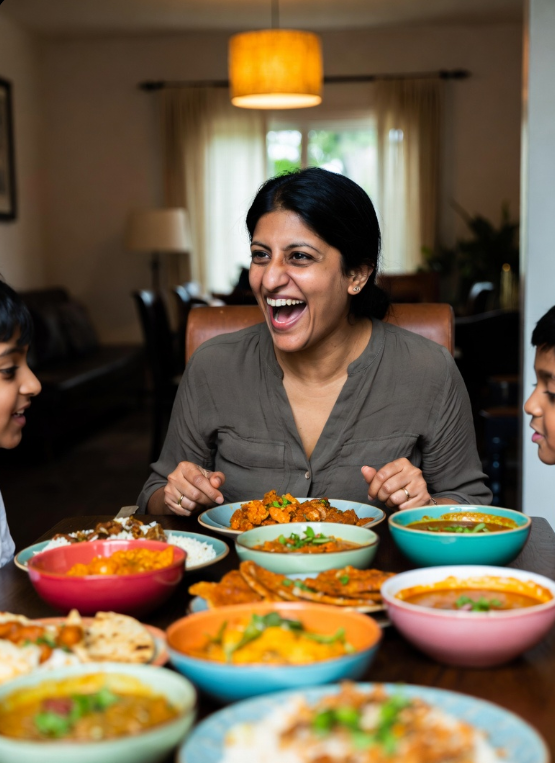
Dal makhani felt like the exact right thing to make that night — not because it belonged to any recipe card in Amma’s handwriting, but precisely because it didn’t. It’s Punjabi, not Tamil, indulgent in a way she never was, and it demands patience: hours of slow simmering that ask nothing of you except that you stay close. While the pages piled up and the baby moved (or didn’t), the dal kept its own schedule — unhurried, quietly becoming something richer than what it started as. That felt right too.

Dal Makhani (Slow-Cooked Black Lentils & Kidney Beans)

Prep Time: 15 minutes (plus overnight soak) | Cook Time: 3 hours | Total Time: 3 hours 15 minutes | Servings: 6

Ingredients

  • 1 cup whole black urad dal (black lentils), soaked overnight and drained
  • 1/4 cup dried kidney beans (rajma), soaked overnight and drained
  • 5 cups water, plus more as needed
  • 1 teaspoon salt, divided
  • 3 tablespoons unsalted butter, divided
  • 1 tablespoon neutral oil
  • 1 medium yellow onion, finely diced
  • 1 tablespoon fresh ginger, grated
  • 4 cloves garlic, minced
  • 1 teaspoon cumin seeds
  • 1 can (14 oz) crushed tomatoes
  • 1 teaspoon Kashmiri red chili powder (or 1/2 teaspoon cayenne)
  • 1 teaspoon garam masala
  • 1/2 teaspoon ground coriander
  • 1/4 teaspoon ground turmeric
  • 1/2 cup heavy cream, plus more for serving
  • 1 tablespoon dried fenugreek leaves (kasuri methi), crushed
  • Fresh cilantro and extra butter, to finish

Instructions

  1. Cook the dal and beans. Add the soaked, drained urad dal and kidney beans to a large heavy-bottomed pot or Dutch oven with 5 cups of water and 1/2 teaspoon salt. Bring to a boil over high heat, then reduce to a low simmer. Cook uncovered for 1 hour, adding water as needed to keep the dal submerged, until the lentils and beans are completely tender and beginning to break down.
  2. Make the masala base. In a separate skillet over medium heat, warm 1 tablespoon butter with the oil. Add the cumin seeds and let them sizzle for 30 seconds. Add the onion and cook, stirring occasionally, for 12–15 minutes until deep golden. Add the garlic and ginger and cook 2 minutes more until fragrant.
  3. Build the sauce. Add the crushed tomatoes to the skillet along with the chili powder, garam masala, coriander, turmeric, and remaining 1/2 teaspoon salt. Cook over medium heat, stirring frequently, for 10–12 minutes until the tomato has darkened and the oil begins to separate from the masala.
  4. Combine and slow-simmer. Pour the tomato masala into the pot with the cooked dal. Stir well, partially cover, and simmer on low heat for 45 minutes to 1 hour, stirring every 15 minutes and mashing some of the lentils against the side of the pot to thicken the dal. Add splashes of water if it thickens too quickly.
  5. Finish with butter and cream. Stir in the remaining 2 tablespoons butter and the heavy cream. Add the crushed kasuri methi. Simmer uncovered for a final 15–20 minutes until the dal is velvety, deeply colored, and thick enough to coat a spoon.
  6. Serve. Ladle into bowls and finish with a swirl of cream, a small pat of butter, and fresh cilantro. Serve with warm naan or steamed basmati rice.

Nutrition (per serving)

Calories: 310 | Protein: 13g | Fat: 16g | Carbs: 32g | Fiber: 9g | Sodium: 420mg

Priya Krishnamurthy
About the cook who shared this
Priya Krishnamurthy
Week 90 of Priya’s 30-year story · Edison, New Jersey
Priya is a pharmacist, wife, and mom of two in Edison, New Jersey — the town she grew up in, surrounded by the sights and smells of her mother's South Indian kitchen. These days, she splits her time between the hospital pharmacy, school pickups, and her own kitchen, where she cooks nearly every night. Her style is a blend of the Tamil recipes her mother taught her and the American comfort food her kids actually want to eat. She writes about the beautiful mess of balancing two cultures on one plate — and she wants you to know that ordering pizza is also an act of love.

How Would You Spin It?

Put your own twist on this recipe — what would you add, remove, or swap?