
 By
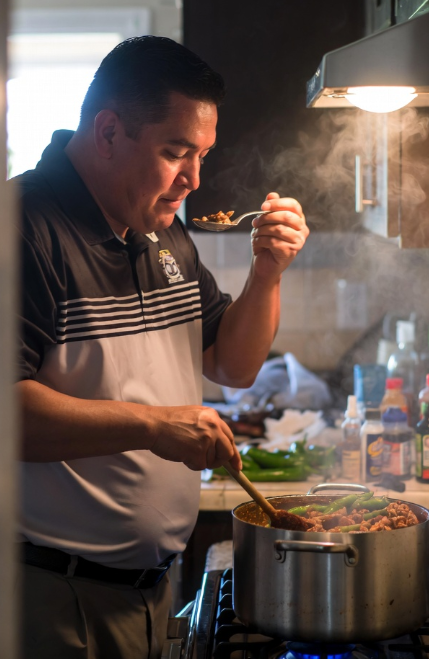
By Late February. The chile from Mamá arrived. Two gallon-size Ziplocs of roasted Hatch green chile, peeled and bagged the way she has done it since before I was born. I put one in the freezer for the spring. The other I started using immediately, because it had been six weeks since the freezer ran out and I had been making do with a brand of frozen green chile from Albertsons that was, technically, edible. Lisa noticed the upgrade within ninety seconds of my first bite of stew. She said, "Did your mom send chile." I said, "She sent chile." Lisa said, "Thank God." Lisa understands. Lisa has been Mamá-trained.
I decided to teach the twins how to make stacked enchiladas. They are ten. They are ready. Stacked enchiladas are a cuisine-defining food in our family, and if you grow up in a Medina house and you do not know how to make stacked enchiladas by the time you are twelve, something has gone wrong. Diego learned at eight. Sofia learned at nine, though she has chosen to use that knowledge mostly to read about food rather than to make it, which is a Sofia choice. The twins are next. Marco took to it with characteristic over-enthusiasm. Elena took to it with characteristic precision.
For people who have not been initiated, let me explain. A New Mexican stacked enchilada is not a rolled tube of tortilla like the ones you see in a Tex-Mex restaurant. It is a stack. You take a corn tortilla, you fry it briefly in oil to soften and crisp it, you dip it in red or green chile sauce, you lay it flat on a plate, you cover it with cheese and onions and whatever you are using for filling, then you put another tortilla on top, more sauce, more cheese, more onions, and another tortilla on top of that. Three layers. Cheese melts down through the stack. You top it with a fried egg, over easy, and the yolk runs into the cheese and the sauce and the whole plate is a religious experience. This is the dish. This is what we eat. This is what our great-grandmothers ate and their great-grandmothers before them, going back to colonial Spanish New Mexico, going back to the Pueblo women who taught the Spanish women how to make tortillas in the first place. It is, in the most literal sense possible, our heritage.
Tex-Mex people will tell you that an enchilada is a rolled thing. Tex-Mex people are wrong. They are not wrong about everything — they are right about brisket, and they are right about queso, and they are right about a few other things I will give them — but they are wrong about enchiladas. The original enchilada was stacked. The Texans rolled it up because they were trying to make it portable for chuck wagons or some other agricultural-industrial reason. The rolling is a corruption. I will die on this hill. I will be buried on this hill. Mamá will visit my grave and say, "He was right about the enchilada." That is the eulogy I want.
I told the twins this story while we were heating the oil. Marco listened with his mouth slightly open, which is how he listens to anything that involves controversy. Elena listened while organizing the spice rack, which is how she listens to anything. They each made their own enchilada. Marco fried his tortilla too long and it shattered when he tried to dip it in the sauce. He laughed. He fried another. He fried it correctly. Elena stacked hers like she was building a model — perfectly aligned, exactly the right amount of sauce, the cheese distributed with care. She used a spatula to ensure flatness. Marco watched her and said, "Why are you doing it like that." Elena said, "Because it is the right way." Marco said, "Mine is also right." Marco was correct. Elena was correct. Both stacks were stacked. Both yolks would run.
I cooked the eggs and laid one on each stack and brought the plates to the table. Diego came down from his room because he could smell it. Sofia came down because Diego came down. Lisa was on a day shift, so she missed it, but I saved her two and put them in the oven on low. The five of us sat at the table and ate stacked enchiladas with a fried egg on top, and the kids cut into their yolks and watched the gold run down through the cheese, and Marco said, "Dad, this is the best thing." I said, "I know." Elena said, "I would like to make these every week." I said, "We will make them often." Sofia said, "Dad, can I take leftovers to school tomorrow." I said, "Yes." Diego said nothing because he was on his second helping and could not talk and chew at the same time, which is a personal failing of his that he has not fixed in seventeen years.
I cleaned up. I washed the comal. I labeled the new bag of chile in the freezer with the date and the heat level Mamá had penciled on the original Ziploc — MEDIUM-HOT, SEPT 2023. I prayed before bed. I thought about the lineage of the stacked enchilada. I thought about Mamá in the kitchen in Las Cruces fifty years ago teaching me how to fry a tortilla without breaking it. I thought about Marco, who broke his tortilla, and laughed, and tried again. The lineage continues. The enchiladas are not a corruption in this house. The enchiladas are stacked. Feed your people. The game is won at the table.
That night at the table, what struck me most was not the chile or even the egg — it was watching the twins understand, for the first time, that a great plate is built in deliberate layers. Elena with her spatula, Marco with his laughing second attempt: both of them learning that the work you put into each layer is exactly what you taste at the end. These crumbled falafel bowls ask for the same attention. You make the falafel from dried chickpeas, you crumble them intentionally, and you build the bowl the way you build a stack — each component placed with purpose, each layer earning its place before the next one goes on top. It is not enchiladas, but it is the same lesson.
Crumbled Falafel Bowls
Prep Time: 20 min (plus overnight soak) | Cook Time: 25 min | Total Time: 45 min (plus soaking) | Servings: 4
Ingredients
- 1 1/2 cups dried chickpeas, soaked overnight and drained (do not use canned)
- 1/2 cup fresh flat-leaf parsley, roughly chopped
- 1/2 cup fresh cilantro, roughly chopped
- 4 garlic cloves, smashed
- 1 small yellow onion, roughly chopped
- 1 1/2 teaspoons ground cumin
- 1 teaspoon ground coriander
- 1/2 teaspoon cayenne pepper
- 1 teaspoon kosher salt, plus more to taste
- 1/2 teaspoon baking soda
- 2 tablespoons all-purpose flour (add more if mixture is too wet)
- Neutral oil for pan-frying (avocado or vegetable)
- 4 cups cooked white or brown rice, or grain of choice
- 2 cups chopped romaine or mixed greens
- 1 cup cherry tomatoes, halved
- 1 cucumber, diced
- 1/2 red onion, thinly sliced
- 1/2 cup pitted Kalamata olives
- 1/2 cup crumbled feta cheese
- Tzatziki or tahini sauce, for serving
- Lemon wedges, for serving
- Fresh dill or parsley, for garnish
Instructions
- Soak the chickpeas. Place dried chickpeas in a large bowl and cover with cold water by at least 3 inches. Soak overnight or for a minimum of 12 hours. Drain and pat dry thoroughly before using. Do not substitute canned chickpeas — the texture will not hold.
- Make the falafel mixture. Add the soaked chickpeas, parsley, cilantro, garlic, onion, cumin, coriander, cayenne, salt, and baking soda to a food processor. Pulse until the mixture is finely ground but not smooth — you want texture, not a paste. Add flour one tablespoon at a time and pulse to combine. The mixture should hold together when pressed but remain slightly crumbly. Transfer to a bowl, cover, and refrigerate for 30 minutes.
- Shape the falafel. Scoop about 2 tablespoons of mixture and press firmly into a small patty or ball. Repeat with remaining mixture. If the mixture cracks badly, add another half tablespoon of flour and remix.
- Pan-fry the falafel. Heat 1/4 inch of oil in a heavy skillet over medium-high heat until shimmering. Working in batches, fry the falafel for 3 to 4 minutes per side until deep golden brown and crisp. Do not crowd the pan. Transfer to a paper-towel-lined plate and season immediately with a pinch of salt.
- Crumble the falafel. Once slightly cooled, use your hands or a fork to break each piece into rough chunks and crumbles. You want a mix of sizes — some larger pieces, some fine crumbles — so every bite of the bowl gets a bit of crust and a bit of interior.
- Build the bowls. Start with a base of rice or grains. Add a layer of greens, then arrange the tomatoes, cucumber, red onion, and olives around the bowl. Pile the crumbled falafel in the center.
- Finish and serve. Top with crumbled feta, a generous drizzle of tzatziki or tahini, and a squeeze of fresh lemon. Garnish with fresh dill or parsley. Serve immediately while the falafel is still warm and crisp.
Nutrition (per serving)
Calories: 520 | Protein: 19g | Fat: 18g | Carbs: 72g | Fiber: 12g | Sodium: 780mg